Go Public: Lusophone trade unions call for urgent action to strengthen public education
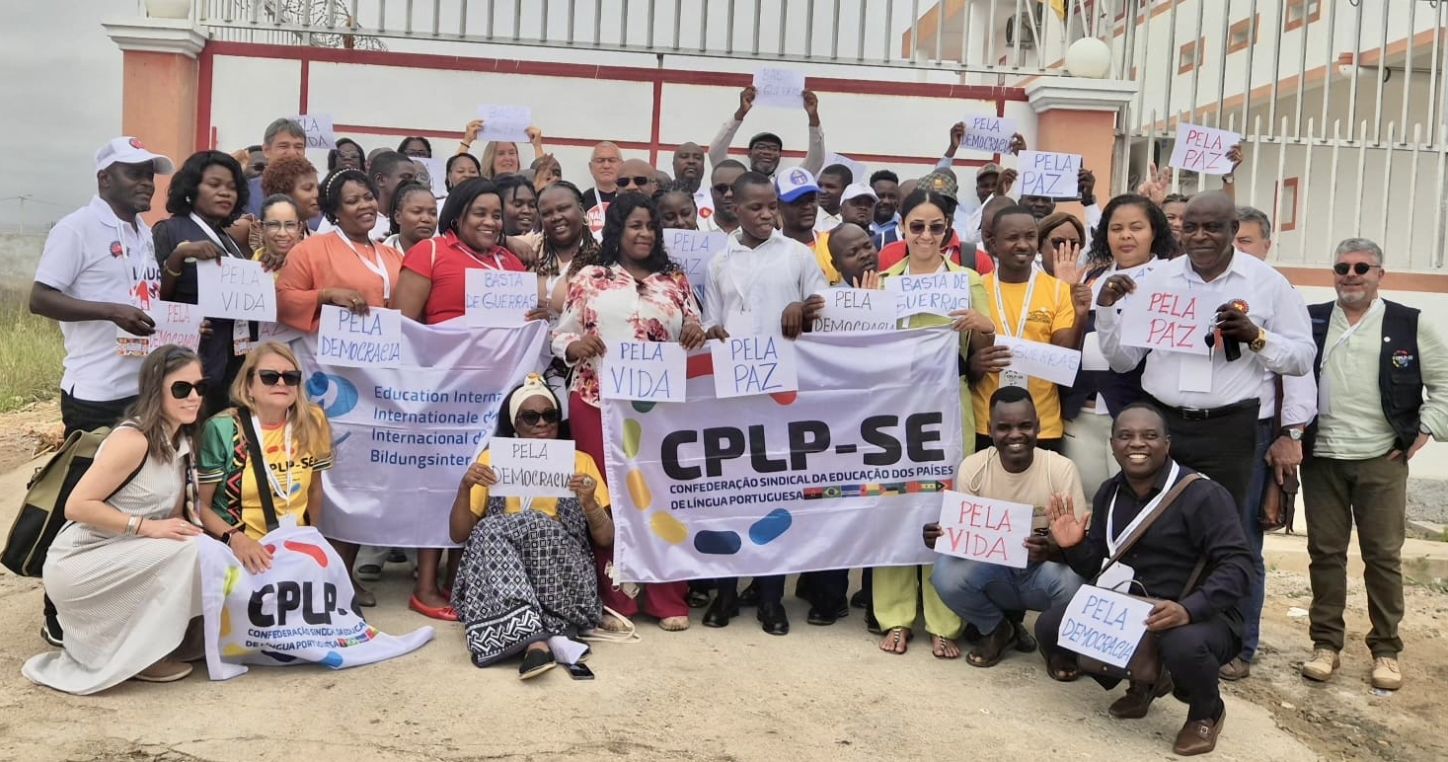
During the First Conference of the Education Trade Union Confederation of the Community of Lusophone Countries (CPLP-SE), held in Lobito, Angola, from 4 to 8 May, trade unions from Angola, Brazil, Cape Verde, Guinea-Bissau, Mozambique, Portugal, and Sao Tome and Principe reaffirmed their commitment to defending education and the urgent need to strengthen organisations and rethink trade union practice. The meeting took place in the framework of Education International’s (EI) global Go Public! Fund Education campaign.
Under the heading “Responding to the challenges of today”, the conference brought together 70 trade union leaders and activists to discuss shared concerns regarding education systems, their funding, and organisational challenges. The exchanges took place against a backdrop of falling public investment in education and sustained increases in military spending worldwide, a trend jeopardising the right to free, quality, public education.
The campaign as a vehicle for union action in Angola
Education union SINPROF-Angola highlighted the importance of the Go Public! Fund Education campaign as a vital tool for improving learning conditions and strengthening trade union action in the country.
César Gomes António, the union’s Secretary for International Relations and Exchanges, pointed out that the campaign is helping trade unions to develop more robust strategies to press governments to invest in public education.
This drive, he added, could lead to tangible improvements, such as decent pay for teachers, suitable education facilities, improved access to teaching materials, and more training and professional development opportunities for teaching staff.
He also emphasised that the campaign reinforces the international dimension of trade union work, facilitating alliance building and cooperation between organisations in different countries. This contributes to strengthening the defence of teachers’ rights and the promotion of quality public education for all.
Trade union advocacy and international funding for education
Another key focus of the conference was the analysis of international funding for public education in Portuguese-speaking countries. April Golden, a specialist from the Global Partnership for Education (GPE), highlighted the importance of meaningful trade union involvement in the processes of identifying, planning, and monitoring education resources.
During her presentation, she explained that the five African countries attending the conference receive international funding for the education sector. She pointed out that access to these resources requires structured plans that include evidence of social participation, including trade union representation.
Organising and planning to defend public education
Education International representative Angelo Gavrielatos stressed that defending public education requires strong trade unions with a clear strategy.
He emphasised the importance of combining organising, political awareness, and strategic planning. He also highlighted the need for close ties with the trade union rank and file and education communities.
Gavrielatos insisted that progress is not possible without credibility, participation, and collective commitment. In this regard, he called for the development of coordinated national campaigns to mobilise governments, communities, and international actors to ensure sufficient and sustained investment in public education.
Funding life, not war
In a message sent to the conference, the President of Education International, Mugwena Maluleke, underlined that the crisis in education funding is not driven by a lack of resources but by political decisions prioritising military spending over essential public services.
He warned that while global military spending is reaching record levels, education budgets are being cut in many countries. This is having a direct impact on teachers’ working conditions and students’ learning environments.
Maluleke reiterated how essential investment in public education is for peace, social cohesion, and sustainable development.
Strengthening participation and educational democracy
The working group discussions covered various challenges for union action. These included insufficient training, communication difficulties, low participation among women and young people, and attacks on freedom of association.
Also highlighted was the need to bring trade unions closer to the day-to-day realities of schools, improve inclusion, and promote leadership renewal.
At the closing session, Heleno Araújo, General Secretary of the CPLP Education Trade Union Confederation and Vice President of EI’s global Executive Board, noted that Education International’s Go Public! campaign is making a significant contribution to strengthening public education in regions all around the world.
He pointed out that, despite the progress made, significant challenges remain in ensuring full access to public education systems with adequate infrastructure and education professionals that are well paid, valued, and recognised for the essential work that they do.
In this regard, he emphasised that the campaign helps maintain an active presence across all regions, promoting awareness raising, adapting to local circumstances, and consolidating funding public education as a priority.
The First Conference of the CPLP Education Trade Union Confederation reaffirmed that the defence of free, quality, public education is inseparable from the struggle for fairer, more peaceful, and more inclusive societies.
Across the Portuguese-speaking world, education trade unions are strongly committed to the Go Public! Fund Education campaign. They urge governments to place public education at the centre of their priorities and to guarantee adequate and sustainable funding, both now and in the future.