School buildings and heatwaves: Defending education workers’ rights

Sign up
Sign up for the Worlds of Education newsletter.
Sign up
Sign up for the Worlds of Education newsletter.
Thank you for subscribing
Something went wrong
Education unions around the world are taking action to protect the health and well-being of education staff and communities in the context of the worsening climate crisis. To mark World Environment Day, celebrated every year on 5 June, we are featuring the example of the French union SNES-FSU. More information and resources are available on our Health and Well-being Hub: https://www.ei-ie.org/en/wellbeing.
For several years, the SNES-FSU has been mobilising to secure a financing plan for the renovation of school buildings and their adaptation to climate change in order to protect the conditions under which staff and students work and study.
I began my career as a secondary school teacher in a dilapidated, asbestos-ridden high school in an industrial estate, close to a dump and an airport. We often had to interrupt our lessons because of the noise from the planes. I was struck by the social inequalities exacerbated by this working environment. In 2017, the staff, parents, and students joined forces to campaign for the removal of asbestos from our school. After a long struggle, we finally succeeded, and the school has now been cleared of asbestos, rebuilt, and better protected from the noise.
The SNES-FSU’s support was essential in achieving this victory. The union provided us with information, assistance, and crucial liaison with the administration. Over the past few years, I have been taking part in relaying information on these issues to our colleagues at the SNES-FSU national headquarters in Paris. We have, for example, secured several ministerial plans for asbestos risk prevention. But we are still pressing for a comprehensive survey of the state of school buildings and a financing plan for the renovation and adaptation of school buildings, amounting to 5 billion euros a year for 10 years.
These school renovations must also contribute to mitigating climate change and adapting to its effects. Together with the SNES-FSU, we have set up an environmental group focused on linking the protection of workers with the transformation of society. We believe that the government must stop the cuts to the Green Fund [1] and adopt a joint financing plan involving the state and local authorities (municipal, departmental, and regional, which own the school buildings), with a budget of 5 billion euros a year for 10 years.
Whilst the number of days affected by heatwaves is set to increase fivefold in a France with +2.7°C and tenfold in a France with +4°C, we see these investments as strategic, as they will ensure the continuity of and equal access to quality public education. We have already experienced several heatwaves during term time. In June 2025 and as recently as the week of 25 May 2026, temperatures exceeded 30°C across the whole of mainland France.
Unlike the government, the SNES-FSU did not wait for the heatwave to arrive before taking action. For several years now, the union has been warning about the state of school buildings and the need for a major renovation plan for middle schools and high schools. In 2024, it was the first organisation to conduct a major survey of school buildings and working conditions. We found that shutters or external protection are absent in 43% of schools in France, despite their potential to reduce classroom temperatures by 3 to 4 degrees. At the time of the survey, temperatures had exceeded 30°C in 63% of schools, with peaks of 38°C (5%) and 40°C (5%); and 91% of respondents felt there were times when the temperatures were harmful to their health.
The SNES, together with the FSU (Fédération Syndicale Unitaire), also contributed to the report by the Ecological and Social Alliance (AES): “L’École bien dans ses murs : pour une rénovation écologique du bâti scolaire” (Schools in Good Condition: Towards an Ecological Renovation of School Buildings), published on 5 September. The AES brings together trade unions and associations such as the FSU, Solidaires, Greenpeace France, Oxfam France, Friends of the Earth, small-scale farming union Confédération Paysanne, and Attac.
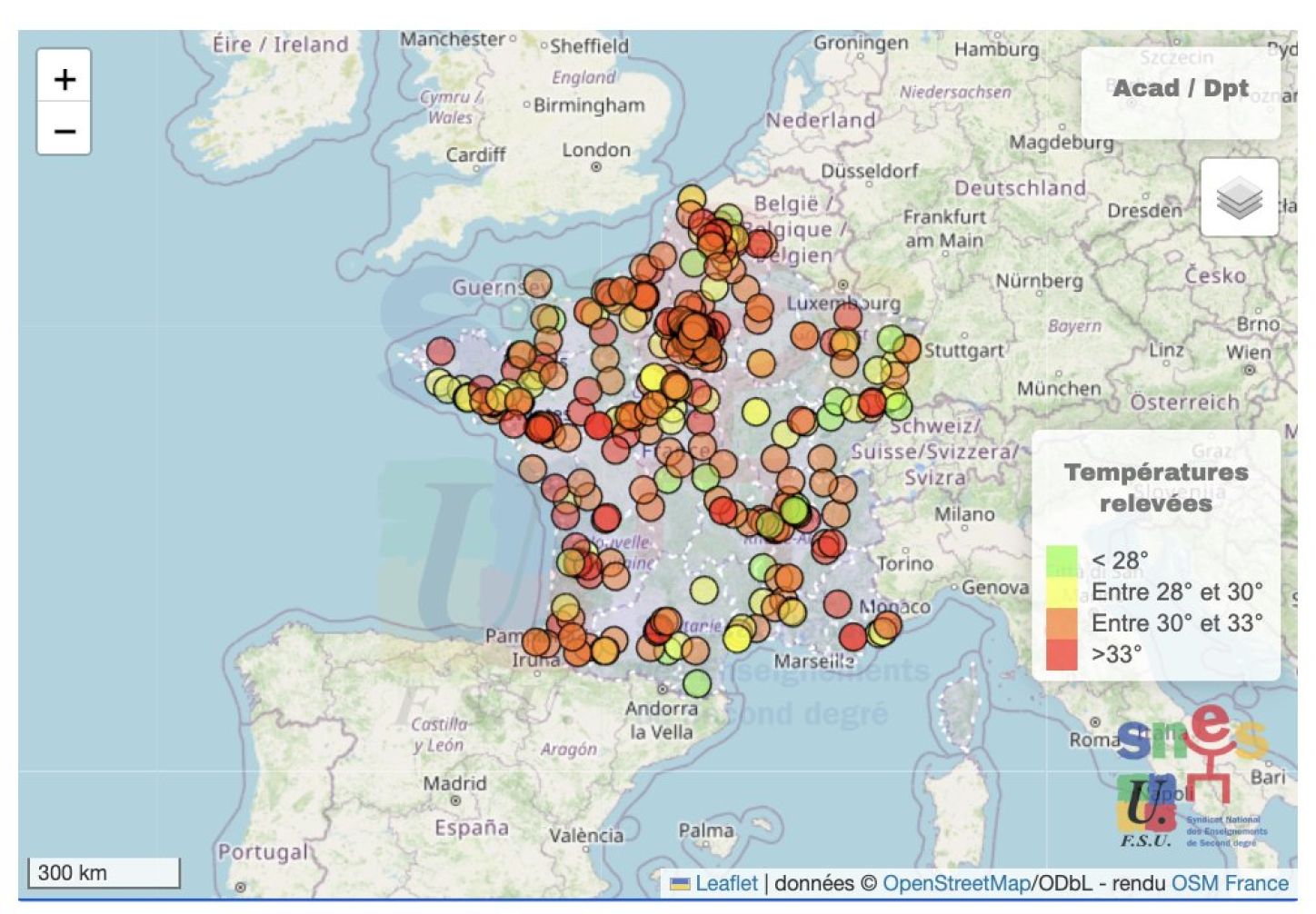
During the heatwave of May 2026, the SNES-FSU launched a major survey of its members. We produced a map of the “weather in class”, with temperature readings and adaptation measures. This unprecedented initiative, one that not even the Ministry has undertaken in our sector, offers some enlightening and insightful findings. Over two days, more than 630 staff members responded to the survey about the situation at their schools: 77.6% of secondary schools had recorded temperatures above 30 degrees, and 87.18% of schools had not implemented any measures to adapt to climate change.
Credit: SNES-FSU
Many staff members also shared comments on their situation:
“33 degrees this afternoon, just one small pedestal fan for the whole class.”
“Almost 32 degrees without even switching on the projector. That said, with 32 pupils and 32 degrees, we were in sync… hell in Brittany.”
“37°C from 11 in the morning to 5 in the afternoon. 32°C from 8 to 11 in the morning. Lille Academy, prefabricated buildings. I ended up rushing off to the local supermarket to buy water out of my own pocket! Fed up with the apathy of the national education system!”
We also documented dozens of cases of staff and pupils feeling unwell in schools, with serious health implications in some instances.
With the SNES-FSU, we have also advised colleagues on the actions to be taken in schools, providing them with relevant regulations and guidance on how to act to defend the working conditions of staff and pupils. Under pressure, the Education Ministry published a “heatwave management” protocol on 28 May 2026. But establishing a protocol on paper with measures that are often unworkable in practice is not enough to tackle the severity of the situation.
For the SNES-FSU, schools being left in this state, year after year, is no longer tolerable. Despite our initial victories, many battles must still be fought with the union to secure the renovation of school buildings and protect the working conditions, health, and well-being of staff and pupils.
Established in 2023, the Fund for Accelerating the Ecological Transition in Local Areas, known as the Green Fund, supports local authorities and their partners in their investments towards the green transition at local level.
The opinions expressed in this blog are those of the author and do not necessarily reflect any official policies or positions of Education International.