Queer union solidarity at the heart of democracy
As authoritarian policies, censorship, and anti-gender campaigns intensify worldwide, education unions are reaffirming a long-standing truth: there can be no democracy without equality, dignity, and inclusive public education. This means education unions standing together against the global backlash on LGBTI+ rights.
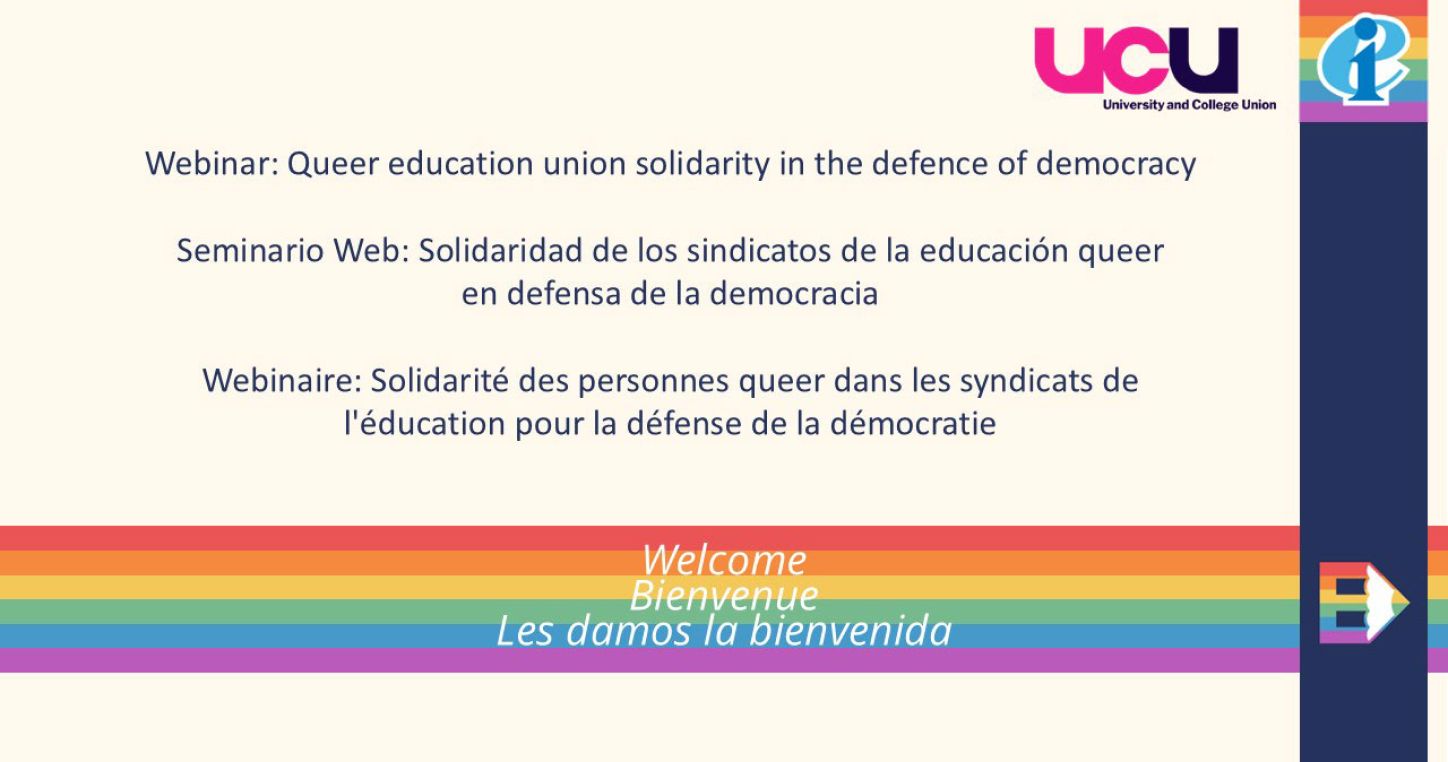
During the Queer education union solidarity in the defense of democracy, a global webinar co-hosted by Education International (EI) and its affiliate the University and College Union (UCU) to mark the International Day Against Homophobia, Transphobia and Biphobia (IDAHOBIT) – May 17th, one message was clear: queer solidarity is not a side issue. It is central to the fight for democratic, inclusive public education and for the dignity of all education workers and students. As education unions continue to organise, bargain, and mobilise globally for LGBTI+ rights, they are defending democracy every day — in classrooms, workplaces, and through collective action.
Solidarity, a core value and a commitment in action for education unions globally
In her opening remarks for the webinar on May 7th, EI Deputy General Secretary Cassandra Hallett set the struggle for LGBTI+ equality within the broader defense of democratic societies. “Human dignity, equality, and freedom are universal rights, and democracy cannot exist without them,” she said.
She also warned that “the only goal of the so-called anti-ideology and anti-rights movements is to attack the most vulnerable among us and to weaken the democratic institutions which protect their rights.”
For too many colleagues, Hallett stressed, “survival, safety, and job security are the core of their daily struggles, and engaging openly in LGBTI+ work can carry real risks. Naming this reality is part of solidarity. We stand together to support each other and to take care of each other.” “At EI, solidarity is a core value and a commitment in action,” she insisted.
She further reminded that the 10th EI World Congress held in 2024 adopted a resolution condemning the rise of anti-LGBTQIA+ ideology from the far-right.
International solidarity is not optional
Drawing on history, Mark Pendleton, Vice President of the University and College Union (UCU), reminded participants that queer liberation and labour struggles have always been intertwined. He reflected on international solidarity shown during the anti-apartheid struggle in South Africa: “The lesson from these stories is that all oppression must be resisted, collectively, intersectionally, and internationally.” For trade unionists, he added, solidarity is rooted in the principle that “an injury to one is an injury to all.”
He went on highlighting that UCU “has a long and proud history of leading the trade union movement in the UK on LGBTQ+ inclusion.”
Pendleton also acknowledged that UCU acts internationally, recognising the UK's role in the creation of many laws that undermine LGBT+ people's rights in places that were colonised, and that “we have a responsibility to act in solidarity with those resisting the continued deployment of those laws against queer and trans people.”
Education unions, he noted, “are uniquely placed to act in workplaces and communities, using our skills as educators to challenge the narratives that seek to diminish our collective humanity.”
Noting that “here in the UK, we are resisting a sustained and coordinated attack on our trans and non-binary comrades and their right to bodily autonomy and self-determination,” Pendleton referred to the UCU LGBT+ charter and insisted on UCU’s strong support of all LGBTI+ rights backed by years of policy adopted at UCU annual Congresses.
The backlash against LGBTI+ people is a backlash against democracy
From a global human rights perspective, Nanoo Sandhu, Director of Programmes at ILGA World, the International Lesbian, Gay, Bisexual, Trans, and Intersex Association, stressed that the current wave of repression is neither isolated nor accidental: “The struggle for LGBTI+ rights, the struggle for workers’ rights, the struggle for public education, and the struggle for democracy are not separate. They are part of one shared demand: that every person should be able to live with dignity, safety, and freedom.”
Sandhu described how LGBTI+ people are routinely turned into scapegoats to normalise wider restrictions on freedoms. “It is not only a backlash against LGBTI+ people. It is a backlash against democracy itself,” he said, underlining that attacks on queer communities often go hand in hand with assaults on trade unions, public education, and civil society.
For this reason, education unions have a “vital role” to play, and “schools and universities are on the front lines of the struggle. They can either become places of censorship and fear, or they can remain spaces of safety, learning, and democratic possibility.”
Sandhu added that solidarity must be grounded and accountable. “International solidarity must not be performative,” he said. “It must be accountable to those most affected.” Sometimes, it means speaking out loudly, sharing resources, training, legal expertise, or exerting political pressure, and at other times it means quiet, locally led support, stepping back and following the lead of local movements, he explained.
Lived realities: dignity at work
The webinar also focused on the experiences of union activists working under discrimination and risk.
Isidro Argua, a former schoolteacher and currently union officer at the Federation of Free Workers - Trade Federation VIII (FFW-TFVIII)/the Philippines, shared how he lost his job after his employer learned of his gender identity. “My contract was terminated because of it. Because I choose to be me,” he said.
Participation in a training on the International Labour Organization (ILO) Convention 190 transformed that experience into collective purpose. “The training did not just provide knowledge, it gave language to experiences like mine It affirmed that what I went through was not right, and more importantly, that it should never happen to anyone,” Argua explained. “Through C190 I became more aware, more empowered and more committed. I now carry a stronger responsibility, not only to protect myself, but to stand up for others who may still be facing discrimination in silence.
For him, queer union solidarity means “more than just inclusion. It is about active support, protection, and empowerment. It means recognizing that LGBTI+ workers often face unique challenges, that our unions must be safe spaces where everyone is valued equally.”
It is a continuous commitment “to listen, to learn, and to act,” to build workplaces “where respect and dignity are non-negotiable.”
Defending rights under criminalisation
From Uganda, Justine Balya, Director at the Human Rights Awareness and Promotion Forum (HRAPF), outlined the difficulties facing LGBTI+ communities under expanding criminalisation. Describing the impact of anti homosexuality legislation and new restrictions on civil society funding, Balya said advocacy work has become increasingly dangerous. “In theory, now it appears that any conversation with queer people, or any conversation about queerness that is not negative is promotion of homosexuality,” she explained.
Despite this, HRAPF continues what Balya described as “firefighting”: providing legal aid, emergency shelter, medical support, and strategic legal action.
International solidarity, she stressed, remains essential: “It’s very important that in spaces outside of Uganda, we continue to speak up about what is going on here,” because global attention “helps us to manage some of the more gross abuses. It keeps attention on the issue, and that provides a degree of protection.”
Balya also noted that research initiatives “targeting the lived realities of queer people in these difficult environments are always helpful, because it helps to focus resources and attention where it is most needed, especially by the community itself.”
Education unions on the frontline
From Eswatini, Lot Vilakati, General Secretary of the Swaziland National Association of Teachers (SNAT), spoke about organising for LGBTI+ rights in a context where same sex relations remain criminalised and cultural taboos are strong. “This creates a fragile environment for LGBTI+ teachers and learners, especially within school.”
“When you talk about culture, you must also talk about rights,” Vilakati argued, insisting that “culture cannot supersede the right, because the minority right, it is a human right.”
He went on reminding the teacher responsibility in protecting minorities: “Whenever we teach, we are teaching the society we belong to, so what happens to teachers also happens to the members of the society.”
Through a cooperation programme run with Education International, the Trade Union Solidarity Centre of Finland (SASK) and OAJ – an EI member organisation in Finland-, SNAT has built members’ capacity to defend minority rights and challenge discrimination in schools.
That work has already had tangible effects, including reversing the expulsion of students targeted for same sex relationships. He also reported: “We are in an election period, where we see one of the members of the minority group contesting for a national gender position. She is a transgender woman, and we are hoping that she is going to win the election. She is going to be my gender officer if she wins.”
“We will keep on protecting our members,” Vilakati affirmed.
From visibility to protection
Closing the discussion, Seth Atkin, Equality Support Official at UCU, cautioned against confusing visibility with safety. “Visibility can make people really quite vulnerable and need protection,” he said, noting that far right attacks deliberately target the most marginalised. The task for unions, therefore, is to provide support and protection and to stand alongside civil society organisations challenging cultures that undermine democracy.
Atkin returned to a core trade union principle: “to stand with the weakest, and to stand alongside each other, all the time.” “There is concerted attack, but there is also concerted solidarity and standing together” - across unions, movements, and borders - to defend democratic freedoms.
He stressed: “Together, we can set up a culture. Elections are part of a culture. We heard about Hungary and how that change has happened there since the Pride, where people actually gathered together and made the biggest Pride in the whole of Europe by a show of solidarity.”
“We need to stand together, take action there, at all the different levels we can,” Atkin concluded.
You can learn more about EI’s work and policy regarding LGBTI+ rights here.
If you want to receive updated information on EI’s work in this area, join the LGBTI+ Rights mailing list here.