Scotland: Education union leaders stress the power and vital importance of global solidarity
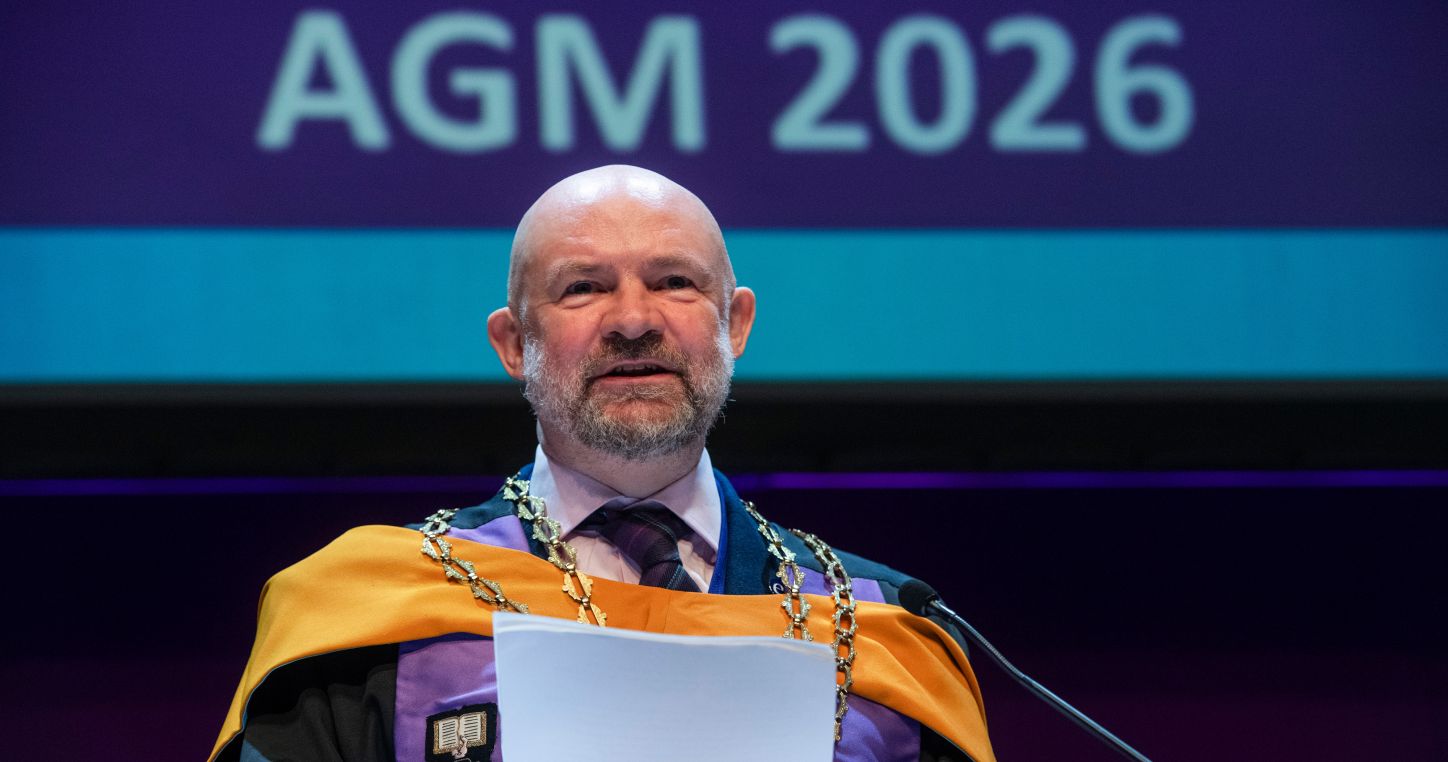
The transformative power and critical role of global union solidarity featured prominently at the 180th Annual General Meeting of the Educational Institute of Scotland (EIS) which took place on 4 to 6 June in Dundee.
Founded in 1847, the EIS is the largest teaching and education union in Scotland and one of the oldest unions in the world. It brings together 65,000 members and represents the overwhelming majority of teachers and lecturers across the nation.
In his final address to the Annual General Meeting, outgoing President Adam Sutcliffe highlighted the union’s engagement in solidarity actions around the world, noting that “trade union solidarity does not begin and end at the school gates, it extends to our brothers and sisters throughout Scotland, to those across the UK and also on the island of Ireland, but more importantly it is truly international, it is global”.
Standing with teachers and students in Palestine
Sutcliffe was part of the EI solidarity mission to Palestine which was detained and interrogated for hours at the Israel-Jordan border before being barred from entering the country by Israeli officials in January. The high-level delegation consisted of union leaders from around the world who had supported a training programme for Palestinian teachers. Their intention was to visit EI member organisation the General Union of Palestinian Teachers to mark the International Day of Education, attend the graduation ceremony, and learn about the situation of colleagues in Gaza and the West Bank.
Reflecting on the experience, Sutcliffe noted that the powerlessness and injustice felt in those moments were just a fraction of what Palestinians face every day. “Whilst I don’t want to minimise the issues we face in our day to day, as trade unionists we must also keep in mind our brothers, sisters and non-binary siblings across the world whose day to day may indeed involve serious risk to life”, Sutcliffe stressed.
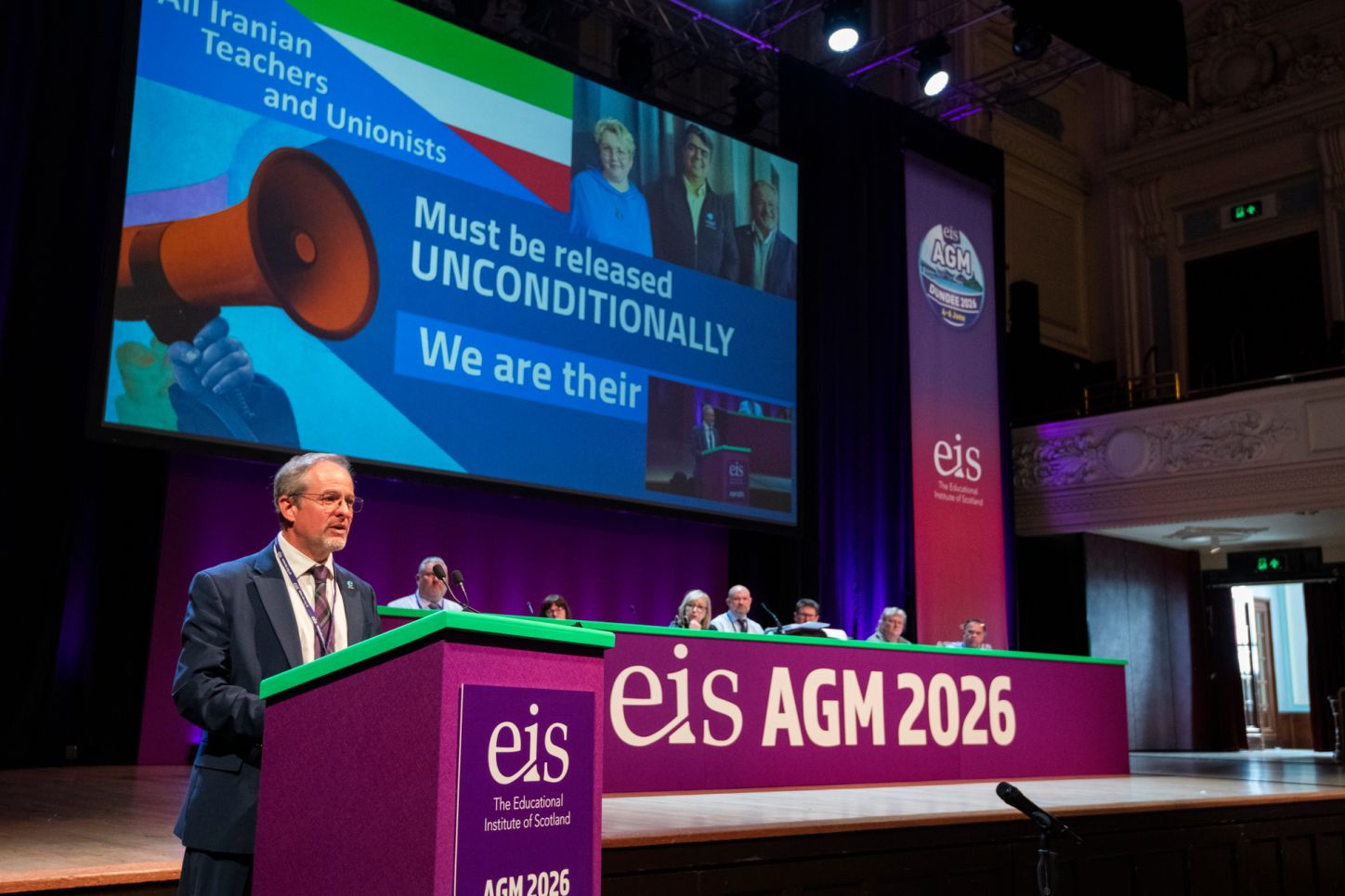
Addressing the Annual General Meeting, EI General Secretary David Edwards thanked Sutcliffe and the EIS for their continued solidarity and emphasised its value for teachers in Palestine. “Ironically, their fear of teachers standing in solidarity with Palestinian teachers and students and attempts to intimidate, isolate, or silence us only strengthened our collective determination to continue supporting our brothers and sisters and to amplify the voices of those who, despite a genocidal war and military occupation, continue to teach and to build hope for future generations”, Edwards noted.
Peace is union business
Sutcliffe reaffirmed his organisation’s commitment to the global union movement, its people, and its values: “We must extend our trade union solidarity and human solidarity to teachers, lecturers and all workers not only in Palestine, Ukraine, Sudan, the Democratic Republic of Congo, Lebanon, Myanmar and Cuba, to name but a few, but also to wherever there is conflict, unrest and authoritarianism.”
Drawing attention to conflicts that do not make the headlines, Sutcliffe shared the heartbreaking story of Mr Fon, a teacher from Cameroon who had supported Sutcliffe during the two years he spent teaching English in the West African country. Mr Fon passed away a few years ago from complications related to starvation. The crisis in his country led to the closure of 80% of public schools and therefore the non-payment of salaries by the Cameroonian government.
In the face of such injustice, it is imperative to remember that “none of us can truly be free to live our lives in peace and comfort until we are all free to live our lives in peace and comfort”, Sutcliffe concluded.
Edwards echoed this call for solidarity. His speech provided a sharp analysis of the state of the world and the ways in which EI is harnessing solidarity and building union power to defend the teaching profession, public education, people, and planet.
Edwards also reiterated Education International’s fierce commitment to peace, democracy, and human dignity: “Peace must be union business because we know at the center of every conflict we witness is also an assault on education. Schools are bombed, teachers displaced, children traumatized, entire communities fall apart”.
Global solidarity supports education communities in crisis contexts, it is instrumental in the release of imprisoned unionists, and it keeps hope alive in the most challenging circumstances.
“Every time a teacher creates a safe classroom, every time a student learns to think critically instead of hate reflexively, every time a community invests in a school instead of a weapon, we expand the territory of peace on this planet”, the EI General Secretary concluded.