France: Massive trade union mobilisation for fair pay, public services, and the future of education
More resources for public services and education, better pay, jobs, and social and fiscal justice: these are the demands behind the trade union call for a national day of strike action and demonstrations on 5 November. Supported by the French affiliates of Education International (EI) and the European Trade Union Committee for Education (ETUCE), this mobilisation is part of a wider social movement, also led by secondary school pupils and students calling for better learning conditions and a real chance of a better future.
Pay, jobs, and public services: joint demands
Following the strike action and demonstrations staged by public sector workers on 29 September and several weeks of mobilisations by the young people of France, the CFDT, CGT, FO, UNSA, and FSU union centres are calling on public and private sector workers, young people, and pensioners to join the strike action and demonstrations on 5 November.
In their joint statement of 5 October, they warn of an “unprecedented downgrading” of workers, with the cost of living rising at a rate not matched by wages and pensions. They also condemn the job cuts and the budget choices that are weakening public services and social protection.
The trade union demands include pay rises, equal pay for men and women, pension and minimum wage upgrades, an increase in the index point, better public sector careers, and more resources for public services. They are also calling for a policy of tax justice and genuine environmental and industrial planning.
The unions are also supporting secondary school pupils and higher education students mobilising for better learning conditions and greater equality, emphasising their right to demonstrate and assemble “peacefully, freely, and safely”.
Education: “Everyone on strike for our wages and the future of our schools”
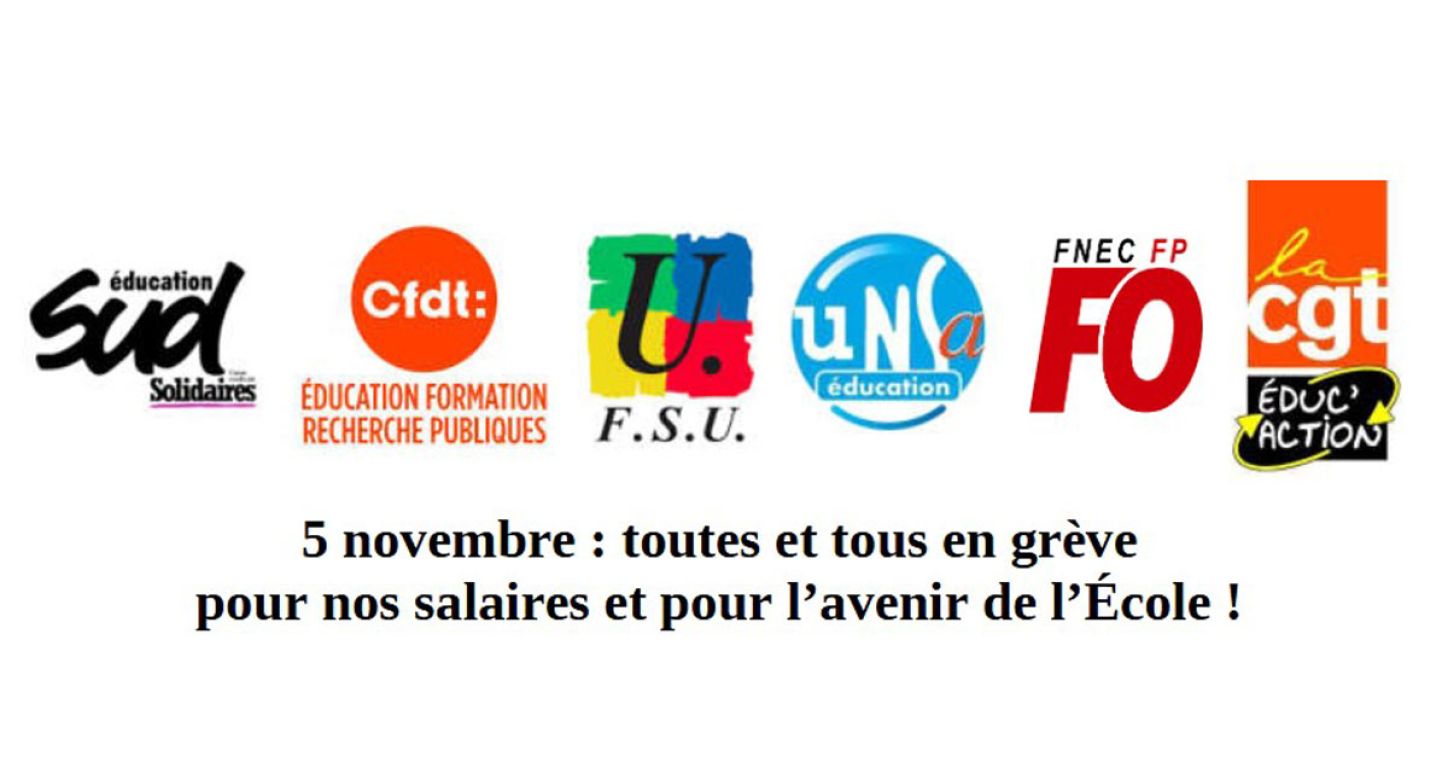
Public education sector unions – SUD Éducation, CFDT Éducation Formation Recherche publiques, FSU, UNSA Éducation, FNEC FP-FO and CGT Éduc’ Action – are putting forward specific demands to address the crisis in the education sector. They are calling for an end to the freeze on the index point and measures to raise pay with no strings attached, the creation of a category B public service corps for AESH (support staff for pupils with disabilities), a national pay scale for education support staff, and a plan to grant tenure to non-tenured staff, as well as the cancellation of the job cuts foreseen in the 2027 budget.
For the inter-union coalition, the issue goes beyond pay alone: “Schools need sufficient staff to meet pupils’ needs and improve working conditions for all.” The unions are therefore calling for a mass mobilisation on 5 November in support of fair pay, working conditions, and the future of education.
ETUCE: ending years of underinvestment
For Jelmer Evers, Director of the European Trade Union Committee for Education (ETUCE), EI’s regional organisation for Europe, the action now underway highlights the consequences of years of underinvestment in education.
“The students’ anger is fuelled by poor prospects and decades of underinvestment. Today, it’s all coming to a head. It’s a bit like a bill that should have been paid a long time ago.”
Evers underscores the direct link between the deterioration in working conditions for staff and learning conditions for students: “Staff working conditions are students’ learning conditions.”
Overcrowded classrooms, staff shortages, dilapidated school buildings, and barriers to higher education, he underlines, all point to a structural crisis. And although the government has announced some initial measures concerning class sizes and access to higher education, for Evers, they fall far short of what is required.
For the head of the ETUCE, the answer lies in a change of direction: “More investment is needed.” He stresses that education has been suffering from underinvestment and austerity policies for at least ten years and only an ambitious investment policy will provide a lasting solution to the crisis.
EI’s French affiliates are also firmly backing this action.
SNES-FSU: “a key stage” in a movement set to continue
For Julien Farges, Vice President of the ETUCE and head of International Relations at France’s SNES-FNU union of secondary school teachers, 5 November should be seen as a new stage in a social movement that has been steadily growing since September.
“5 November is a crucial point in the campaign; it is an important stage, but it is a stage. The mobilisation will continue and it will intensify until the government meets our demands.”
For Farges, there is “a tremendous sense of determination at the demonstrations” and a clear call from the public “for quality public services and jobs that provide a decent living”. He also points to the “immense anger that has built up over 10 years of government policies that have led to a staggering rise in economic and social inequalities”.
For the SNES-FSU, the stakes are particularly high in secondary education. The union is calling for pay rises, more jobs, smaller class sizes, more teaching and support staff, a complete overhaul of the reforms to upper secondary education, the baccalaureate and the “Parcoursup” admissions system, as well as a large-scale national plan to renovate school buildings.
UNSA Éducation: ensuring young people have a genuine chance of a better future
Morgane Verviers, a member of the ETUCE Bureau and General Secretary of UNSA Education, emphasises that “the mobilisation of upper secondary school pupils has shown that this generation is not afraid to take a stand”.
Verviers points out that emergency measures are no longer enough, and that the decisions taken within the framework of the 2027 budget must ensure lasting improvements to public education and job attractiveness in the sector. UNSA Éducation will therefore be demonstrating on 5 November for financial measures “to strengthen public education and the appeal of our profession, and, more broadly, to ensure a genuine chance for a better future for the young people of our country”.
FSU-SNUipp: securing different budget choices
Alexandra Bojanic, from the Rights, Freedoms, and International Unit of the FSU-SNUipp education union, also sees the day of action as part of an ongoing social movement: “The series of days of action shows the need to secure a different budget for a fairer society. 5 November must be taken as an opportunity to step up this mobilisation.”
For the FSU-SNUipp, “other budgetary choices are possible and necessary”. The union is therefore calling for a mass cross-sector day of action based on shared demands: higher salaries, pensions and social benefits, equal pay, stronger public services, tax justice, and environmental planning.
Go Public! Fund Education
The demands being voiced in France are aligned with Education International’s Go Public! Fund Education campaign that calls on governments to fully fund public education and invest in the workers that make it happen.
The day of action on 5 November illustrates the importance of making education a budget priority rather than an adjustment variable. In a context marked by entrenched inequalities and staff shortages, trade unions are calling for a response based on public investment, staff recognition, and the strengthening of public education.
Pensioners join the movement
The movement is spreading beyond the world of work and the education sector. Trade unions representing pensioners are also calling on people to join the cross-sector day of action on 5 November and are explicitly expressing their solidarity with students.
They are backing their calls for the resources needed to ensure decent learning conditions: buildings and equipment in good condition, smaller class sizes, and teachers for every subject. “Every effort must be made to offer young people a better future,” they insist.
Pensioners are also joining the calls for better wages, the defence and development of public services, strong social protection and a fairer tax system, as well as demanding that pensions be raised and indexed at least to inflation.
Rejecting any attempt to pit generations or different sections of the population against one another, their statement concludes with a declaration of solidarity that reflects the spirit of this day of action: “It is only by standing together that we can fight, and win what we demand.”