The teacher shortage is not gender-neutral: Researchers call to address inequality
The Education International (EI) Research Network (ResNet), which brings together trade unionists and researchers, explained that the global teacher shortage cannot be understood — or confronted — without addressing the gendered inequalities that shape education systems, the workplace, and the profession itself.
Putting gender at the centre of the struggle
During a meeting of the Research Network, held on June 15th and 16th, participants examined the teacher shortage through a gender lens. The aim was “to strengthen the evidence on the teacher shortage by integrating a gender perspective, to explore how research can better support unions, advocacy, collective, and policy work.” This discussion was linked to EI’s wider priorities, including the Gender Equality Action Plan and the Go Public! Fund Education campaign.
According to the speakers participating in the virtual meeting, to examine the teacher shortage with a gender lense, one must examine the deeper structures that shape who enters the profession, who stays, who advances and whose work is valued. Speakers also argued that the teacher shortage is also tied to workload, stress, care responsibilities, gender stereotypes, unequal access to leadership and chronic underfunding in public education.
A profession built on women workers, but not on equality
For EI Research, Policy, and Advocacy Director, Antonia Wulff, the discussion had to be anchored in the strategic commitments adopted by EI’s World Congress in 2024 “calling for urgent action on the shortage.” She also stressed the need to look closely at why “fewer and fewer younger people” are choosing to become teachers.
She went on reminding the everyday realities that make the shortage impossible to treat as gender-neutral. Workload and stress levels, career progression, career pathways, as well as “issues around violence and mental health. These, she noted, “have a strong gender dimension that requires some careful consideration, some careful interrogation from our side.”
Antonia Wulff also highlighted one of the central contradictions in education systems worldwide: “The majority of teachers are women, particularly in early childhood education. We also know that a majority of school leaders remain men in most countries.” She also noted that many EI member organisations report segregation by subject, with men often concentrated in more scientific and math-focused fields, and women concentrated more in humanity and care focused fields.
When governments impose austerity, she also said, “health and education are the first victims.” That is not only “a blow to public services,” it is also “a direct attack on women’s work,” because women make up the majority of the workforce in education and are among the first to feel the impact of deteriorating working conditions, she reported.
Who gets blamed — and who holds power
In her keynote, Marie-Pierre Moreau, Professor in the Sociology of Education, Work and Inequalities at Anglia Ruskin University, reflected on the growing visibility of gender in public discussion. She warned that greater visibility does not necessarily mean greater justice: “We live in a world where gender has never been as much talk about,” she said, yet “the issue of gender equity has become very contentious.”
For Marie-Pierre Moreau, gender inequality in teaching is a social justice issue in multiple ways. While women make up most of the teaching workforce, she insisted, they are concentrated in the parts of the labour market that are “less rewarded, or considered as less prestigious.” At the same time, she noted, there is also “a lot of suspicion towards men who teach”, especially in nursery and primary education, which creates its own barriers in a context where systems are already struggling to recruit and retain staff.
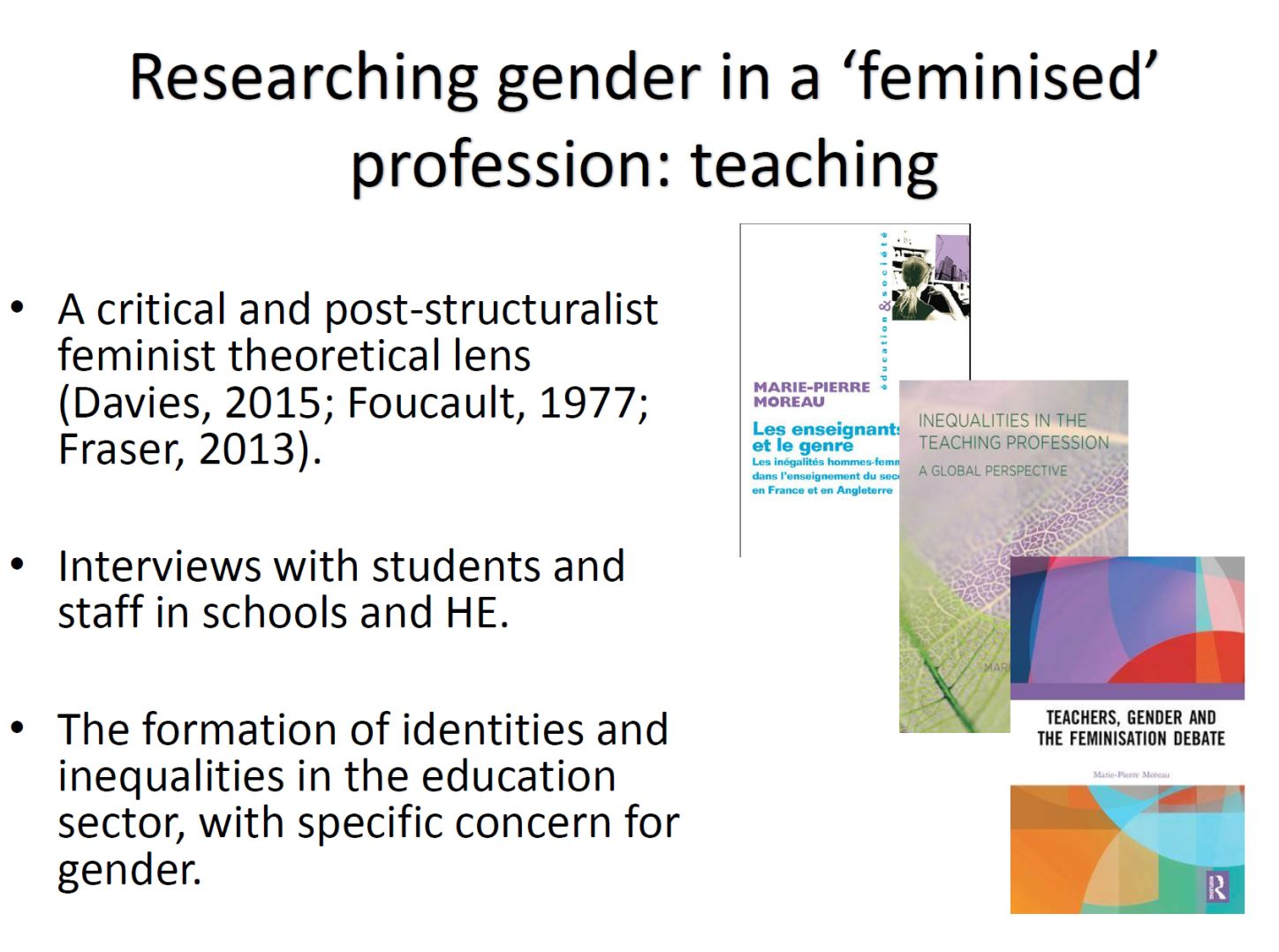
She also focused on the language used to describe the profession. “When you say something, it does not just reflect a reality, it actually constructs the reality,” she said, as she detailed the many meanings attached to the term “feminisation.”
In her analysis, the word is often used loosely to refer to the numerical presence of women, to supposedly feminine qualities associated with teaching, or to the idea that the profession is somehow “female-friendly.” Each of these meanings, she demonstrated, can be used to describe care as women’s work and to devalue teachers’ labour.
She went on challenging the persistent argument that teaching is a family-friendly profession. Drawing on survey evidence from the United Kingdom, Marie-Pierre Moreau noted that teachers often work in the “50-60 hours bracket a week” and struggle to balance work and caring responsibilities. Far from proving that teaching is naturally suited to women, she argued, this points instead to a profession shaped by overwork and contradiction.
She also said:“it is very clear that the problem does not lie in the feminisation of teaching, but instead the construction of this feminisation is a problem.” She also rejected familiar claims that boys need more male teachers as role models, saying that there is no evidence supporting these claims.
From research to union power
The ensuing discussions highlighted a series of urgent priorities for future research and union action: women’s access to leadership positions, the pay gap, teachers leaving the profession, stereotypes around care and authority, and stronger cross-national comparisons. Participants expressed the need to put a strong focus on leadership, but also on the over-representation of women in teaching support positions and on challenging stereotypes about what the feminisation of the profession is presumed to mean.
Building collective strategies for gender justice
EI Research, Policy, and Advocacy Coordinator Gina Pancorbo presented the EI’s Health and Well-Being Hub, a collaborative platform designed to support union workers and representatives in promoting healthier workplaces, with a particular focus on “the mental and the physical well-being specifically of women.” She explained that the hub gathers resources on work-life balance, mental health and stress, gender violence, reproductive health and psychosocial risks at work.
She added that the platform depends on collective participation. Affiliates, researchers and union members are being asked to contribute their own materials so that the movement can build “a global database with knowledge and resources.”
She also previewed the Fifth World Women’s Conference 2026, which will bring together women trade union leaders from across the world. One of its plenary sessions, she said, will look at the global teacher shortage “through a gender lens,” including the status of the profession, access to teaching, workload and care responsibilities.