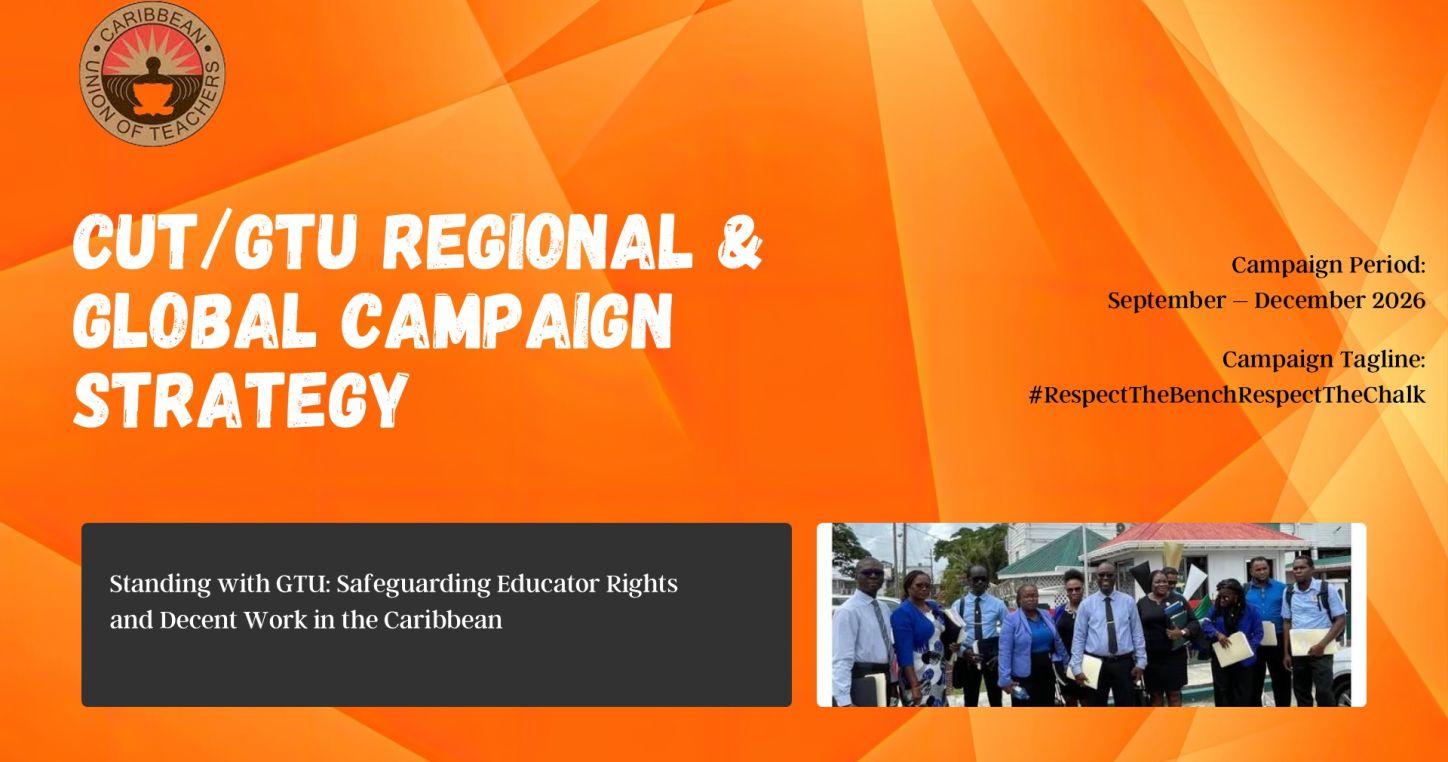
Caribbean unions launch regional and global campaign to support Guyana’s teachers
The Caribbean Union of Teachers (CUT) has launched a regional and global solidarity campaign in support of the Guyana Teachers’ Union (GTU), bringing together education unions across the Caribbean and international allies to defend educators’ rights, strengthen social dialogue, and secure a resolution to long-standing disputes affecting teachers in Guyana.
Running from September to December 2026, the campaign, titled Standing with GTU: Safeguarding Educator Rights and Decent Work in the Caribbean, seeks to raise awareness of the challenges facing Guyanese educators while mobilising support from education unions, regional institutions, and international partners. Under the slogan #RespectTheBenchRespectTheChalk, the initiative links respect for the rule of law with respect for the teaching profession.
It reiterates that quality education in the Caribbean depends on fair compensation, respect for collective bargaining, and genuine engagement with teachers’ unions.
A regional concern for education and trade union rights
According to CUT, the dispute extends beyond Guyana’s borders and has implications for educators and trade unionists throughout the Caribbean. The campaign stresses that GTU has faced systemic pressure and delayed collective agreements, while warning that attacks on teachers’ rights in one country threaten the integrity of trade union rights across all 26 CUT member territories.
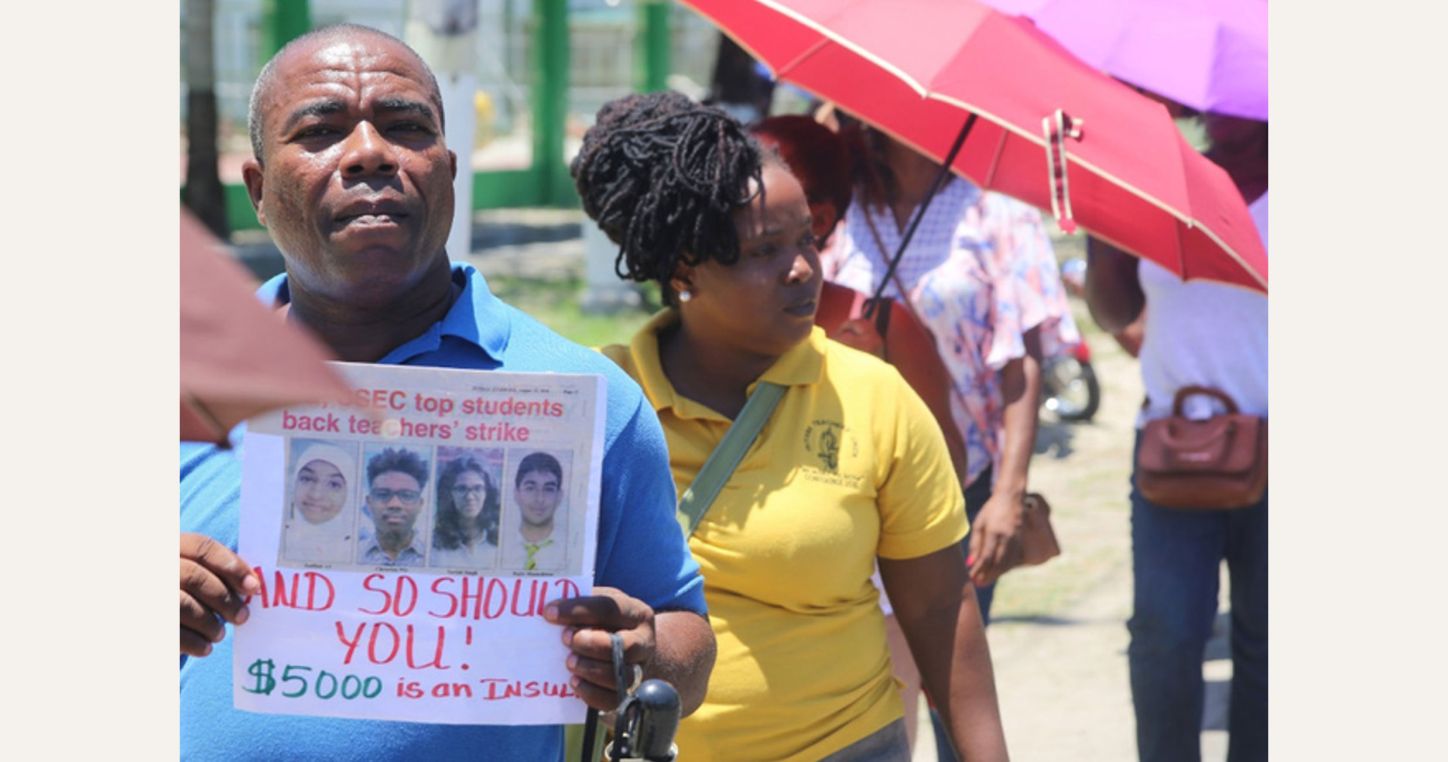
In a letter addressed to Guyana’s Minister of Education, Sonia Parag, CUT President Sharon Kelsick stressed the importance of social dialogue between governments and education unions.
She wrote:
“Across the Caribbean, history and experience demonstrate that a robust, resilient, and progressive education system cannot be built in isolation. It requires an enduring and collaborative partnership between governments and the trade unions that represent the teaching workforce.”
CUT President Sharon Kelsick.
Kelsick warned that prolonged conflict undermines not only labour relations, but also educational outcomes.
“Nothing good comes from prolonged division. The continued delay in resolving these fundamental matters only hurts our teachers, destabilises our school communities, and ultimately penalises the students who depend on us all.”
Legal rulings and collective bargaining must be respected
A central concern highlighted by CUT is the continued delay in implementing measures affecting the operational capacity of the GTU, particularly issues linked to union dues and compliance with court decisions.
In her letter, Kelsick emphasised that respecting legal decisions and restoring normal industrial relations processes is essential to rebuilding trust.
“The decision of the High Court on these matters delivered a clear legal framework. The continued non-compliance or delay in fully honouring the court’s ruling inflicts severe and unnecessary damage upon the operational capacity of the GTU and, fundamentally, undermines the morale and trust of Guyana’s dedicated educators.”
CUT President Sharon Kelsick.
The campaign’s objectives include generating regional and international support to encourage a settlement of all outstanding issues between the GTU and the Government of Guyana, while demonstrating the collective strength of Caribbean education unions in advancing quality public education and workers’ rights.
Building solidarity across the Caribbean and beyond
The campaign brings together multiple actors. While the GTU is leading mobilisation on the ground in Guyana, CUT’s 26 member unions will coordinate regional actions, diplomatic outreach and solidarity initiatives.
The International Labour Organization (ILO) is identified as a key avenue for defending internationally recognised labour standards.
The campaign is also aligned with Education International’s Go Public! Fund Education, an urgent call for governments to invest in public education, a fundamental human right and public good, and to invest more in teachers, the single most important factor in achieving quality education.
For Kelsick, the path forward clearly lies in dialogue rather than confrontation.
“The CUT firmly believes that there is no challenge too complex to be resolved through authentic, open, and honourable negotiations.”
In February 2024, EI General Secretary David Edwards sent out a letter addressed to Guyana’s public authorities highlighting the challenges encountered by GTU in negotiations with relevant authorities.
While acknowledging that the government “expressed a strong commitment to improving its education system and to increasing education spending to 6% of Guyana’s GDP, and 20% of the national budge,” he reminded that “the quality of an education system depends on the degree to which a nation’s teachers are professionally qualified and well supported, with decent salaries and working conditions as well as quality environments for teaching and learning.”
Edwards went on highlighting:
“Collective bargaining also applies to public servants directly employed by the Government. The ILO consistently emphasises that priority should be given to collective bargaining to settle disputes related to the determination of terms and conditions of employment in the public service. If negotiations are unsuccessful due to disagreement, the Government should consider conciliation, mediation, or arbitration by an independent body trusted by the parties.”
EI General Secretary David Edwards.
The EI leader further underscored the significance of a collaborative approach rooted in ILO Convention 98: “I therefore invite the Government of Guyana to enter into meaningful and constructive negotiations with the Guyana Teachers' Union, guided by the principles of fairness and mutual respect. I believe that a collaborative approach based on the provisions of ILO Convention 98 can lead to a resolution that addresses the concerns of teachers.”
Planned actions from September to December
Over the coming months, CUT and its affiliates will roll out a series of coordinated actions across the region. Initial activities include the launch of member toolkits, “Wear Orange Fridays”, and formal communications to the CARICOM Secretariat, Education International and other international partners.
Subsequent phases will focus on engagement with regional unions, outreach to international media, and encouraging education unions to petition their respective ministries of education in support of Guyanese teachers. The campaign proposal also envisages the possibility of a formal filing with the ILO, with support from Education International, should progress remain insufficient.
Additional communication initiatives will include a series of videos featuring teachers’ experiences, social media mobilisation materials, and opinion pieces authored by regional union leaders, including CUT President Sharon Kelsick.
A call for dialogue and resolution
CUT has formally invited Minister Parag and senior officials from Guyana’s Ministry of Education to meet with a high-level regional delegation to help facilitate discussions and identify a sustainable solution. The organisation has offered to host or facilitate conversations alongside GTU leaders, with the aim of restoring stability and rebuilding trust in Guyana’s education sector.
As Kelsick concluded in her appeal:
“Our goal is not to assign blame, but to assist in charting a practical, fair, and sustainable path forward, one that respects the legal rulings of the land, honours collective bargaining principles, and restores stability to Guyana’s education sector.”
For education unions across the Caribbean, the message is clear: defending the rights of teachers in Guyana is part of a broader struggle to protect public education, trade union freedoms, and decent work for educators throughout the region.