Caribbean education unions turn regional solidarity into action for fully funded public education
Education unions from across the Caribbean addressed a shared challenge: governments must invest in teachers and public education if they are serious about teacher retention and every student’s right to quality education. Unionists left the regional meeting with concrete commitments to organise, mobilise, build alliances, and hold governments accountable.
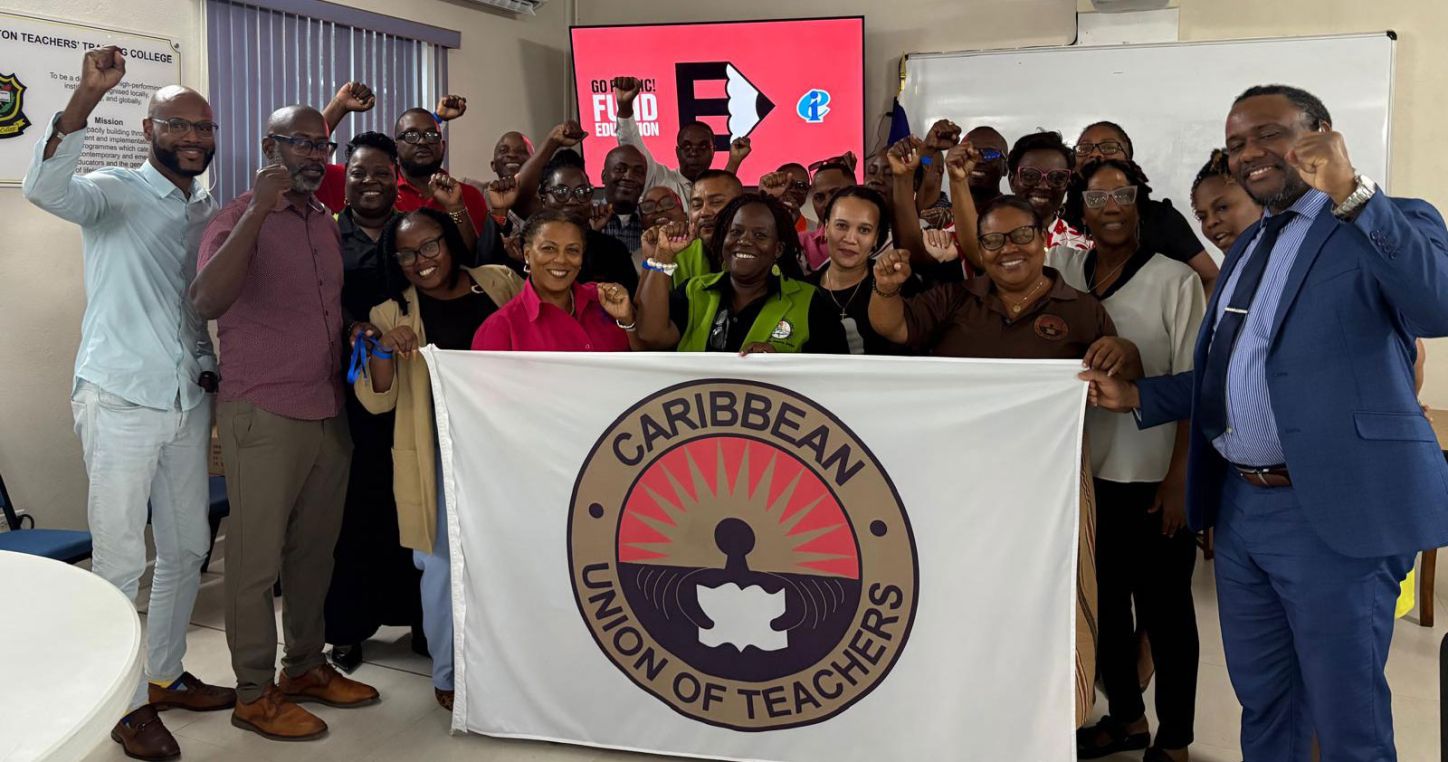
On October 30th and 31st, 2026, the Barbados Union of Teachers (BUT) hosted the Caribbean regional evaluation and planning meeting of Education International’s Go Public! Fund Education campaign. Education unions from Barbados were joined by member organisations from Belize, Grenada, Guyana, Jamaica, and Saint Vincent and the Grenadines. The meeting was led by Caribbean Union of Teachers (CUT) President Sharon Kelsick and CUT General Secretary Vern Charles.
Across borders, the experiences shared by union leaders pointed to problems that are increasingly regional in nature: uncompetitive pay, rising workloads, insecure employment, challenges related to student behaviour, pressures from outside the classroom, inadequate resources, and difficulties recruiting and retaining qualified teachers.
Despite differences between national education systems, one common conclusion arose: the teacher shortage cannot be addressed without confronting the conditions that drive teachers out of the profession.
A teacher retention crisis demands investment in the profession
In Barbados, unions stressed the need to look beyond headline teacher-to-student ratios and examine what is happening inside individual schools. They pointed to localised shortages, workload pressures, difficulties replacing absent teachers, ageing infrastructure, inadequate resources, and employment insecurity.
As Barbados Secondary Teachers’ Union President Mary Anne Redman noted: “Problems with recruitment are compounded by problems with retention. Retention is an industrial relations priority.”
For Belize, the President of the Belize National Teacher’s Union (BNTU), Nadia Cadiz, warned: “We have a crisis. There are two teachers out of ten missing in every school. In high schools, on average, there are five missing teachers.”
For Jude Bartholemew, President of the Grenada Union of Teachers (GUT), one of the solutions is straightforward: “If you want to keep teachers, make them permanent.”
Job security also emerged as a fundamental trade union issue. In Saint Vincent and the Grenadines, the union highlighted how employment instability can push trained educators away from the profession.
“Improving teachers’ working and living conditions is essential to attracting and retaining qualified educators,” stressed St Vincent and the Grenadines Teachers' Union (SVGTU) President Fiona Charles-Williams, adding that “job insecurity can affect morale and retention, potentially pushing qualified teachers to seek opportunities elsewhere.”
The SVGTU presentation further reinforced the link between education quality and employment conditions: qualified, experienced teachers are essential to sustaining teaching quality, while high turnover and the underuse of trained educators undermine continuity and learning.
Unions put public education financing on the agenda
Not only do education systems need more teachers:, they also need sustained investment in qualified teachers, good working conditions, safe schools, professional development, and strong public education systems.
In Guyana, the Guyana Teachers' Union (GTU) reported around 2,800 Teaching Service Commission vacancies in 2026, including leadership posts. Its priorities include filling vacancies promptly, protecting teachers’ purchasing power, ensuring fair and transparent employment procedures, monitoring education spending, and strengthening social dialogue.
In Jamaica, the same principle underpins the Jamaica Teacher's Association (JTA) approach to Go Public!. “Government must invest adequately and fairly in public schools. Teachers need decent pay, safe workplaces, and a professional voice,” underlined JTA President LaSonja Harrison.
For the JTA, the campaign is not a one-off initiative. Its national strategy combines sustainable public investment, mobilisation of teachers and communities, evidence-based policy advocacy, coalition-building, transparency, and accountability.
From a regional workshop to national union action
A central purpose of the Barbados meeting was to ensure that regional exchange will be translated into action at national level.
The Belize National Teachers’ Union committed to developing national advocacy and mobilisation, engaging teachers, parents, communities, and other stakeholders, documenting the problems confronting the education system, and building a sustained campaign to make the government accountable for its investment in public education.
The Guyana Teachers’ Union emphasised the value of learning from other Caribbean unions, describing the meeting as “a strong source of motivation” that helped it identify areas for improvement, strengthen its approach, and consider strategies developed by sister unions that could be adapted to Guyana.
The Grenada Union of Teachers’ agenda is to: collect stronger evidence, organise training, build public awareness and solidarity around the teaching profession, and use credible evidence and a unified union voice to engage the Ministry of Education.
As GUT President Bartholemew explained:
“Ultimately, we expect this campaign to be more than a fundraiser: a catalyst for lasting policy change and a testament to the power of teachers organizing collectively for the education our children and our country deserve.”
In Saint Vincent and the Grenadines, the campaign is already linked to capacity-building, public advocacy, collective bargaining, teacher welfare, and demands for adequate education financing. SVGTU has used television and radio programmes, workshops, research, meetings with government, and training for union members to take Go Public! to members and communities.
The Jamaica Teacher's Association committed to stepping up its Reformation Now: Schools Jamaican Children Deserve campaign through stakeholder consultations, solidarity visits, media engagement, and partnerships with regional and international unions.
“We return with valuable lessons and a renewed resolve to translate our collective learning into meaningful action. Solidarity!” LaSonja Harrison said.
The JTA has also set out measurable commitments for the next phase of the campaign: publish a national education financing position paper, press for transparent, needs-based per-student funding, advocate for dedicated support for special education and mental health, track teacher vacancies and workloads, monitor school conditions, and build a broad national coalition in every parish.
Regional solidarity is union power
The Barbados unions also committed to bringing the recommendations of the United Nations on the Teaching Profession to educators and the wider public.
Young members Marissa Harte and Ria Scott acknowledged that the meeting had enabled the Barbados Secondary Teachers' Union (BSTU) to learn from sister unions and develop new strategies, adding that the UN recommendations could provide additional support for the union’s advocacy.
The Barbados Union of Teachers (BUT) similarly identified educating members and the public about the UN recommendations as a critical next step, and underlined the importance of regional solidarity, informed advocacy, planning, and coordinated action.
The commitments from Barbados demonstrate how Go Public! Fund Education is becoming a tool for building union power across the Caribbean.
From documenting teacher shortages and challenging insecure employment to mobilising communities, demanding fairer financing, and strengthening collective bargaining, unions are connecting national struggles through a common regional agenda.
Participating unions reaffirmed that, in the Caribbean and elsewhere, governments cannot build strong public education systems without investing in the people who make them work, respecting their rights, listening to their unions, and making quality public education a political priority.