COP31: Governments fail people and planet
Hosted in Antalya, Türkiye, from November 9 to 20, COP 31 failed to reach an agreement, falling far short of the level of ambition and consensus needed to address the climate crisis. Governments failed to commit to transition away from fossil fuels despite the devastating impact of the climate emergency on people and planet.
The largest Conference of the Parties (COP) to date, COP 31 set out to enable constructive dialogue and tangible measures to tackle climate change, under the slogan From dialogue to consensus, from consensus to action.
During the leaders’ summit, United National Secretary General Antonio Guterres was clear: “Fossil fuels must go the way of the dinosaurs. But that won’t happen on its own. The dinosaurs did not have a lobby. But fossil fuels do. And their strategy is simple: Distort the science. Delay the policy. Delay the action. Delay the accountability. It’s time to kick the habit – and end the fossil-fuel addiction.”
Unfortunately, the fossil fuel lobby in Antalya was strong. Apart from leaders, country delegations, and observers, the 92,000 COP 31 participants also included representatives from over 100 corporations and interest groups linked to fossil fuel interests.
Central to the COP31 agenda was electrification – driving global commitments to reduce emissions by transitioning to clean electricity. However, the commitment to increase electricity’s share of energy consumption to 35% by 2035 was not adopted despite having some country support.
Trade union delegation advocated for workers and planet
Education International (EI) was represented at COP31 by Correna Haythorpe, Member of the EI Executive Board and President of the Australia Education Union, and Jennifer Ulrick, EI Research, Policy, and Advocacy Coordinator. The EI representatives joined the International Trade Union Confederation delegation as part of TUNGO, the trade union constituency of the United Nations Framework Convention on Climate Change.
The trade union delegation worked tirelessly to ensure explicit references to workers, labour rights, and social dialogue in key decisions. Unfortunately, the COP ended two days late without any agreement on either the cover decision or the formal arrangements for the operationalisation of the Just Transition Mechanism.
Workers condemned governments for failing to agree on an outcome and to deliver the Just Transition Mechanism promised at last year’s climate summit.
Education at COP 31
Negotiations took place to develop a new Action for Climate Empowerment (ACE) Action Plan that aims to encourage people to engage in climate action through education, training, public awareness, and access to information. However, despite a draft plan emerging, Russia blocked its adoption due to its opposition to the mention of combatting disinformation and misinformation and the use of the term “gender-responsive” (despite this being agreed language in previous ACE documents).
The annual meeting of the Greening Education Partnership (GEP) took place on 13 November. As part of the meeting, Turkey announced that it was the 100th country joining the GEP and a new working group on monitoring and evaluation was launched. EI participated in discussions on practical strategies to bring the policy toolkit Educators at the Heart of Greening Education to life on the ground, as well as charting the next steps for GEP 2.0.
14 November was a thematic day focused on children, youth, education, and skills. EI attended a high-level ministerial dialogue on education featuring education ministers from Türkiye, Kiribati, and Nepal. While the session included a focus on the role of teachers, no democratically elected teacher representative was invited to speak, indicating that governments have still not fully recognised the role of education unions in climate action.
Education International will continue to advocate for teachers and their unions to be recognised as key actors in policy making on climate and education.
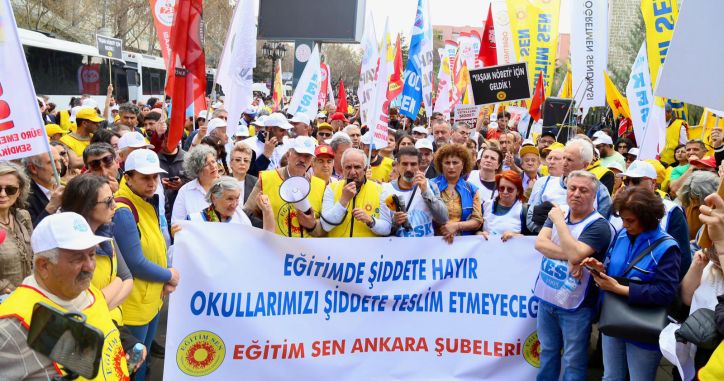
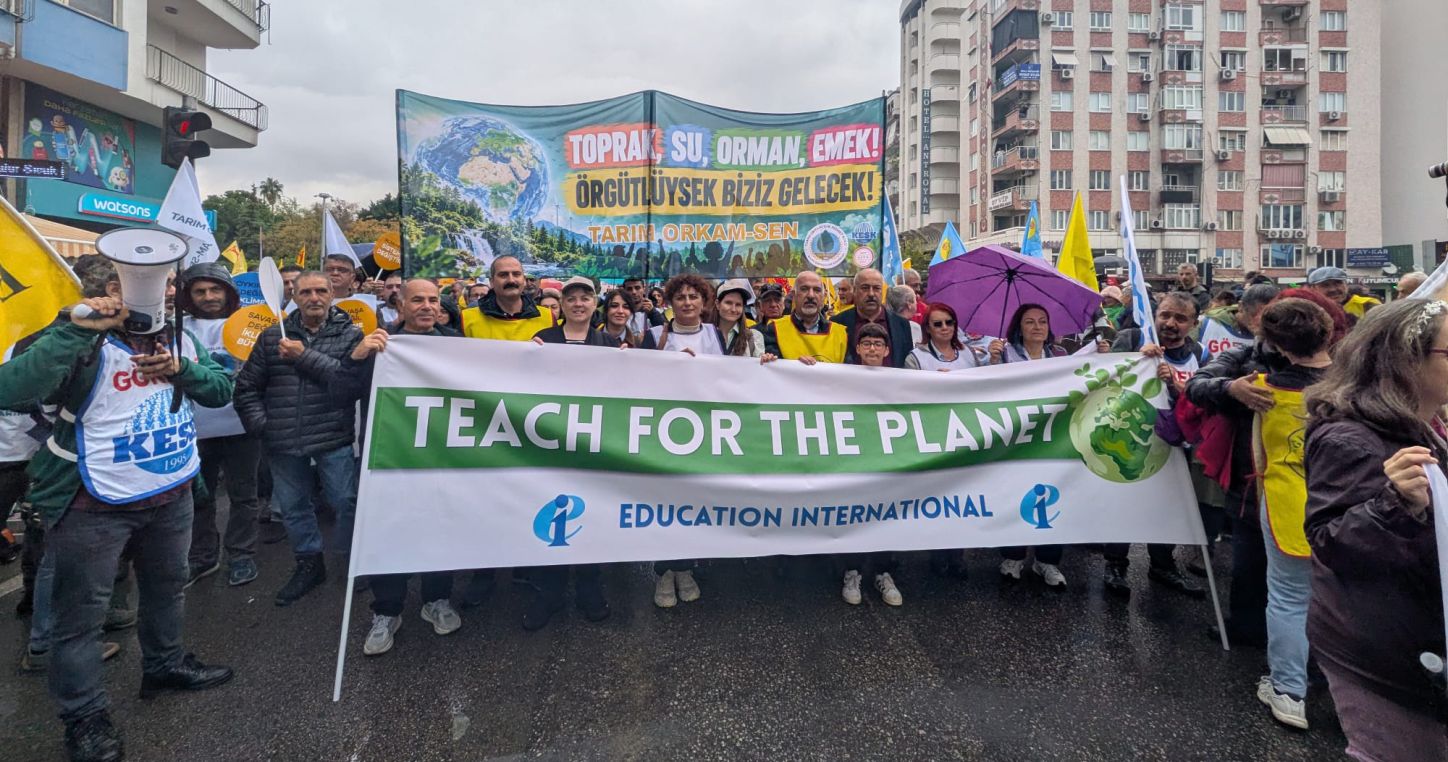
EI marched with Turkish member organisation, Egitim Sen, in Antalya during the people’s day of action, joining other unions and rights groups to call for climate justice.
Climate justice - a priority for education unions
Since 2021, EI has worked to advance climate justice through the Teach for the Planet campaign. This global mobilisation will continue and intensify.
The 15th meeting of the EI Climate Network will take place on 2 December. The Network brings together climate activists from education unions around the world to lead EI’s work for climate education and climate justice.
Education unions are also gearing up for the first EI global Climate Summit which will take place in Adelaide, Australia on 20-22 April 2027. EI member organisations will come together to build power as a union movement to defend climate justice and strengthen the Teach for the Planet campaign.
Education unions around the world are fully committed to harnessing the power of education to ensure a sustainable and just future for all.