Education Unions at the Frontline of the Fight Against Bullying Based on Sexual Orientation and Gender Identity
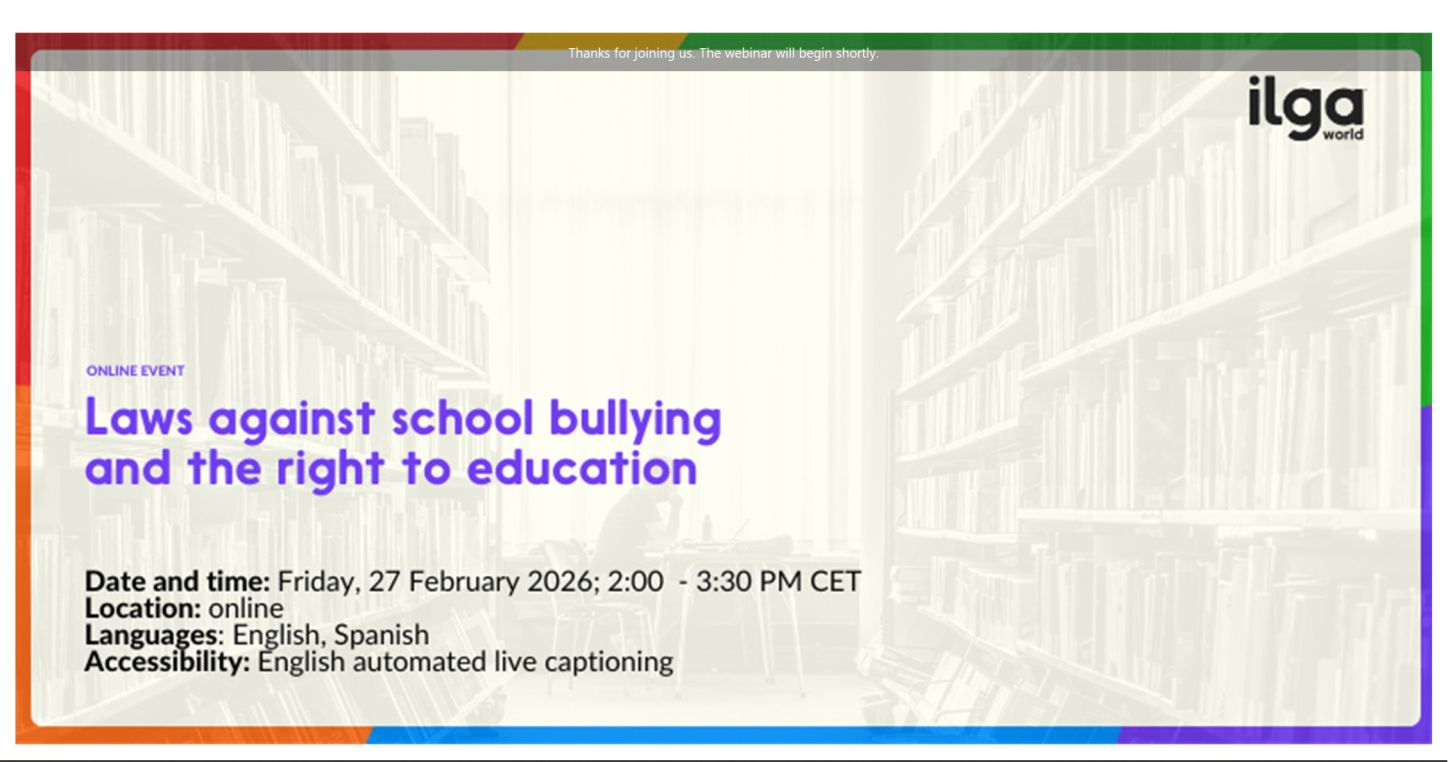
Bullying based on sexual orientation, gender identity, gender expression and sex characteristics (SOGIESC) continues to deny millions of learners and education workers their right to safe, inclusive and quality education and learning. This reality – and the urgent need for collective action – was at the centre of a global webinar organised by the International Lesbian, Gay, Bisexual, Trans, and Intersex Association ( ILGA World) on Laws against school bullying and the right to education.
Bringing together United Nations (UN) experts, legal specialists, youth activists and education trade unionists, the event made one message clear: education unions are indispensable actors in combating SOGIESC-based bullying and turning legal protections into lived realities in school communities.
Bullying, safety, and the right to education
“Education is not only about access or enrolment. It is about whether learners can learn in safety, whether they are treated with dignity and whether they feel that they belong,” said Graeme Reid, United Nations (UN) Independent Expert on sexual orientation and gender identity, reminded participants that the right to education is inseparable from safety and dignity, to open de discussion held on February 27th, 2026.
Highlighting some of the key findings of the report that he presented to the 80th session of the UN General Assembly in November 2025, he warned that discrimination and bullying based on sexual orientation and gender identity remain widespread and systemic. “Research consistently shows that LGBT learners are disproportionately affected by physical violence, sexual harassment, verbal abuse, cyberbullying and social exclusion,” he said.
Reid also stressed the long-term consequences of hostile school environments: “Students who feel unsafe are more likely to miss school, disengage from learning or leave education entirely. Over time, this affects academic achievement, mental health and future opportunities.”
He underlined states’ legal obligations noting that “international law explicitly prohibits discrimination in education and requires states to protect students from bullying, violence and exclusion in school settings.”
The ILGA World Database: Evidence for advocacy
A major part of the webinar was the presentation of ILGA World’s new database section on protections against school bullying.
“This new section tracks laws or legislation that explicitly ban school bullying or harassment in education based on sexual orientation, gender identity, gender expression and sex characteristics,” reported ILGA consultant Curro Peña Díaz.
He explained that the data reveal a profound global gap: “Only a minority of UN Member States have comprehensive legislation at national level explicitly protecting students from SOGIESC based bullying.”
While acknowledging that laws alone are not enough, Peña Díaz was clear about their strategic value: “Legislation is not a silver bullet, but it offers a framework for policies, protocols and accountability. It allows families, students, unions and education authorities to challenge inaction.”
For education unions, the database is a powerful tool to support bargaining, advocacy and policy engagement, grounding demands in solid comparative evidence.
The webinar also explored bullying beyond the classroom.
Education workers also face bullying
Bringing the trade union perspective, Michelle Mosupye, Executive Officer at the National Professional Teachers’ Organisation of South Africa (NAPTOSA), highlighted that SOGIESC-based bullying affects not only learners, but also teachers and education staff.
“We speak a lot about learners, but the teachers too are affected. Their mental health is impacted, they experience anxiety, and some are seeing psychiatrists.”
She described how discrimination particularly affects transgender and gender diverse educators: “Teachers who do not conform to gender norms face discrimination from school management and conservative leadership, especially in rural areas.”
Mosupye emphasised the role of unions in shaping policy and practice: “In South Africa, the National Education Policy Act forces government to consult teacher unions. This gives us a critical role in influencing policies to ensure teachers and learners are not discriminated against.”
She also pointed to union engagement on curriculum reform, as “we played a critical role in integrating comprehensive sexuality education - a subject called life orientation - into the curriculum, from primary to secondary education.”
Mosupye also mentioned that NAPTOSA played a critical role in the establishment of SOGIESC guidelines, having been involved in a consultative process aiming at the reduction of bullying in schools due to gender identity issues, targeting gender diverse learners or teachers or transgender persons.
On the global level, she reminded that several Education International’s Congresses adopted resolutions “that speak to anti-bullying, particularly to the LGBTI+ persons.”
Online spaces, legal protection and new risks
Enrique Gallego Capdevila, Special Counsel at the law firm Cooley, addressed the responsibilities of online platforms and regulators.
He was adamant that “platforms have an obligation and a responsibility to allow young users to interact, seek information and navigate their identity in safe spaces.”
Gallego Capdevila, however, cautioned against over restrictive age verification policies: “For some young people, being online is not a luxury. It is a source of mental support, peer validation and information that they cannot access elsewhere.”
These insights underline the importance of union engagement in debates on digital regulation, child protection and education technology, ensuring that safety measures do not undermine rights.
Youth leadership and school change
From the Philippines, Aaron James Villapando of the youthled organisation PANTAY shared powerful examples of student driven change.
“Youth participation should not be tokenistic. Students are not just beneficiaries – they are co creators of solutions,” he acknowledged
He explained how tools such as the Rainbow Report Card help schools assess inclusivity: “We ask schools whether they have antibullying policies, gender sensitivity training, inclusive mental health services and safe reporting mechanisms.”
Villapando also noted that change is possible when dialogue replaces fear: “When we converse with school administrators, we realise they often come from a place of protection, not hate. They just need guidance.”
States’ duties
Closing the webinar, Farida Shaheed, UN Special Rapporteur on the right to education, delivered a strong call to action.
“SOGIESC-based bullying is a direct breach of human rights obligations. It is not a peripheral issue,” she said.
She warned that silence in law leads to silence in practice: “Where the law is silent, discrimination often remains invisible and unaddressed.”
Shaheed went on stressing that states must act immediately: “The obligation to ensure safe, non discriminatory educational environments is an immediate obligation under the right to education.”
She also highlighted the importance of unions and participation: “Teachers, students, unions and communities must be recognised as agents of change. Their voices must shape laws, policies and implementation.”
A trade union imperative
The ILGA webinar made clear that education unions are at the heart of the struggle against SOGIESC-based bullying. By defending education workers, shaping inclusive curricula, engaging in social dialogue and using tools like the ILGA World Database, unions help transform schools into spaces of safety, dignity and equality.
Education International and its member organisations worldwide are fully committed to this struggle. As a member of ILGA, Education International affirms that addressing SOGIESC‑based bullying is both a fundamental trade union responsibility and an integral part of upholding the right to education for all. ILGA’s regional structures and allied organisations offer Education International’s affiliates important opportunities for collaboration in supporting this work at national and local levels.