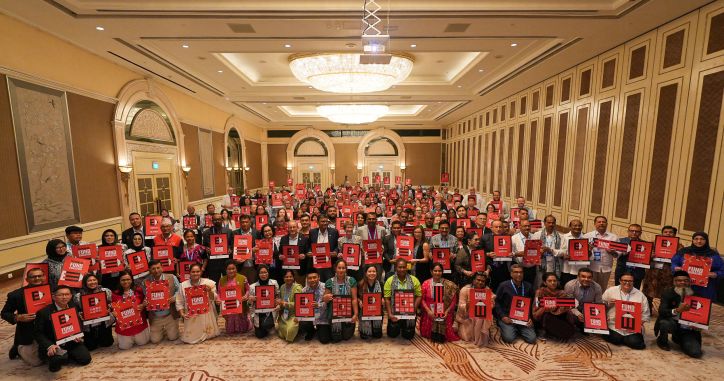
Teachers remain at the heart of education, ISTP concludes
After two days of rich and insightful discussions, the International Summit on the Teaching Profession (ISTP) concluded with a strong recognition of the relational nature of education and with concrete commitments from the participating delegations.
The dialogue between education ministers and education unions centred on the Summit’s three themes: the evolving teaching profession, the autonomy of educators and school leadership, and artificial intelligence and educational technology.
Reflecting on the Summit, Larry Flanagan of the Educational Institute of Scotland, stated: “We are exhorted to be clear about what we value in education and what we want to protect. To me that is evident: Humanity of the classroom; the joy of learning; the smile of children. We nurture our own societal futures in our schools – so let’s be careful”.
Discussions on the evolving teaching profession highlighted that education remains firmly rooted in the critical teacher-student relationship. Participants recognised the global challenge around the recruitment and retention of teachers, with unions noting that the main reasons for this are insufficient salaries and unreasonably high workloads. As governments work to address the global teacher shortage, unions stressed that professional standards must be upheld. “Every child, at all levels, deserves a qualified teacher”, Flanagan insisted.
The importance of building trust was a key takeaway of the discussions on the autonomy of educators and school leaders. While policy coherence is essential to building trust in systems, collaborative autonomy within the system is the foundation of schools that model democracy for societies.
Different approaches to AI in education
While all countries agreed that teachers remain at the heart of quality education, significant differences emerged in how – and to what extent – they plan to integrate artificial intelligence into their classrooms. Governments were more inclined to see the opportunities, whereas teachers and their unions advocated for a more cautious approach and called for more regulation.
Unions argued that while technological change can present opportunities for teachers, it also risks increasing pressure on a profession already under strain. “In Estonian schools we are currently working to ensure the integration of artificial intelligence in teaching is guided and responsible. This requires additional effort from teachers and continuous adjustments to teaching and learning. The Estonian Educational Personnel Union therefore advocates for ensuring that amid all these changes, the well-being and workload of education professionals are also properly taken into account”, pointed out Reemo Voltri, President of the Estonian Educational Personnel Union.
This point was echoed by the Spanish delegation that stressed that the provision of quality training on AI for teachers was crucial but that it had to be integrated into teachers’ regular working hours.
Concerns were also raised about the impact of AI on students’ cognitive development. OECD Director for Education and Skills Andreas Schleicher warned about students ‘cognitive offloading’ when using AI in excess. “Learning is always about cognitive struggle and effort – we need students to do the hard work as well.”
Unions also brought attention to the impact AI can have on students’ social skills. “We have to make sure that some of the more deceptive anthropomorphic AIs are not going to build attachments with children that they should be forming with their teachers, friends, and peers. That will mean some regulations”, said Education International General Secretary David Edwards.
Teachers are irreplaceable
Throughout the discussions, the fundamental fact that teachers are and must remain at the heart of education systems was recognised and enforced.
“One thing is absolutely clear: AI is not going to replace teachers. We see that we need more of them, not fewer,” stressed Kristina Kallas, Estonia's Minister of Education and Research.
The OECD Director for Education and Skills, echoed this idea, noting: “Across all our conversations one idea keeps resurfacing - education is fundamentally a human enterprise, it’s relational, it’s built on trust, it’s built on connection, and it’s not a transactional business we can automate.”
“Tools, time and trust done right, done deliberately, done purposefully, in a respectful way, with the right conditions to support teachers, with the right salaries, the right opportunities for their development - that is the foundation of quality education. That collaborative professionalism is at the heart of quality education. It's about the relationships, the student-teacher relationship, and that's what we have to protect. And that's what this dialogue has to protect above and beyond”, Edwards concluded.
Country commitments announced
Each participating country presented three concrete commitments to improve its education systems in the next year at the summit’s closing session. These commitments will be tracked over the coming year, with Education International and OECD monitoring progress. Country commitments will be made available at the ISTP 2026 website in the coming days. The summit’s final report will be issued later this year.
As the delegations return home with new insights and a clearer vision of the future of education, preparations are beginning for the next International Summit on the Teaching Profession which will be hosted by the United Kingdom in 2027.