Global Education Monitoring Report 2026: Progress in ensuring access to education falls short of Sustainable Development Goal
With the 2030 deadline for achieving Sustainable Development Goal (SDG) 4 only a few years away, the Global Education Monitoring Report has released its 2026 edition focusing on access and equity.
The latest report reviews country progress on expanding participation in education across all levels since the turn of the millennium. It explores the factors that led to different countries progressing at different rates, and what can be learnt for improving access and equity in the future.
“Though the report demonstrates some important progress, it is clear that we still have a long way to go to ensure universal access and equity in education. With more than 273 million children out of school - a figure that has risen for the seventh year in a row - governments must redouble efforts and fully fund free, quality, public education for all”, stated David Edwards, Education International General Secretary.
The report argues that long-term sustainable progress in access and equity at scale requires a systemic approach combining coordination across sectors, sustained political commitment, implementation capacity, and adaptation to local contexts. The report also analyses gaps in country reporting and identifies areas where improvement is needed in terms of monitoring progress.
Access to education: what progress since 2000?
The report’s findings demonstrate that although access for all will not be achieved by 2030, there have been some large strides. Since 2000, enrollment has increased by 30% in primary and secondary education globally, by 45% in early childhood education, and by 161% in postsecondary education. In the same time period, the completion rate has increased from 77% to 88% in primary education, from 60% to 78% in lower secondary education, and from 37% to 61% in upper secondary education.
Nonetheless, progress is more limited if measured since 2015. Furthermore, the out-of-school population has been rising for seven consecutive years. In 2024, 273 million, or approximately 1 in 6 children, adolescents, and youth are excluded from education. This is likely to be a gross underestimate, given the difficulties in collecting data in conflict-affected countries.
Key data across levels of education include:
Pre-primary education: The participation rate in early childhood education one year before primary entry was 75% in 2024. The report rightly identifies the importance of abolishing fees as a means to enhance participation. In 2023, 69 out of 119 countries with data guaranteed at least one year of free pre-primary education. However, many governments rely heavily on non-state provision: only 10 countries with data spend over 1% on pre-primary education.
Primary and secondary education: Since 2000, sub-Saharan Africa has more than doubled enrollment and more than tripled secondary enrollment. Globally, between 1998 and 2023, the average duration of compulsory education increased by 1.2 years and the average duration of free education increased by 0.8 years.
Post-secondary education: In the past 25 years, there has been a growing gap between access and graduation. The tertiary education gross enrolment ratio more than doubled from 19% in 2000 to 44% in 2024, a one percentage point increase per year, while the graduation ratio increased at less than half that rate over the same period, rising from 17% to 27%. Demand for higher education is constrained by affordability: only one third of countries have free public universities and the extent and nature of student subsidies vary greatly.
Growing shortage of qualified teachers
The report highlights major concerns in relation to meeting every child’s right to a qualified teacher. Only 11% of low-income countries require a bachelor’s degree for primary teachers, and only 78% of primary teachers are academically qualified (down from 89% in 2013). Urgent action is needed from governments to tackle this shortage of qualified teachers.
Declining education budgets
Regarding education finance, only 22% of countries with data met the international benchmarks of spending at least 4% of GDP and 15% of public expenditure on education in 2023. Over half of countries with data had actually decreased the share of funding spent on the sector since the start of the SDG 4 agenda in 2015.
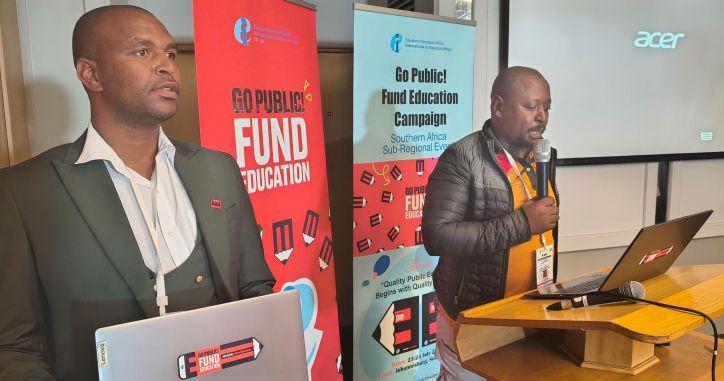
Go Public! Fund Education
The report confirms education union warnings about the impact of education underfunding and the global teacher shortage on the universal right to quality education.
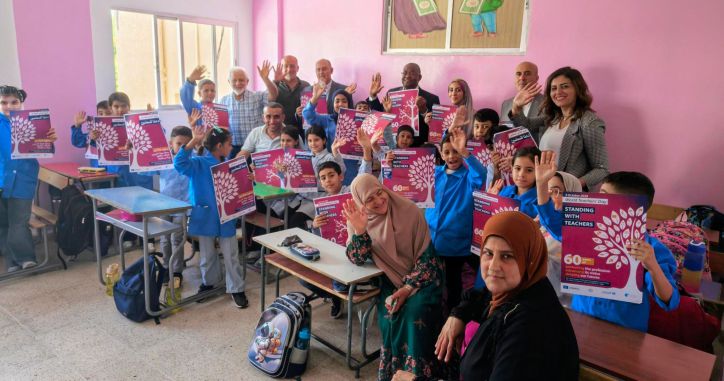
Education International’s global campaign Go Public! Fund Education is an urgent call for governments to invest in public education, a fundamental human right and public good, and to invest more in teachers, the single most important factor in achieving quality education. The campaign is active in more than 50 countries and is expected to be present in 90 countries by the end of the year.
Click here to find out more about the campaign and get involved.