Research, solidarity, and union action: ResNet charts a path to strengthen the status of the teaching profession
Teacher pay, child labour, climate action in education, and the rapid expansion of artificial intelligence were among the key issues discussed as members of Education International’s Research Network (ResNet) met to examine the challenges facing educators worldwide and identify strategies for strengthening the status of the teaching profession.
Bringing together researchers and union leaders from across the globe, the 19th meeting of ResNet reaffirmed the critical role of evidence-based research in supporting educators’ rights, influencing public policy, and strengthening union advocacy for quality public education.
Research in the service of educators and their unions
Opening the meeting, Education International (EI) Deputy General Secretary Cassandra Hallett stressed that independent, rigorous research is essential to advancing policies that improve the working and learning conditions of educators and students alike.
“As a global community of education researchers, we come together to share what we know and to learn from each other about effective research on behalf of members that influences public opinion and government policy,” she said.
Hallett also underscored the importance of research at a time when evidence and expertise are increasingly challenged in public debate.
She noted that ResNet provides a vital global forum where researchers and education unions can exchange knowledge, strengthen collective advocacy, and ensure that research remains rooted in the lived realities of educators and education support personnel.
The meeting was moderated by Stacey Pelika, Director of Research at the National Education Association (NEA) in the United States and Chair of the EI Research Institute.
“Those of us who are doing research are doing it not out of ideology, but out of wanting to understand what is happening and inform where we go,” Pelika said.
Highlighting the link between research and advocacy, she added: “We need the data so we can continue to argue about the policy.”
Global research reveals a profession under pressure
A central focus of the meeting was the latest findings from EI’s Global Status of Teachers research, presented by Professors Greg Thompson and Ben Arnold.
The research paints a concerning picture: while teachers are widely recognised as playing a fundamental role in society, that recognition is not reflected in public policy, funding decisions, or working conditions.
“There was a sense that teachers have a key role to play in society, but the actual status accorded to the profession wasn't reflected in that sense of importance,” Arnold explained.
Across many countries, education continues to be treated as an area for budget cuts rather than a public good worthy of sustained investment. Participants noted that austerity policies, chronic underfunding, inadequate salaries, staff shortages, and excessive workloads continue to erode the attractiveness of the profession and contribute to the global teacher shortage.
The findings reinforced a message that education unions have highlighted for years: teaching is highly skilled professional work, requiring deep expertise, intellectual labour, emotional commitment, and strong relationships with students and communities. Yet too often educators are denied the professional respect, trust, autonomy, and resources they need.
AI and technology must support—not replace—educators
Participants also examined the growing influence of technology and artificial intelligence in education.
While digital tools can support teaching and learning, concerns were raised that governments and private actors are increasingly presenting AI as a substitute for professional educational work rather than a tool to assist educators.
The discussion highlighted how promises of efficiency can mask cost-cutting agendas that devalue professional expertise. In practice, educators frequently find themselves correcting errors, adapting AI-generated content, and managing new responsibilities created by technological systems.
Participants warned that technology must not be used to deepen the de-professionalisation of teaching. Instead, educators and their unions must have a decisive role in shaping how AI is developed, regulated, and used in schools.
As Thompson emphasised, unions must continue to pursue advocacy strategies that address educational change from multiple angles.
“It is about trying to make decisions that are strategic around what is the advocacy work that we need to do around the broad sweep of educational change, knowing that some of it has to be industrial, some of it has to be social, some of it is always local and contextual,” he said.
Arnold added that discussions about workload alone risk overlooking the broader nature of educators’ work.
“Professional work is really the key question. When the question gets bogged down in workload, we ignore that there is a huge emotional nature to the work. There is a real cognitive and intellectual element of the work. What is human? What is professional work? What do we advocate for?”
EI research advancing social justice and public education
The meeting also highlighted the breadth of Education International’s research agenda and its contribution to union action around the world.
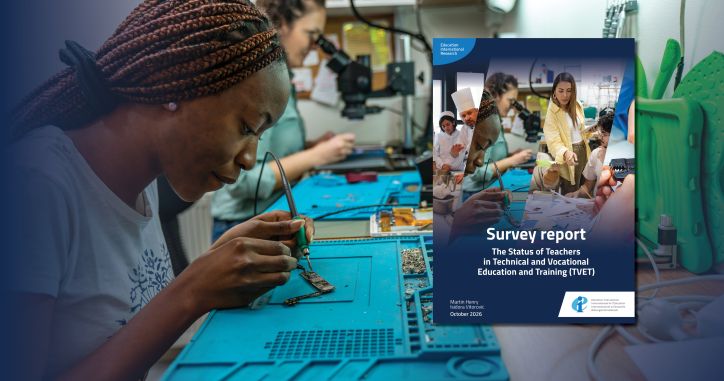
Martin Henry, Research, Policy, and Advocacy Coordinator at Education International, took the opportunity to highlight EI-led research on diverse issues. Some of these research topics are technical and vocational education and training (TVET) , teacher pay and remuneration, child labour, greening education, LGBTI, and regional European and African research. Additionally, Teacher-led Learning Circles for Formative Assessment (T3LFA) leadership, Artificial Intelligence (AI) and collective bargaining, AI and education technology, the ISTP briefing, the autonomy of educators and school leadership, and gender, especially in regards to Arab education unions and restrictive backlash, were other important, highlighted works.
Participants also explored EI’s work on teacher-led professional development, collective bargaining in the context of AI, and the growing influence of education technology on education systems.
Together, these projects demonstrate how research can strengthen unions’ capacity to defend public education, advance equity and inclusion, and ensure that educators' voices are central to policy discussions.
Building union power through evidence and collective action
A strong conclusion emerged from the discussions: improving the status of the teaching profession requires strengthening educators’ collective voice and ensuring that unions are fully engaged in decision-making at every level.
Participants agreed that research is most powerful when it supports organising, collective bargaining, and advocacy. By documenting educators’ experiences and exposing the realities of underfunding, excessive workloads, low pay, discrimination, and privatisation, research helps unions build the evidence needed to win change.
The 19th ResNet meeting demonstrated that research is not an academic exercise detached from the workplace. It is a tool for building union power, advancing professional rights, and defending quality, inclusive public education.
By bringing together researchers and trade unionists from around the world, ResNet continues to strengthen the collective capacity of education unions to shape the future of education—one grounded in evidence, solidarity, professional respect, and the voices of educators themselves.