Privatisation threatens young children’s rights: Unions and partners call for urgent public investment in early childhood education
Early childhood education (ECE) is increasingly recognised as a cornerstone of the right to education. Yet across the world, a widening gap between public commitments and public investment is allowing privatisation to prosper — often at the expense of children, families, and education workers.
On July 1st, 2026, the webinar entitled “The privatisation of Early Childhood Care and Education: What is at stake?” gathered a global coalition of unions, civil society organisations, and education advocates for the launch of new publications. One is on Privatisation of Early Childhood Care and Education: Trends, Challenges and Human Rights Implications, and the other one tackles Privatisation of Early Childhood Care and Education: Trends and Policy Implications in Argentina.
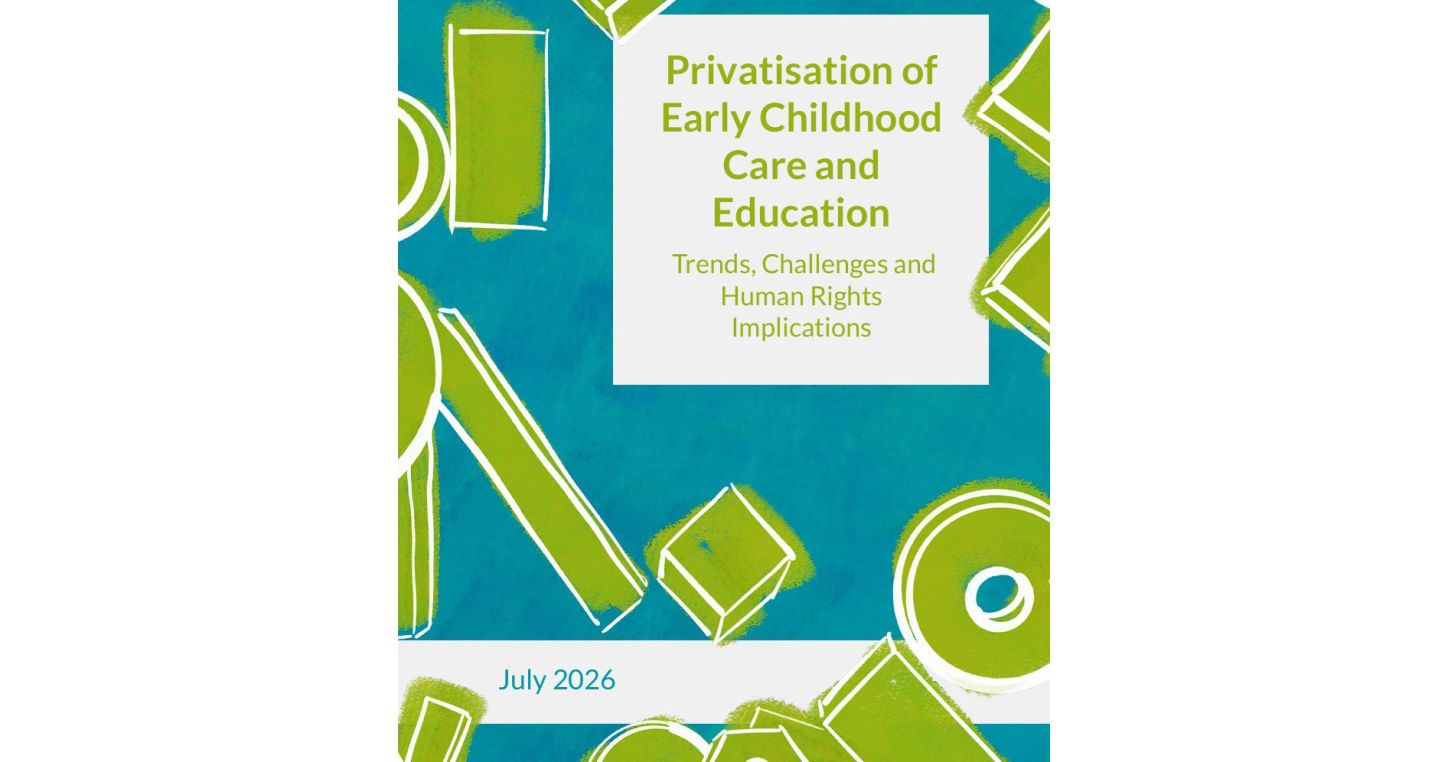
The reports examine the growing privatisation of ECE and the policies needed to strengthen free, quality public early childhood education for all. They highlight how market forces are deepening inequality — and why governments must act now. Their message is clear: without strong public systems, ECE risks becoming a commodity rather than a universal right.
These publications were released and co-commissioned by the Latin American Campaign for the Right to Education, Education International, the Global Campaign for Education, the Initiative for Social and Economic Rights, the Right to Education Initiative, the World Organization for Early Childhood Education (OMEP, Francophone acronym) and the Public Education and Human Rights Coalition. Education International contributed through data, editing and reviews.
A global trend driven by underinvestment
In her introduction remarks, Mercedes Mayol Lassalle, OMEP past president and professor of public policies for ECE at the University of Buenos Aires, emphasised: “What is at stake is the right of every young child to a fair start in life. Private provision does not diminish public responsibility. On the contrary, it calls for stronger state governance, stronger regulations, and renewed public commitment to children's rights.”
She also focused the debate on rights: “The real question is: How can we ensure that every child enjoys the right to quality ECE regardless of who provides the service?”
Private provision in ECE is not an inevitable development, but rather the direct consequence of political choices; And the research underscores how privatisation entrenches inequality from the earliest years of life.
For Rajakumari Michaelsamy, Programme Manager for Early Childhood Care and Education at the Right to Education Initiative and author of Privatisation of Early Childhood Care and Education: Trends, Challenges and Human Rights Implications, “privatisation in ECE is a growing global trend today. Private actors dominate both segments of ECE for children under three as well as the pre-primary education.”
She added that weak legal frameworks, low public spending, and the persistent framing of childcare as a private responsibility are key drivers of privatisation. ECE, she noted, receives only a small share of already limited education budgets, leaving the door open for private providers to expand.
The consequences are far-reaching: “Reduced access, rising costs, and growing inequalities, particularly for children from marginalised communities,” Michaelsamy stated.
Drawing on her findings from the Argentinian case study, Privatisation of Early Childhood Care and Education: Trends and Policy Implications in Argentina, Carolina Semmoloni, former OMEP Youth Representative to UNESCO, and the Co-Director of the Early Childhood Education and Care research initiative at the San Andrés Center for Applied Educational Research, noted how limited public provision brings families into the private market: “Access to early childhood care and education is often determined by family socioeconomic status,” and leads to “reinforced existing social and economic inequalities.”
Insufficient infrastructure, and weak regulatory frameworks create conditions where private providers expand “by default and omission”, Semmoloni explained. For the youngest children in particular, access to quality education often depends on what families can afford.
A systemic failure affecting education workers
At the same time, privatisation is reshaping the world of work in early childhood education.
As Education International ‘s Deputy General Secretary, Cassandra Hallett stressed, “when governments fail to guarantee the right to early childhood education through strong public systems, adequate public financing, and robust legal protections, privatisation expands to fill that gap. Nowhere is this more evident than in early childhood education.”
And the impact on educators is undeniable. “The expansion of private provision often goes hand in hand with problematic working conditions, including lower wages, precarious employment, limited professional development opportunities, inadequate qualifications, weak labour protections, and restricted access to collective bargaining.”
She went on saying that quality education depends on decent work. “There can be no quality ECE without qualified, supported and respected teachers and education support personnel. There can be no quality ECE without decent work.”
With women making up the vast majority of the ECE workforce, these trends also reinforce gender inequality — both in paid employment and unpaid care.
Hallett continued: “The report also highlights the gendered dimensions of ECE privatization. Women make up over 90% of the ECE workforce. When services are privatised and under-regulated, it is often women workers who face low pay, precarious employment, and inadequate professional recognition. At the same time, when affordable, publicly funded early childhood education is unavailable, it is women who shoulder a disproportionate share of unpaid care responsibilities, often limiting their opportunities for paid employment, education, and participation in public life. Advancing gender equality therefore requires both reducing the burden of unpaid care work and ensuring that paid care and education work is properly valued, recognized, and supported.”
She concluded:
“Early childhood education must be recognized as a universal human right. It must be publicly funded, publicly governed, and available to all without discrimination. It must also be delivered by qualified and respected professionals enjoying decent working conditions and strong labour rights. It must remain a public good, not a commodity, and the reports help point us in that direction.”
A call to reclaim ECE as a public good and fight inequalities
According to Anna Cristina D’Addio, Chief of Education Policy, GEM Report at UNESCO, the evidence shows clear trend across regions: “ECE is the most privatised level of education almost everywhere, and the youngest children are the most privatised within ECE.”
She also stressed how weak governance and underinvestment create “a regulatory and financing vacuum” in which private providers flourish, often without adequate oversight. In many systems, fragmented responsibilities between ministries further undermine accountability and coherence.
She warned that this dynamic risks replacing public resources, rather than complementing them. When states fail to act, private actors step in.
The stark consequences of these types of policies can already be seen in places like Uganda. Angella Kasule Nabwowe, Executive Director of the Initiative for Social and Economic Rights, described a system where families bear the burden: “Privatisation is often not a policy choice, but a consequence of insufficient public investment in ECE. Access continues to depend largely on a family's ability to pay.”
With the majority of children excluded from formal early education, and private providers largely unregulated, inequalities are deepening. Public provision remains minimal, particularly in rural areas, she noted.
While reversing privatisation may not be possible in the short term, strong regulation is non-negotiable. Colette Byrne, Researcher at the Early Childhood Research Centre linked to the Dublin City University, insisted that states cannot outsource responsibility: “Even if services are outsourced, responsibility cannot be outsourced; the state remains the primary duty bearer.”
She called for robust accountability frameworks that go beyond financial indicators, asking instead who is excluded, whether quality is equitable, and whether labour conditions support children’s learning and wellbeing. Transparency must be enforced to ensure that public funds serve the public good.
Go Public! Fund ECE
The publications and the webinar conclusions are in line with Education International’s Go Public! Fund Education campaign launched in 2023. This campaign is an urgent call for governments to invest in public education, a fundamental human right and public good, and to invest more in teachers, the single most important factor in achieving quality education.
This is also supported by the UN Recommendations on the Teaching Profession. These recommendations provide policy advice for governments to ensure that every child’s right to a professionally trained, qualified, and well-supported teacher is fulfilled.
Some of them target specifically teachers in the ECE sector. This is the case for example of the Recommendation 36, calling for commensurate fairness between the salaries of teachers at different levels of education and for gender pay equity: “Teachers should receive salaries and benefits at the same level as compared to other professions with similar educational requirements. Gender pay equity should be ensured, and there should be commensurate fairness between salaries at different levels of education, including early childhood education and technical and vocational education and training.”
Learn more about EI's work on ECE here.