Feminist leadership in education
Sign up
Sign up for the Worlds of Education newsletter.
Sign up
Sign up for the Worlds of Education newsletter.
Thank you for subscribing
Something went wrong
Although globally there is total consensus on the value of education and gender parity has been reached in school enrollment, deeply entrenched patriarchal structures continue to deny girls and women the actual economic, social, and political benefits of their education. Moreover, women tend to dominate the ranks of teachers while the leadership of education unions tends to perpetuate patriarchal leadership, ways of thinking and behaving. The UN is currently shifting away from “gender parity” toward “gender transformative education” – which means using classrooms to actively deconstruct harmful masculinities, re-writing curricula to eliminate bias, implementing gender responsive budgeting, and ensuring women occupy top-tier leadership positions within global education institutions. How can feminist leadership help?
To answer that question, we must first understand what feminist leadership is. How does patriarchy manifest in unions? How can feminist leadership help in dismantling these patriarchal structures, cultures, ways of thinking and behaving? What are useful ways of understanding what needs to be changed and what are some useful strategies?
What is feminist leadership?
Feminist leadership is “women and men with a feminist vision of social justice, individually and collectively transforming themselves, their organizations, their movements and societal norms to pay close attention to gender power structures and discriminatory practices – both formal and informal – in order to advance gender equality within their organizations and social movements as well as in the communities and constituencies they serve (Batliwala, 2010). Feminism advances the idea that no one should be judged, valued or discriminated on the basis of their biological sex or gender identity. It identifies patriarchy as a system of male power and privilege that leads to women’s subordination in public and private domains. And feminist analysis and tools help us tackle not only the obvious layers of inequality but also the deepest layers at which gender-based and intersectional discrimination and violence operate. At the heart of feminist leadership is shifting power dynamics toward equity and equality.
Gender equality related challenges within education unions
There are many challenges and complexities in addressing gender equality and exercising feminist leadership in unions: (i) unions tend to be hierarchically structured and predominantly led by men even though the majority of teachers are women; (ii) gender equality laws & policies have not realized their promise because of institutionalized gender inequality; (iii) gender discrimination persists in obvious and hidden ways despite new technologies, policies, programs, and economic growth; and (iv) challenges such as women’s double burden, sexual harassment and violence, unequal gender power dynamics and the devaluing of care work, hinder our problem-solving efforts.
Therefore, to have a significant impact on gender inequality, we must change the rules of the game. These rules are both formal and informal and are meant for achieving social or economic ends; they define relationships and they establish power hierarchies. These rules determine who gets what, what counts, who does what and who decides. These are the rules that maintain women’s unequal position in society as well as the position of other marginalized groups. They include values that perpetuate the gendered division of labor, devalue women’s lives, restrict women’s access to land and other key economic resources, restrict women’s mobility, restrict women’s control over their own bodies perhaps most fundamentally, devalue reproductive work. These rules play out in formal organizations like unions and also in markets and the state as well as in informal systems like kinship systems and marriage and inheritance rules. They are often so ubiquitous that we consider them “normal”.
The Gender at Work framework
We can use the Gender at Work Framework (Rao and Kelleher, 2002) to highlight deep structures of inequality and discriminatory social norms in organizations and communities. It can be used to look at what changes we want to see in societies and in organizations, to map challenges and opportunities, as well as change strategies and outcomes.
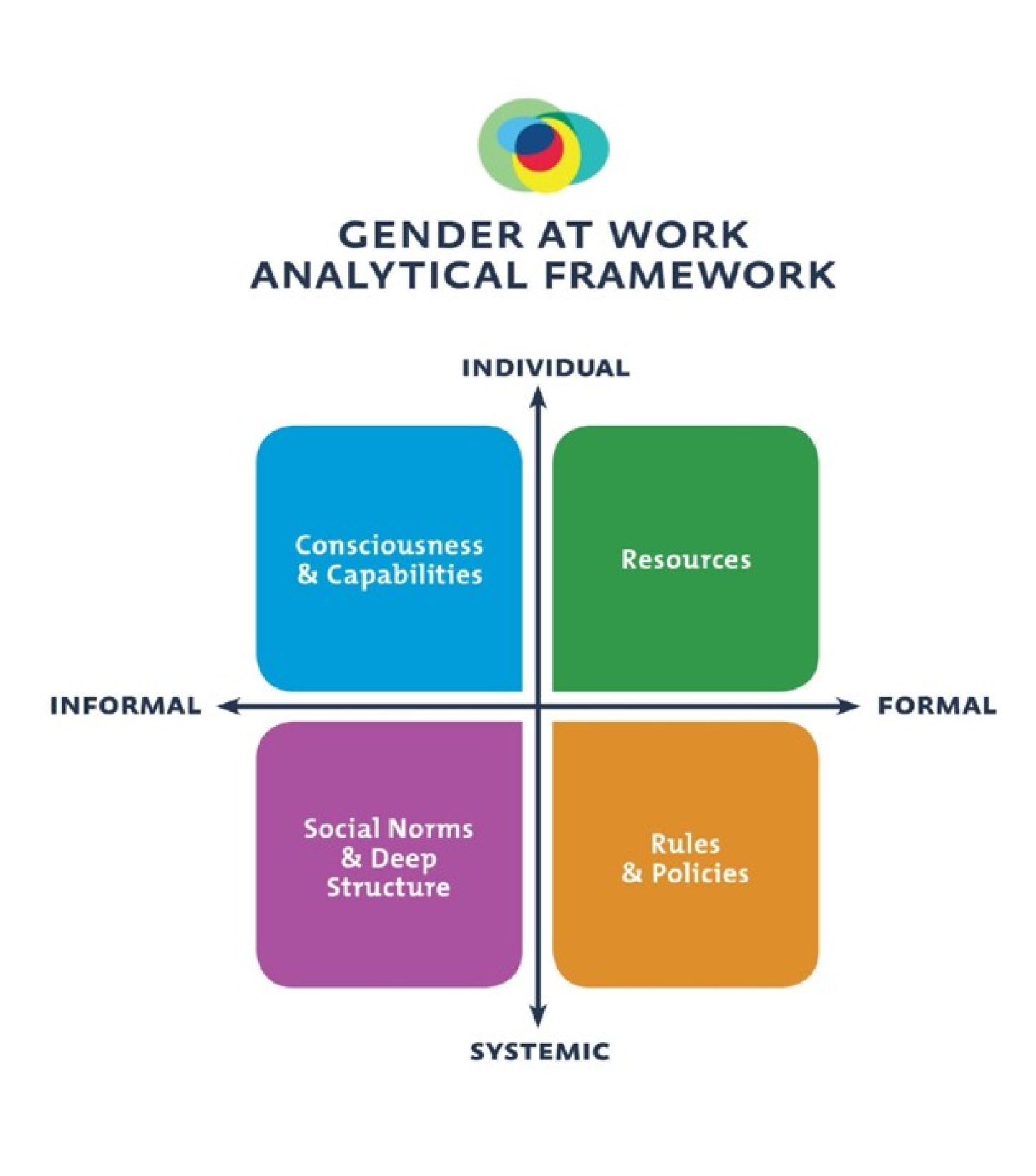
The Gender at Work Framework views organizational change as being multifaceted and holistic; change in one quadrant may affect change in another though not in predictable ways and for change to be sustained, positive change must happen all four quadrants especially in social norms and deep structures.
The top two quadrants are individual:
- Top right: Resources, such as voice, budgets, access to health and education, etc.
- Top left: Individual consciousness and capability – knowledge, skills, political consciousness, and commitment to change toward equality.
The bottom quadrants are systemic:
- Bottom right: Formal rules as laid down in constitutions, laws, and policies.
- Bottom left: Social norms and deep structures – including those that maintain inequality in everyday practices.
How can we apply the Gender at Work framework to education unions?
If we imagine that the problem is that union structures and dynamics were built by men and remain dominated by them, with masculinized power relations acting as the central obstacle to expanding women's participation, then, our objective could be to train and mentor future leaders and chip away at the gender discriminatory culture of unions. Below we map opportunities and challenges of this problem onto the Gender at Work Framework.
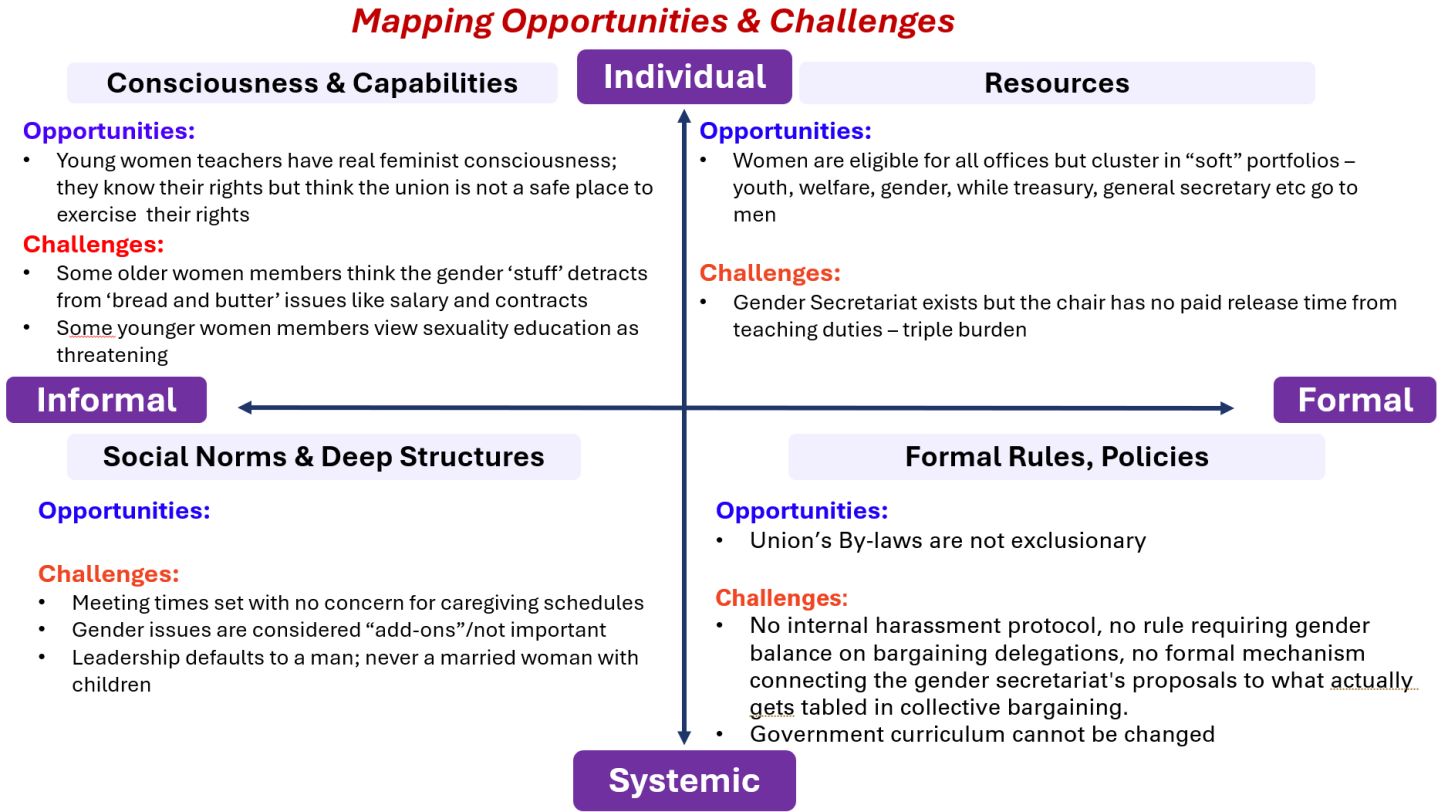
Below, we map the possible change objectives onto the Gender at Work Framework.
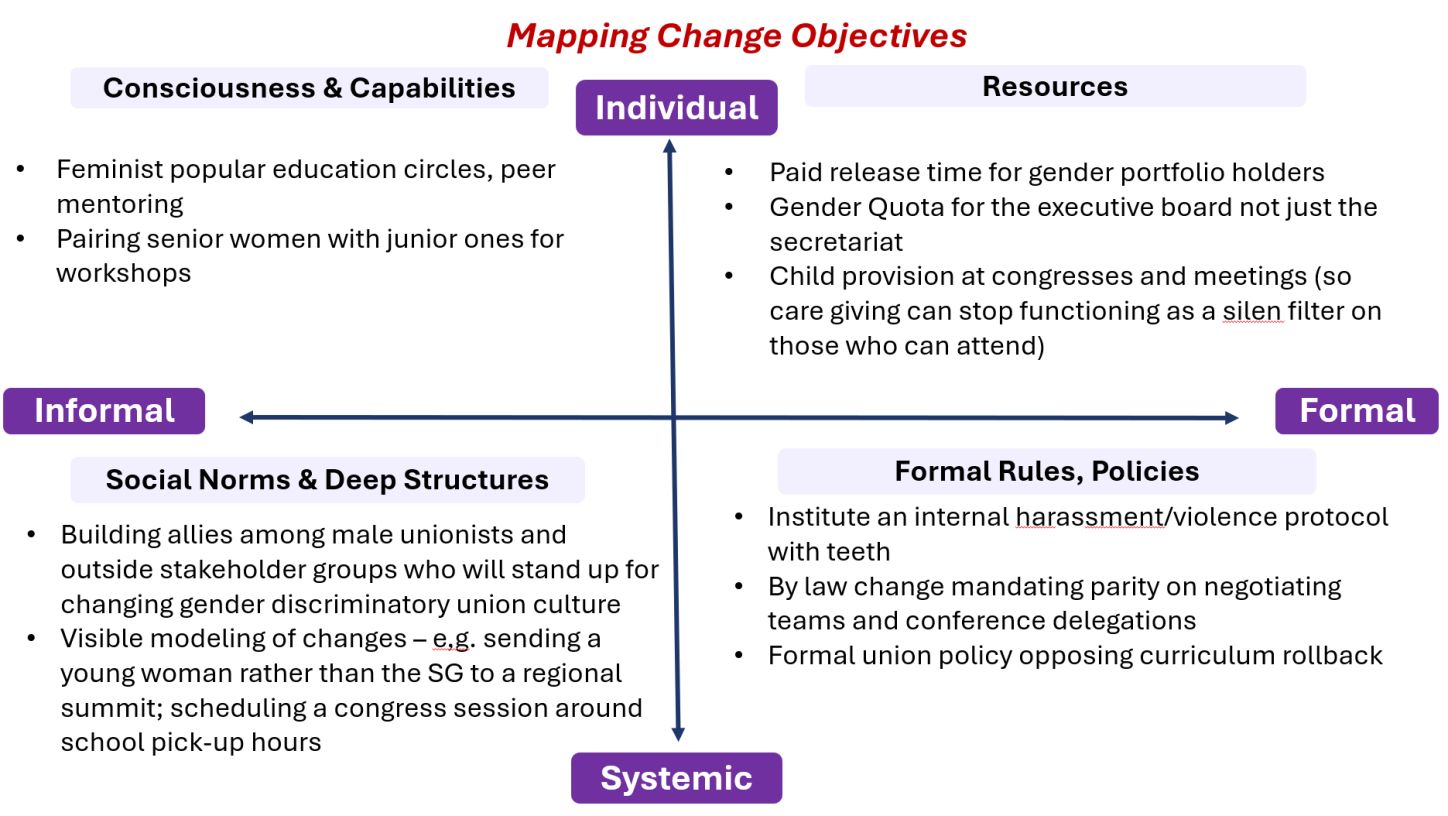
Finally, we map feminist change strategies that could help in addressing our change objectives.
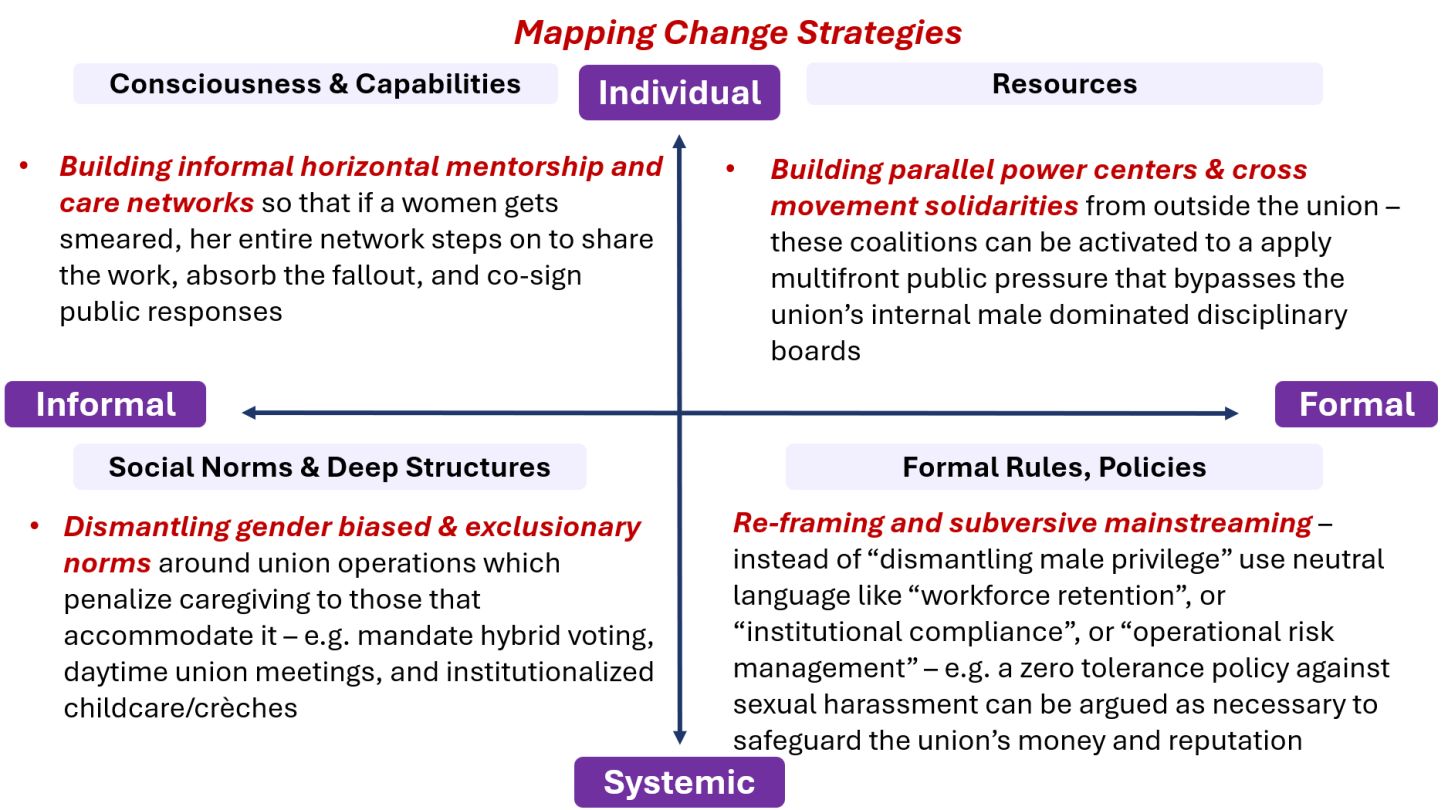
Every union and country context will differ from another so what is possible in one place might not be possible in another. Using the Gender at Work framework to map challenges and opportunities helps us to look clearly at what kind of change is needed and possible in a particular union context. That can help to clearly articulate our objective for change and explore feminist strategies for addressing that change. Most important in any change project is trying to chip away at the deep structures and discriminatory norms that find their way into policies and practices, and specifically how power operates in the union to discriminate and undermine women and other minority voices, participation and rights.
There are many dimensions of power and feminist strategies primarily work to build power with - collective power and solidarity, and power within through education, consciousness raising and mentoring.
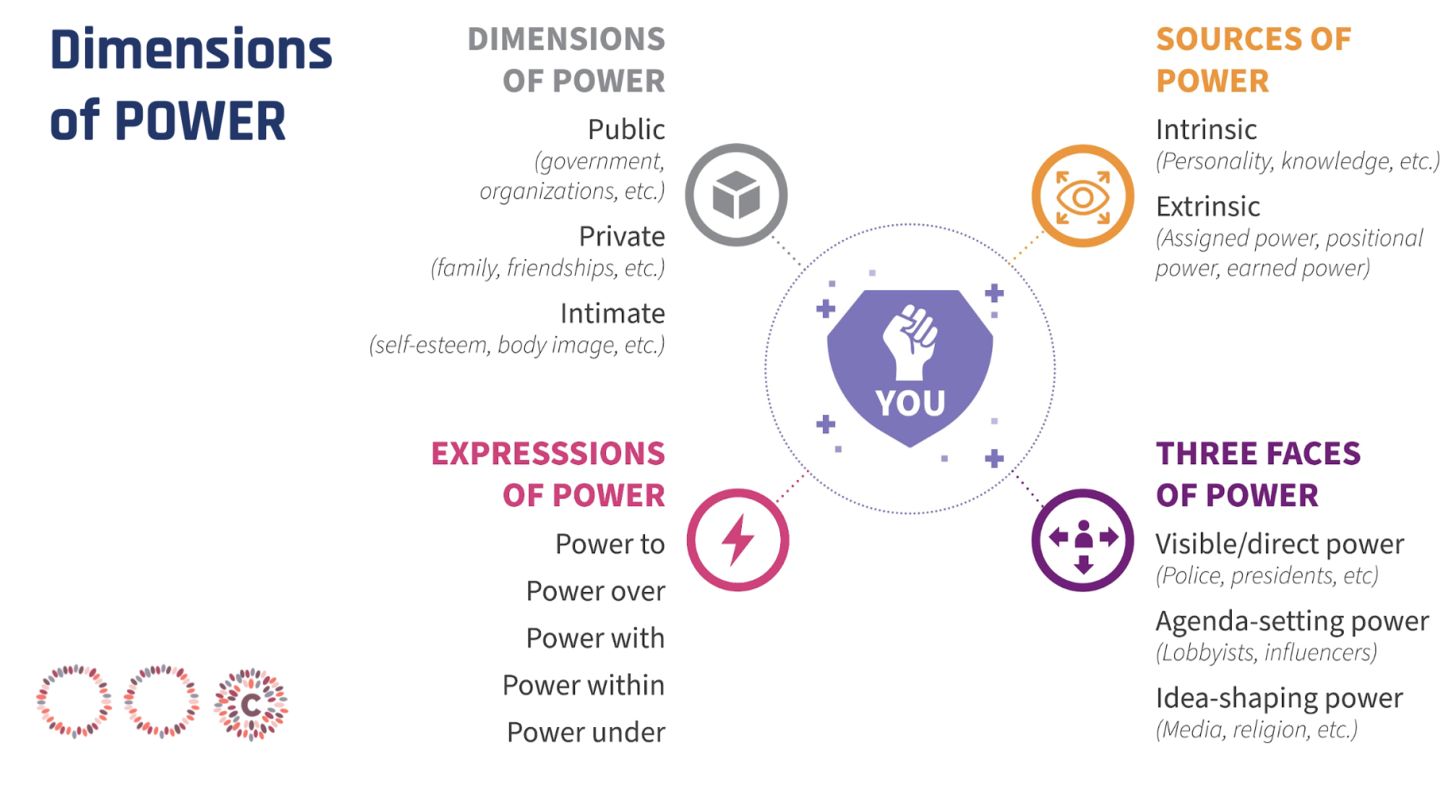
As you reflect on your own power and the collective power of women in your union, what kinds of power do you need to build? How can you build alliances within and across unions to bring about the changes you want to see? What strategies will work in your context? How can feminist leadership shift deeply entrenched rules about who gets what, what counts, who does what and who decides?
This article is based on the keynote address delivered by Dr Aruna Rao to the 5th Education International World Women’s Conference which took place in Bahia, Brazil in September 2026.
The opinions expressed in this blog are those of the author and do not necessarily reflect any official policies or positions of Education International.