Mother-tongue education, democratic pluralism, and social peace
Sign up
Sign up for the Worlds of Education newsletter.
Sign up
Sign up for the Worlds of Education newsletter.
Thank you for subscribing
Something went wrong
Throughout human history, education has not merely been a process of transmitting knowledge but also a tool for shaping society. Every ruling power has sought to realize its vision of society by constructing its own educational model. Conversely, movements for freedom have developed alternative pedagogies of their own. From the Socratic method grounded in critical inquiry in Ancient Greece, to the Enlightenment ideal of “public education for all”; from John Dewey’s experience-based democratic education to Paulo Freire’s emancipatory pedagogy, education has always been a political field. This is because education shapes not only an individual’s knowledge, but also their identity, sense of belonging, and relationship with the world.
For this reason, educational policies are directly linked to political choices that determine which knowledge will be taught, which identities will be made visible, and which will be excluded. Education can cultivate democratic and critical citizens, yet it can also produce conformist, obedient, and unquestioning individuals. Likewise, it can build a social culture that recognizes differences, or it can create the conditions for exclusion and conflict.
Peace in Turkey: from monolithic modernization toward pluralism
Social peace begins with mutual recognition. However, such recognition is not limited to acknowledging the existence of individuals or peoples, it also requires the equal recognition of their language, culture, historical memory, and collective rights. Where recognition is incomplete, equality cannot exist, and where equality is absent, lasting peace is impossible. In this context, the right to education in one’s mother tongue is not merely a pedagogical arrangement, but also a political, cultural, and ethical right.
The issue of mother-tongue education is directly connected to the homogenization policies frequently encountered in the construction processes of modern nation-states. As in many countries, the nation-building process in Turkey has treated cultural and linguistic diversity not as a pluralistic richness, but as an area to be standardized around a central identity. Although this differs from classical forms of colonialism, it points to a form of power that can be described as internal colonialism: the establishment of epistemic and cultural domination by a central identity over peripheral cultures.
In Turkey, Kurds, Armenians, Assyrians, Circassians, Laz, Arab people, and other communities face serious restrictions in using their mother tongues as languages of instruction. These restrictions are not merely technical or administrative choices, they reflect a power relationship constructed through language. The monolingual structure of the education system reproduces a public sphere defined by a single language and identity, rendering other languages invisible and marginal. This invisibilization is one of the clearest manifestations of mechanisms of cultural hegemony.
The absence of constitutional guarantees for mother-tongue education demonstrates that the education system still retains a monolithic and homogenizing character. The monolithic educational model defines citizenship not through cultural diversity, but through a specific linguistic and identity norm. Thus, although the principle of equal citizenship formally persists, in practice it is confined within an assimilationist framework. In a democratic society, however, education should be restructured as a pluralistic, egalitarian, scientific, and multilingual public right that respects freedom of belief. Such restructuring is not merely a pedagogical reform, but also a matter of historical justice and democratization.
Numerous studies in linguistics, psychology, anthropology, and educational sciences demonstrate that monolingual education deepens linguistic, cognitive, and psychological inequalities among children. It not only places children at an academic disadvantage but also damages their relationship with their cultural identities. This leads to a loss of self-confidence at the individual level and to exclusion and alienation at the societal level. In this way, the education system becomes a mechanism that reproduces inequalities rather than eliminating them.
Epistemic hierarchies, frequently found in colonial modes of thought, position certain languages as “central” and “universal,” while relegating others to “local” and “secondary” status. The monolingual educational model that excludes the mother tongue operates with a similar logic: the official language is coded as the carrier of progress and public life, while other languages are confined to the private sphere. This approach excludes cultural plurality from the public sphere and reinforces a vision of a homogeneous society.
Research, however, shows that children learn more rapidly in their mother tongue, that their conceptual development progresses more healthily, and that their cultural identities are strengthened. Mother-tongue education not only increases academic achievement but also enables children to feel equal and valued in the public sphere.
Lasting social peace is possible not where differences are suppressed, but where they are recognized and institutionally guaranteed. When the education system ceases to function as an instrument of homogenization and standardization and instead becomes a vehicle for pluralism, the principle of equal citizenship will acquire its genuine meaning. Recognizing the right to mother-tongue education is not merely the fulfillment of a cultural demand, it is one of the fundamental steps toward a pluralistic future in which a democratic society frees itself from colonial residues.
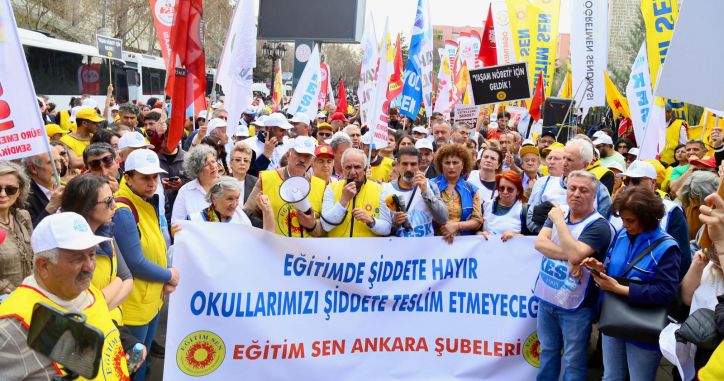
As Eğitim Sen, we continue our struggle to realize the right to mother-tongue education, one of our fundamental principles. A we celebrate International Mother Language Day on 21 February, we salute all peoples and call for the removal of all legal and de facto barriers that hinder the free existence and development of different mother tongues and cultures, for constitutional guarantees of mother-tongue education, for greater local participation in education, and for the provision of public and egalitarian education for all.
The opinions expressed in this blog are those of the author and do not necessarily reflect any official policies or positions of Education International.