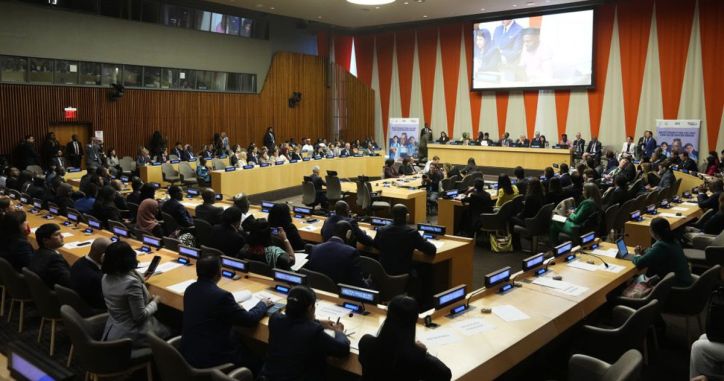
For strong public education systems: unions learning from each other, sharing experiences, and building collective action
At a time when education systems across Africa are confronted with major structural challenges – chronic underfunding, teacher shortages, unequal access, growing competition from the private sector – education unions have a vital role to play. A training session organised in Accra, Ghana, brought together several unions from the region and provided an opportunity for genuine dialogue between unions with extensive experience in advocacy campaigns and those taking part in study circles.
The training event, Study Circles to Go Public! Fund Education: United for Quality Public Education, jointly organised by Education International (EI) and the CSQ (Centrale des Syndicats du Québec), was specifically designed to bring together two key aspects of trade union action: EI’s global Go Public! Fund Education campaign and study circles, a form of collective organisation in the workplace with a proven track record across all continents.
Held from 24 to 26 February 2026, the event brought together eighteen trade union representatives from nine African countries (Benin, Burkina Faso, Burundi, Cameroon, Chad, DR Congo, Niger, Senegal and Togo). It was led by the participants themselves, who shared their experiences and ran several workshops on both the campaign and study circles.
Study circles: a tried-and-tested trade union tool
In his welcome address, Dennis Sinyolo, Director of Education International’s African Regional Office, highlighted the role of study circles in the trade union struggle in Africa. Having risen from this movement, in Zimbabwe, during the 1980s and 1990s, he emphasised their value to trade union development.
“Study circles are a powerful tool for recruiting new members and strengthening trade unions through capacity building and collective organising,” he said, adding that he had also been a study circle facilitator at his own school.
For Sinyolo, the stakes are clear: faced with education policies that are often ambitious on paper but poorly implemented, trade unions need to organise to press governments to honour their commitments.
Anchoring the campaign within schools
The participants underlined that study circles help strengthen trade unions in the education sector, develop a common language, and make schools a hub for union mobilisation.
The CSQ’s Secretary-Treasurer, Luc Beauregard, reaffirmed his organisation’s commitment to strengthening trade union cooperation across the French-speaking world. He emphasised the importance of solidarity among French-speaking trade unions and highlighted the value of study circles as a practical tool for trade union capacity building.
The CSQ provides funding for study circles in Benin, Niger, the Democratic Republic of Congo, and Chad. It is currently considering extending these projects to the other countries taking part in the training programme: Burkina Faso, Burundi, Cameroon, Togo, and Senegal.
Organised in the workplace, the study circles are built around regular, structured meetings, facilitated by trained members, with an agenda drawn up together with the participants. Spread over a one-year period, they include union training on matters such as career and employment status issues, trade union rights, gender, climate change, or education funding.
They build the capacities of the union’s rank-and-file through a participatory approach in which members discuss trade union and education related issues with a view to finding collective solutions.
The study circle method is not a project as such, but should be part and parcel of the way the union operates.
Chronic underfunding of education
Despite international recognition of education as a fundamental human right and a public good, millions of children are still excluded from education. According to the figures cited during the training session, over 272 million children and young people of primary and secondary school age are out of school worldwide, including 110 million in Africa.
Teacher shortages, a result of the underinvestment in education, represent a real challenge for the region. Projections by UNESCO indicate that 44 million new teachers will be needed by 2030 to achieve Sustainable Development Goal 4, including 15 million in sub-Saharan Africa. The main cause is the persistent lack of public investment, which is well below the international benchmark by which at least 6% of GDP or 20% of public spending should be allocated to education.
“Teaching should not be a fallback job or a stepping stone to other careers but an attractive profession, a first-choice career. For no education system can exceed the standard of its teachers. Similarly, a country’s level of development cannot exceed that of its education system,” added Sinyolo.
Go Public: structuring union action
Launched by EI in January 2023, the Go Public! Fund Education campaign is now being deployed in 27 African countries. It calls on governments to invest in public education, education workers, infrastructure, and teaching resources.
During the event in Accra, EI representative Angelo Gavrielatos insisted on the need for every member organisation to translate this mobilisation into concrete strategies.
Specific work has been carried out on key indicators for education systems: How can we access this data? How reliable is it? How should it be interpreted? How can we cross-reference these indicators to strengthen trade union advocacy?
At national level, this requires the development of a national campaign plan approved by the union’s leadership and governing bodies, he emphasised, highlighting the importance of a shared analysis of the challenges, research, a clear strategy, and a risk assessment.
The Accra declaration: a collective commitment
The participants adopted the Accra Declaration 2026 – Study Circles to Go Public! Fund Education. This document urges Africa’s governments to meet or go beyond the international standards for education funding, to prioritise investment in teachers, education support personnel and school infrastructure, and to establish institutionalised mechanisms for social dialogue with trade unions.
Positive assessment
The participants now have access to a common language for both the campaign and study circles, enabling them to support one another in the future. This training was designed to promote South-South cooperation, and a large-scale follow-up programme will be put in place to encourage exchanges between the trade unions involved.
The education unionists particularly appreciated the wealth of the peer-to-peer exchanges and highlighted the effectiveness of the active learning methods (role play, practical exercises), which make study circles more concrete and directly transposable to trade union action.
To build on this momentum, several proposals have been put forward, such as the holding of regular meetings between trade unions, the strengthening of South-South cooperation, and the establishment of a network or platform for ongoing exchanges.
You can also click here to read the article about this training on the EI Africa website.