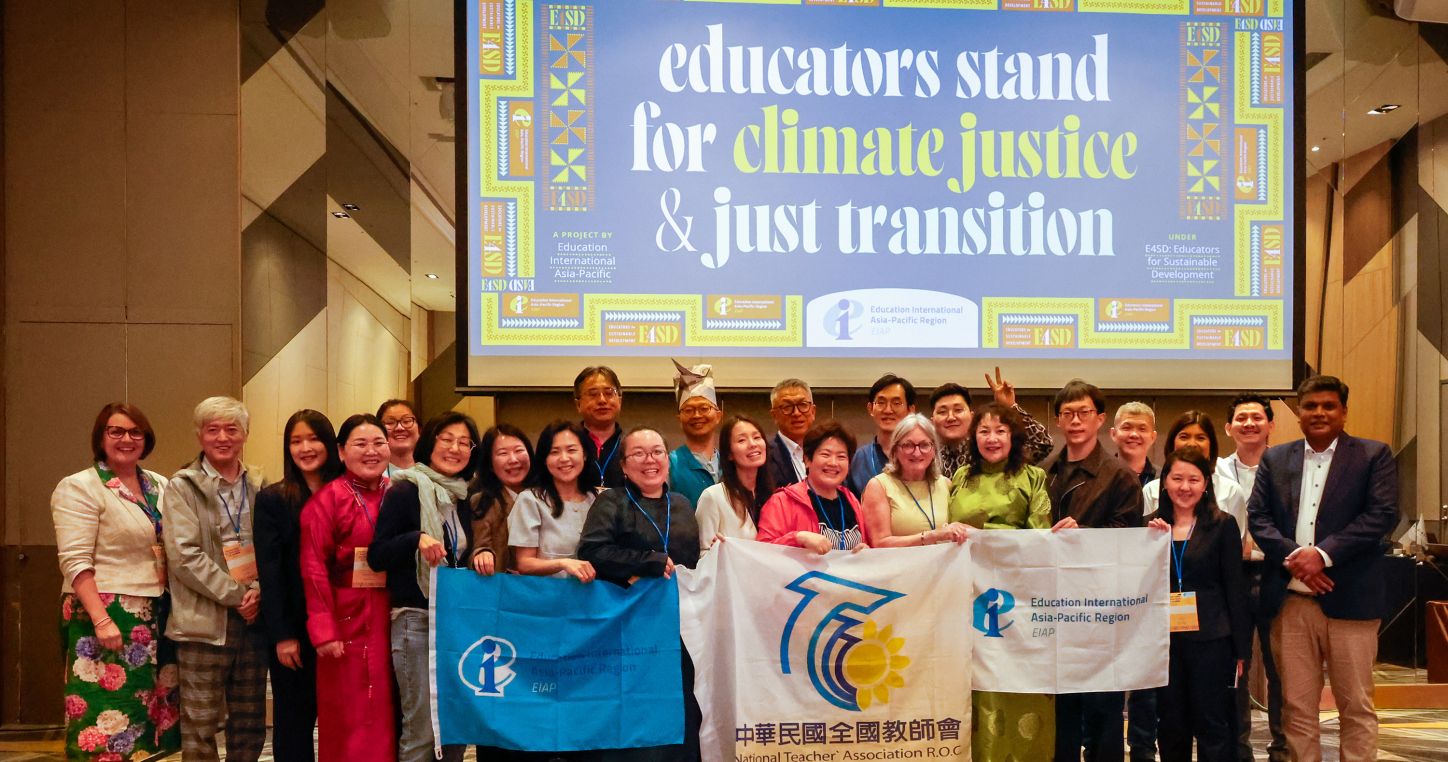
Educators in North Asia stand for climate justice and a just transition
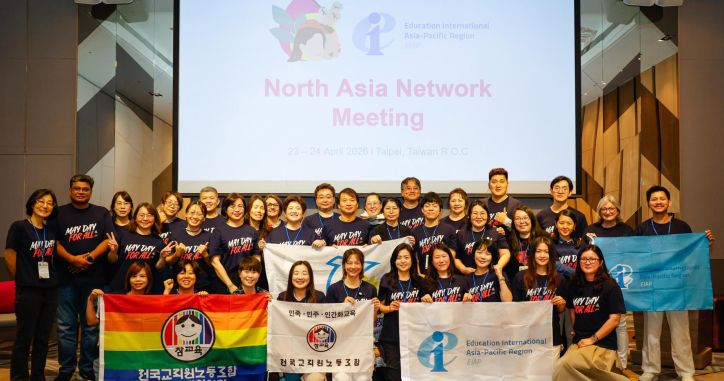
Education unions from Japan, South Korea, Taiwan, and Mongolia reaffirmed their commitment to people and planet at the Educators Stand for Climate Justice and Just Transition conference, organised by Education International Asia-Pacific (EIAP) in Taipei from 21 to 22 April 2026.
Now in its fourth year, the conference is the flagship event in North Asia of EIAP’s Educators for Sustainable Development (E4SD) programme. Since its launch, the programme has engaged more than 60 unions across the Asia-Pacific region.
Representatives from the Japan Teachers Union (JTU), Korean Teachers Union (KTU), Korean Federation of Teachers’ Unions (KFTU), Federation of Mongolian Education and Science Unions (FMESU), and the National Teachers Association – Taiwan (NTA Taiwan) came together to share how climate change is impacting the teaching profession and to commit to concrete national climate action plans.

Climate justice is social justice
EIAP Regional Director Anand Singh set the tone for the two-day conference with a frank and forward-looking opening address. Framing the gathering against a backdrop of deepening global climate impacts, ongoing conflict, and a critical SDG reckoning point, he challenged educators to own their power as agents of change.
“We are not bystanders to the climate crisis. We are among its most consequential responders. Every educator in this room has the power to shape how the next generation understands the world — its systems, its injustices, and its possibilities. That is not a small power. That is an enormous one.”
Anand Singh, EIAP Regional Director

Anand Singh, EIAP Regional Director, delivers opening remarks at the E4SD North Asia conference, Taipei, 21 April 2026.
Singh underscored that the E4SD programme was never designed as a one-off event but as a deliberate, multi-year journey beginning in Fiji with Pacific affiliates, moving to Bangkok for Southeast Asia, on to Kathmandu for South Asia, and now completing its regional arc in Taipei. “Each of these meetings has built on the last,” he said. “Together, they have formed something greater than a series of events. They have built a living, breathing network of educators committed to the same vision of a just and sustainable future.”
“The question before us is not whether climate change will affect education in Asia-Pacific. It already is. The question is whether education will be part of the response — and whether we, as education trade unions, will lead that response.”
Anand Singh, EIAP Regional Director
Singh called on participants to leave Taipei with more than inspiration. He outlined four concrete expectations: a clearer shared picture of where climate education stands in each country; two or three practical union commitments per affiliate for the next twelve months; a stronger North Asia network; and above all, the confidence that comes from knowing “from Japan to Korea, from Taiwan to Mongolia, there are educators and union leaders who share this commitment and who stand with us.”
NTA Taiwan President Chun-Liang Hou welcomed delegates warmly, expressing gratitude for the opportunity to host the network in Taiwan and reaffirming NTA’s commitment to climate action as both a professional and moral imperative for educators.
“Through education, teachers and students will not be just people impacted by climate change but actors of change, as stressed in the EI Teach for the Planet campaign.

Mr. Wei Yang, research fellow at the Taiwan Climate Action Network, delivered the keynote address, challenging participants to rethink the very purpose of education in the climate emergency era, pushing beyond the framing of schools as producers of workers for a green economy. Mr. Satoshi Tamai, Director at ITUC-AP, joined remotely to call on governments to implement climate policies that centre the rights and welfare of workers and their communities, stressing that “only through united efforts can we effectively organise and achieve collective victories.”
Solidarity messages were delivered by Ms. Beverley Park, Director of International Cooperation at the Canadian Teachers’ Federation, and Ms. Nicole Calnan, Federal Secretary of the Australian Education Union, both long-standing partners of EIAP. Park and Calnan emphasised that educators and union leaders can and must demonstrate real leadership on climate action and that teaching itself is foundational to both democracy and climate justice.
Voices from the region: shared crisis, shared commitment
Representatives from JTU, KTU, KFTU, FMESU, and NTA Taiwan also shared how climate change is already affecting the teaching profession in their respective countries such as worsening heat stress inside the classroom. They also shared that curriculum reforms regarding climate change education and professional training to better address climate anxiety among students are pressing concerns for their members.
Outcomes: from words to action plans
The conference culminated with each national delegation developing a climate action plan, mapping their activities and commitments for the year ahead in line with the E4SD programme. Plans span seminars and member climate literacy programmes, collective advocacy campaigns, and formal lobbying for curriculum reform. The action plans speak to a movement that is translating conviction into deliverables, and ensuring access to adequate teacher training and equipping educators with the skills, knowledge, and tools needed to deliver effective climate education to students.
The meeting has also been covered in the Taiwanese media.