Togo: Research and trade union voices at the centre of the Go Public! Fund Education campaign launch
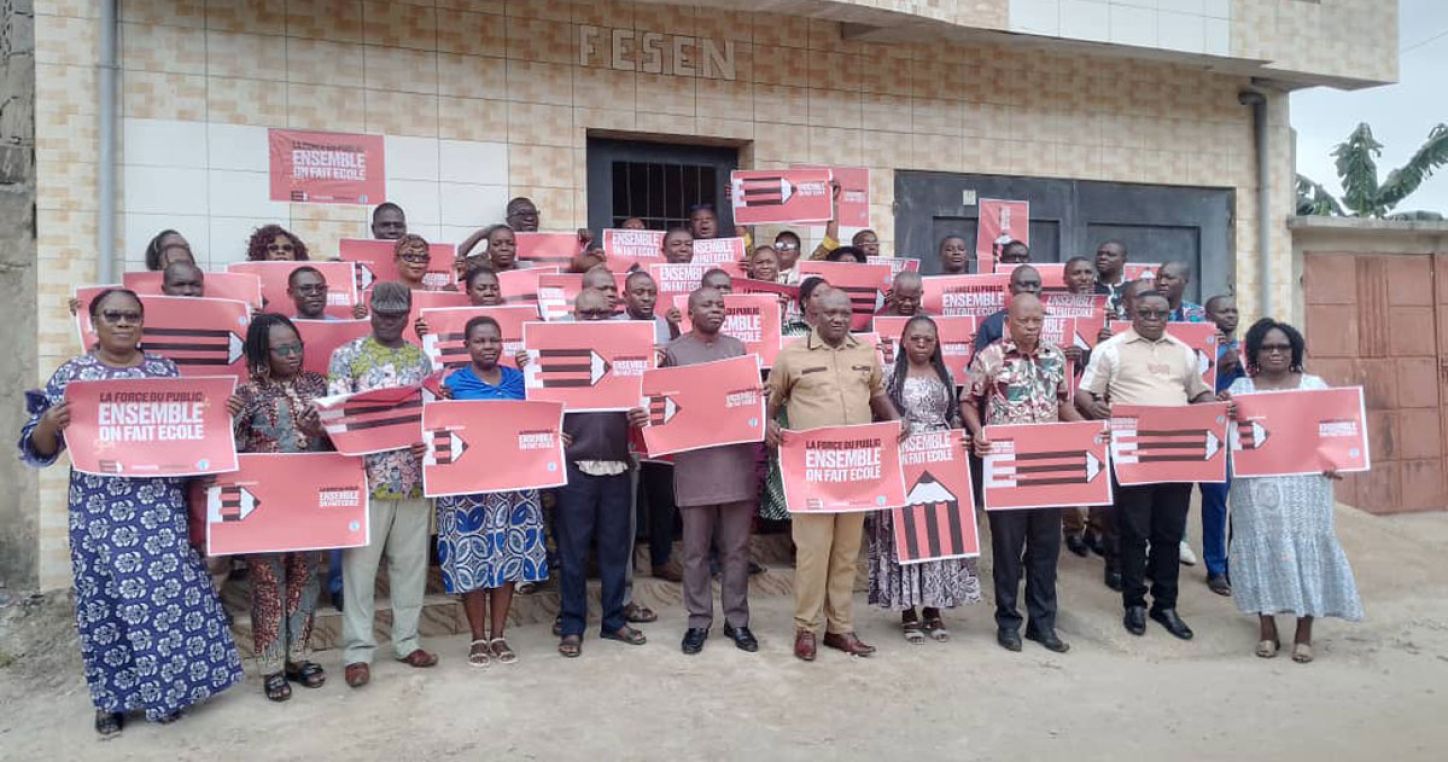
It is essential that trade union advocacy and the fight for public education be supported by facts, analysis, and clear demands. The importance of this approach was reaffirmed by the National Federation of Education Trade Unions (FESEN) at the launch of Education International’s Go Public: Fund Education campaign in Togo. Central to the launch was the publication of new research into the funding of public schools and the privatisation of education in Togo.
Held from 6 to 7 August 2026 in Lomé, the national campaign launch stressed that public education in Togo is still faced with significant challenges in terms of funding, infrastructure, working conditions for education staff, and the quality of learning. For the FESEN, an affiliate of Education International (EI), it is essential that the campaign promote adequately funded, inclusive, equitable, and quality public education for all children in Togo. The country’s seven other teachers’ federations were also represented at the launch.
In her welcome address to participants, Mariama Chipkaou, Chair of EI’s Africa Regional Committee, underlined: “This is not simply the launch of a campaign, it is the launch of a renewed national commitment to defend education as a fundamental human right, a public good, and a public responsibility. We are coming together at a critical moment, as education systems across Africa face huge challenges: insufficient public funding, teachers shortages, growing inequalities in underfunded schools, and the increasing privatisation and commercialisation of education.”
“We encourage Africa,” she continued, “to take renewed steps to increase funding for education, improve school infrastructure, recruit and retain qualified teachers, improve teachers’ professional development and guarantee decent working conditions for all education staff.”
“We call on the Togolese government to fully implement the United Nations recommendations on the teaching profession. We strongly urge development partners to continue supporting national priorities in education, while respecting the principle that strong public systems must remain at the heart of education development. I encourage you, teachers and your unions, to remain united, organised, and proactive. Teachers are not merely educators, they are the guardians of the future of every child and every nation. Protect education, invest in teachers, and let us build the future in full solidarity,” added Chipkaou.
Research moves the debate beyond slogans
The focal point of the event was the research paper “Public education funding and the privatisation of education in Togo”.
The aim of the research was to provide an overview of public funding for education and the growth of the private sector, with a view to informing advocacy initiatives in support of quality public education.
The paper examines the state’s financial commitments, the distribution of education resources, policies regulating the private sector, subsidies granted to education institutions, teachers’ working conditions, and the effects of privatisation on access, equity, and inclusion. The findings are based on documentary research into budgets, school statistics, regulatory texts and education policies, as well as twenty interviews with education system actors.
For the union, the launch of the research had significant political implications. It was not merely a matter of declaring that public education must be defended, but about demonstrating why, how, and with what priorities.
On the first day of the campaign launch, dedicated to capacity-building for FESEN members, a summary of the research findings was presented by Professor Bilakani Tonyeme of the National Institute of Education Sciences at the University of Lomé, followed by discussions and exchanges between the participants.
The FESEN’s Federal General Secretary, Hippolyte Akilé-Esso Lorié, said the campaign “reflects our deep conviction that public education remains crucial to our nation’s development and deserves a strong collective commitment from the public authorities, teachers, social partners, and all citizens”.
He also explained that the first day of the launch was “dedicated to building our members’ capacities. The choice to do this was not arbitrary. A strong trade union is, above all, a union whose members have a firm grasp of the issues, understand the challenges, and have the arguments needed to convince and mobilise”.
Addressing the participants, he insisted that “during this session, you will have the opportunity to discuss matters with the researcher who conducted this important study. The findings presented to you provide a solid scientific basis for our awareness-raising and advocacy work. I invite each of you to take an active part in the work, to ask questions, to share your experiences, and contribute to the discussions. The knowledge gained today must be relayed to all our grassroots organisations so that every teacher can become an ambassador for the campaign”.
He concluded by saying that the FESEN is convinced that the challenges faced by the education system can only be overcome through collective action based on reliable data, constructive dialogue, and a shared commitment to defending public education.
“The responsibility we bear is great. By defending public education, we are defending equal opportunities, social justice, national cohesion, and the future of our country.”
Underfunding: the crux of the campaign
The research paints a worrying picture with regard to funding. The study indicates that between 2015 and 2025, public spending on education grew at a slower rate than the national budget and gross domestic product. The share of education spending in GDP fluctuated between 3% and 5%, while international recommendations advocate investment of between 4% and 6% of GDP. The share of the national budget allocated to education has reportedly fallen from around 15% to less than 8% between 2014 and 2026.
As the researcher, Professor Tonyeme, acknowledged, “the research findings basically show, first and foremost, that state education is underfunded by the state and that, at the same time, the state funds the private sector in one way or another. And that’s already posing a problem. Secondly, the private sector is not properly regulated, which means that the quality of education in private schools is a real concern. I have also been able to show that trade unions need to campaign for the state to significantly increase funding for the public education system, but also to better regulate and supervise the private sector.”
In its Lomé Declaration adopted on 7 August 2026, the FESEN highlights the chronic underfunding of public education in several African countries, falling below the international thresholds of 6% of GDP and 20% of the national budget. It also draws attention to the deterioration in pay and working conditions for teachers and education support personnel.
The Declaration urges the Togolese government to implement the United Nations’ recommendations on the teaching profession, and “to meet or surpass international standards for education funding”, “to prioritise investment in public education, teachers, support staff and school infrastructure”, and “to strengthen institutionalised mechanisms for social dialogue with education trade unions in general and the FESEN in particular”.
Privatisation and inequalities: trade unions sound the alarm
The research also highlights the growing presence of the private sector in Togo’s education system. In Greater Lomé, the private sector plays a significant role in the provision of education, with 80% of schools being private in some areas. The study distinguishes between international schools, prestigious private schools, and mainstream private schools, highlighting that this diversification contributes to social segmentation in education.
For the trade union, this development is not without significance. Access to certain schools depends heavily on families’ financial resources, which undermines the principles of equity and inclusion. The research also highlights that state schools generally have better-trained teachers but face significant material constraints. Private schools, however, may offer better facilities but often employ teaching staff who are poorly or inadequately trained.
Mr Lorié noted that “the most striking aspect of the research findings is the weight of private education within the education system. When we began discussing these matters with the authorities and the government, we were sent figures that we did not fully understand. Thanks to this research, we now have reliable, objective data that we can rely on. This enables us to get a rough idea of the funding, and the share of the state itself, within Togo’s education system.”
In its Lomé declaration, the FESEN expresses its “concern at the rapid spread of privatisation and the commodification of education” and reiterates that “education is a fundamental human right and a public good”.
Based on this analysis, the study recommends:
- An increase in public spending on education;
- An improvement in school funding mechanisms;
- Stricter regulation of the private sector;
- An improvement in teachers’ working conditions; and
- Better protection of education as a public good and a fundamental right.
These measures are essential to guarantee inclusive, equitable, and quality education in Togo.
A high-level event to bring the evidence to light
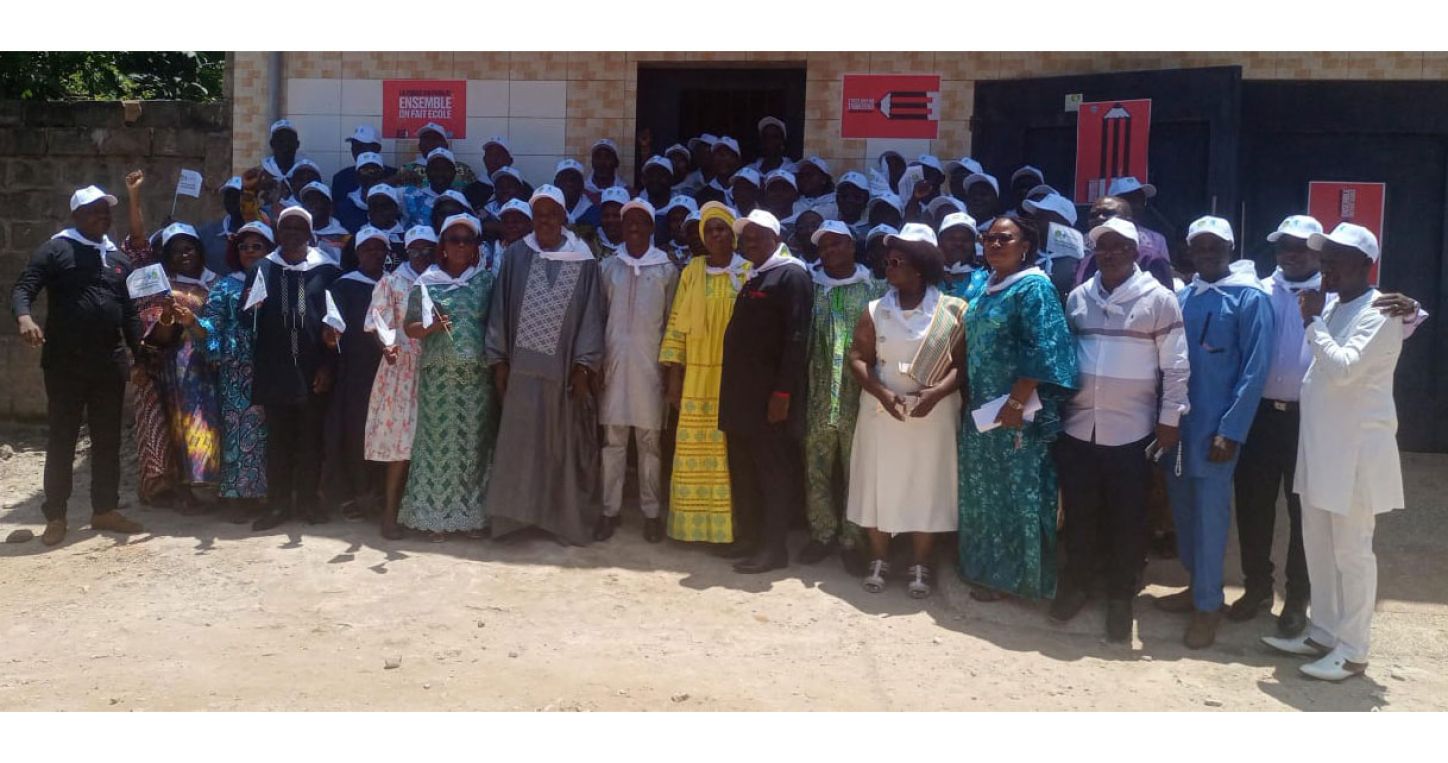
The second day of the campaign launch, on 7 August 2026, consisted in a high-level event at the FESEN’s headquarters in Lomé. Presentations were given by Education International Africa, the Minister for National Education, Mama Omorou, and representatives from the Ministry of the Economy and Finance, as well as technical and financial partners. The presentation of the research findings was central to these sessions.
For Minister Omorou, many challenges still lie ahead:
“This study, which you have produced, is an expression of love for public education and for the children of Togo. This is the full meaning of Go Public! Fund Education. It means refusing to accept the inevitable; it means choosing frank dialogue over futile confrontation. It means recognising the state’s efforts at the same time as calling for more. For the government, it means honouring these commitments. For the trade unions, it means being a strong source of proposals. For everyone, it means placing the best interests of Togo’s pupils front and centre.”
Mama Omorou, Minister for National Education
He went on to acknowledge that the Ministry of National Education regards the trade unions as strategic partners. “The success of the reforms we are undertaking will not work against you, but with you. This campaign should not merely be a platform for demands or criticism, but a platform for proposals: proposals to improve working conditions, proposals to raise standards, and proposals to make Togo’s state schools the best in the country. This is what our eminent professor recommends. I commend your sense of responsibility and assure you of the government’s commitment and its willingness to listen.”
The research has therefore served as a basis for dialogue between the government, parliamentarians, trade unions, civil society, parents’ associations, and the media.
In its Lomé Declaration, the FESEN undertakes to present the results and conclusions of the research to the authorities in charge of education and finance, parliamentarians, national and international non-governmental partners, and decentralised local authorities.
From research to collective action
From the outset, the campaign plan envisaged that swift research work would be conducted to provide “evidence and facts” on education funding and private education, and that the results would then be made public at the campaign launch, in the presence of the authorities, partners, and the media.
Linking research, trade union training, and public mobilisation is essential. Following the launch, FESEN officials and local trade union leaders will take ownership of the research findings and recommendations, to consolidate the foundations of the national campaign.
The FESEN’s Lomé Declaration reaffirms its commitment to “maintain and intensify” its monitoring role in the development and strengthening of public education in Togo, to develop national plans aligned with the Go Public! Fund Education campaign, and to produce and share national data on funding and working conditions.
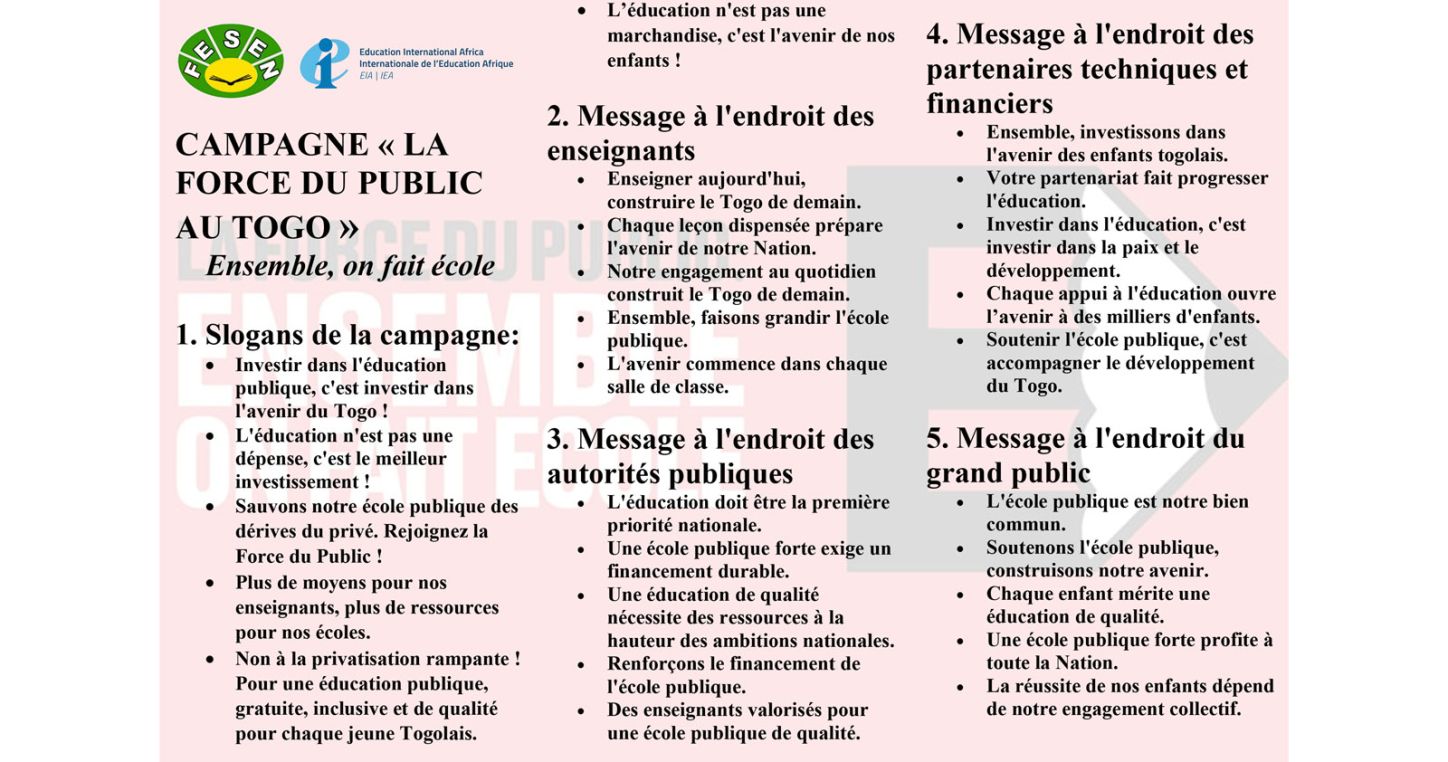
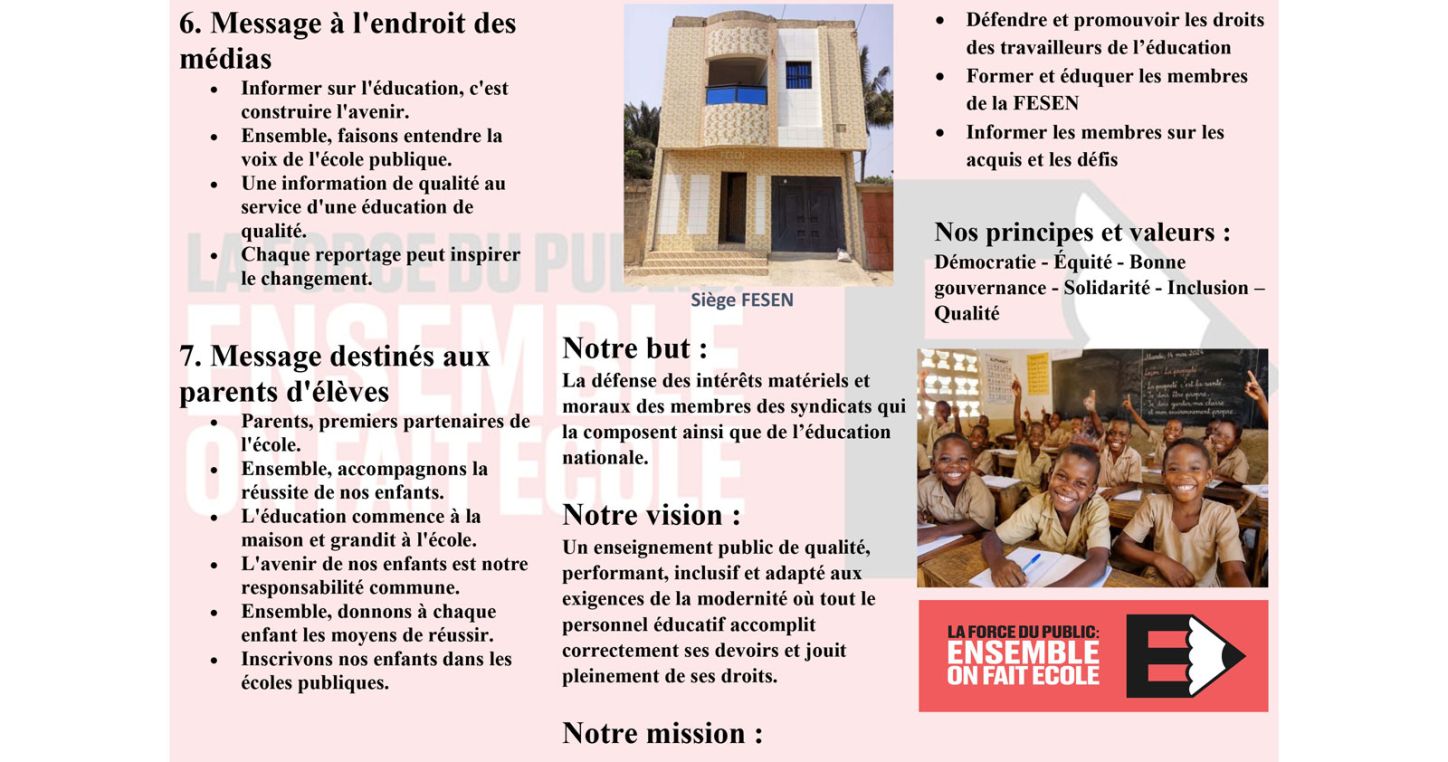
Communication at the heart of the campaign
The media were well represented, as General Secretary Lorié noted. “We had the online press. We also had national television and quite a few private media outlets. Mariama Chipkaou, who represented Education International Africa, told me she’d never seen anything like it in terms of the communication tools we deployed. Our plan is to keep other African countries informed, so that they can learn from our experience. I’m able to say that this has truly been a successful endeavour.”
He went on to note that this was the first time a minister had been seen to get involved in a trade union’s activities. The Minister for National Education even made a point of congratulating the researcher.
“The Minister asked him for all the information he had presented, particularly regarding the privatisation of education, and said that staff from his department would be in touch with us for further details. They will use the research at the Ministry, as they have now received the documentation. The Chair of the National Assembly’s Education Committee urged us to continue with the initiative, which they are expected to endorse at the National Assembly. He sent a message to the Speaker of the National Assembly asking him to take the research findings into account,” reported the FESEN leader.
Following the launch of the campaign, the trade union federation has planned a grassroots mobilisation starting on 10 October. Later that month, the FESEN will also meet with the National Assembly’s Education Committee.
As Mr Lorié also pointed out, “the campaign is a tool that will enable us to mobilise and attract even more members and strengthen our ranks, as a trade union is only as strong as its members. Regional representatives have been provided with electronic versions of the documents and communication tools. They will begin raising awareness locally, using key messages directed at the authorities, teachers, and parents. They will use these resources as we prepare to go out into the field to campaign.”