Nepal: Education unions turn Go Public! campaign training into local action
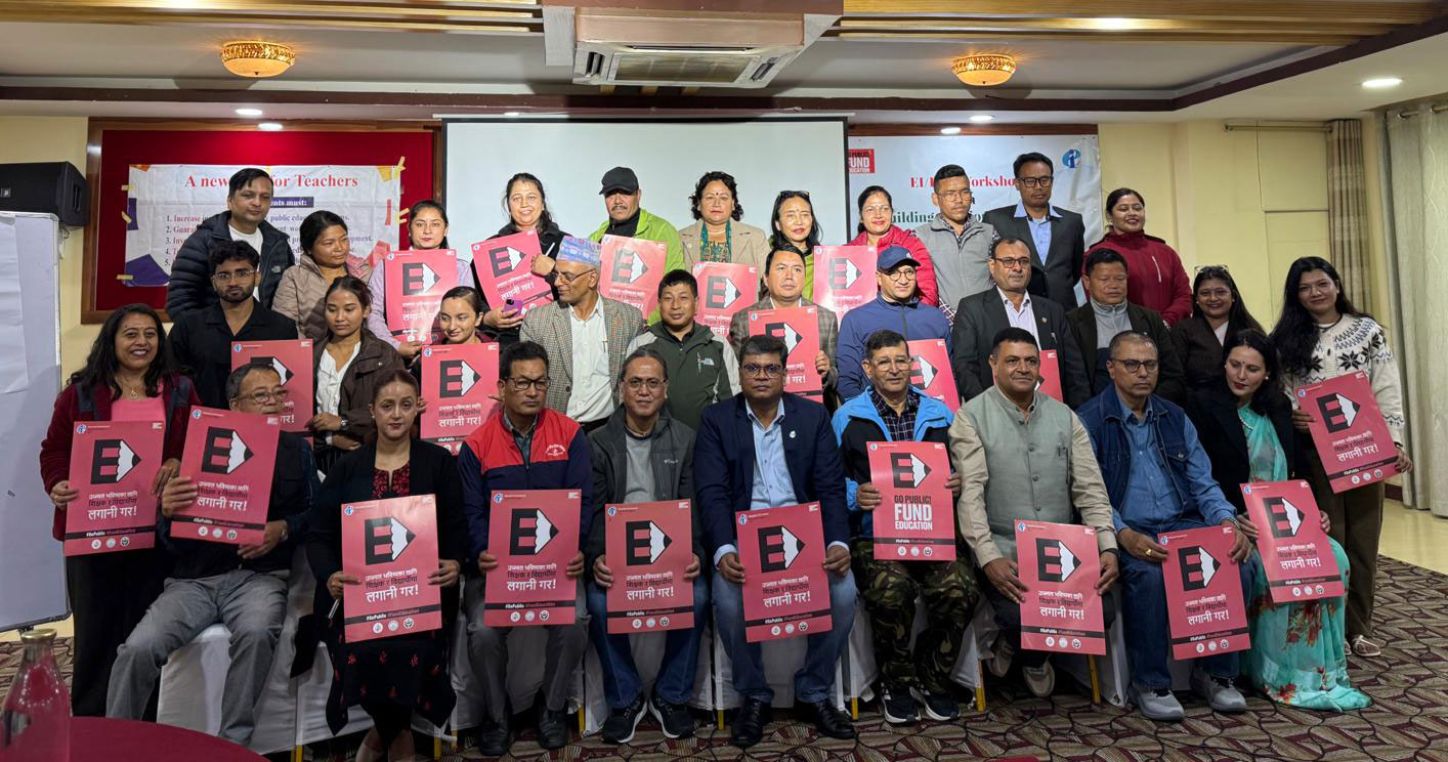
Thirty unionists from four Education International (EI) member organisations have developed practical campaigns to win greater investment in public education, strengthen union organisation, and mobilise communities across Nepal.
Organised by EI in cooperation with the Danish Union of Teachers (Danmarks Lærerforening, DLF), the workshop focused on building the campaigning power of EI member organisations. Participants identified barriers to quality public education and prepared initiatives on school funding, dropout prevention, school meals, safe drinking water, and digital learning. They also turned the demands of Education International’s Go Public! Fund Education campaign into concrete local organising plans.
The workshop held in the capital city Kathmandu from October 30th to November 1st, 2026, brought together equal numbers of women and men from the Nepal Teachers’ Association (NTA), Nepal National Teachers’ Association (NNTA), Institutional Schools’ Teachers’ Union (ISTU), and Nepal School Employees’ Council (NSEC).
From regional commitments to local campaigns
The workshop followed the 10th EI Asia-Pacific Regional Conference, held in Jakarta, Indonesia, in October 2026, where education unions reaffirmed the need for sustained public investment, decent working conditions, and strong, inclusive public education systems.
“Across Asia-Pacific, education unions are campaigning for greater public investment, better working conditions, and stronger public education. The campaigns developed here show how unions can turn regional commitments into local action, build public support, and influence education policies,” said Anand Singh, EI Asia-Pacific Regional Director.
Campaigning and organising workers and communities
Participants stressed that securing increased education funding requires organising members, building alliances with parents and communities, and taking credible proposals to local authorities. In the meantime, these campaign activities strengthen and empower unions.
“Demanding more education funding is not enough. We must organise our members, engage communities, and approach local governments with achievable proposals. Campaigning can make our branches stronger and build public trust,” said Hansa Bahadur Shahi of NNTA.
For Tarachandra of NTA, “safe drinking water is a basic need for our students. By working with parents, communities, and local government to address this problem, we can improve our school, bring union members together, and earn public trust.”
“Quality public education requires adequate funding and proper support for everyone working in schools. Our campaign seeks free education for children and better conditions for school employees. Working with parents and communities will also strengthen our organisation,” also noted NSEC’s Bibika Malla.
Defending rights across the education sector
The workshop also highlighted the insecure working conditions faced by teachers in Nepal’s private schools and the importance of linking the Go Public! Fund Education campaign with the defence of labour rights throughout the education sector.
“Many private school teachers still lack job security, fair salaries, and social protection. Our campaigns must bring teachers, parents, and communities together to secure employment contracts, decent working conditions, and fundamental labour rights,” acknowledged Hom Kumar Thapa of ISTU.
Participants also committed to advancing their plans through their union branches. NTA, NNTA, ISTU, and NSEC will support follow-up action to organise members, engage communities, and drive Go Public! forward at local level.
Anand Singh, EI consultant Sagar Nath, and union leaders facilitated the sessions. Dong Tolentino of Building and Wood Workers’ International addressed the opening session, underscoring the wider trade union movement’s stake in defending quality public services and workers’ rights.
International trade union movement stands with Nepal’s unions
Meeting in Kathmandu for their Annual Coordination Meeting, representatives of the International Trade Union Confederation Asia-Pacific, Global Union Federations, and Trade Union Solidarity Support Organisations further expressed strong solidarity with Nepal’s trade union movement at a “critical moment”.
The organisations voiced serious concern over measures taken by the Government of Nepal that undermine trade union rights, particularly in public services. They stressed that “administrative reforms, political neutrality, and the pursuit of administrative efficiency must not be used to justify weakening independent trade unions, restricting workers’ fundamental rights, or undermining established mechanisms of social dialogue.”
They reaffirmed that freedom of association and the rights to organise and bargain collectively are fundamental, internationally recognised rights. Nepal’s Constitution guarantees workers the right to form and join trade unions and to engage in collective bargaining, while the country’s ratification of International Labour Organization’s Convention No. 98 commits the government to uphold these rights.
Their joint statement calls on the Government of Nepal to reverse measures that undermine freedom of association and collective bargaining, fully respect constitutional guarantees and international labour standards, ensure that public sector workers can organise without interference or discrimination, and engage in genuine social dialogue with representative unions. It also calls for the immediate restoration of workers’ representation in tripartite bodies, Education Councils and the Education Board, the Social Security Fund, the Foreign Employment Board, and the Central Labour Advisory Councils.
The International Trade Union Confederation Asia-Pacific, Global Union Federations, and Trade Union Solidarity Support Organisations also encouraged Nepal’s unions “to strengthen their unity, solidarity, and cooperation in defending workers’ rights, protecting independent trade unionism, and advancing social justice.”
They went on reaffirming their readiness to support affiliated organisations and the wider trade union movement in protecting fundamental rights, upholding international labour standards, and strengthening democratic trade unionism in Nepal.