What you need to know about PISA 2025
What is PISA?
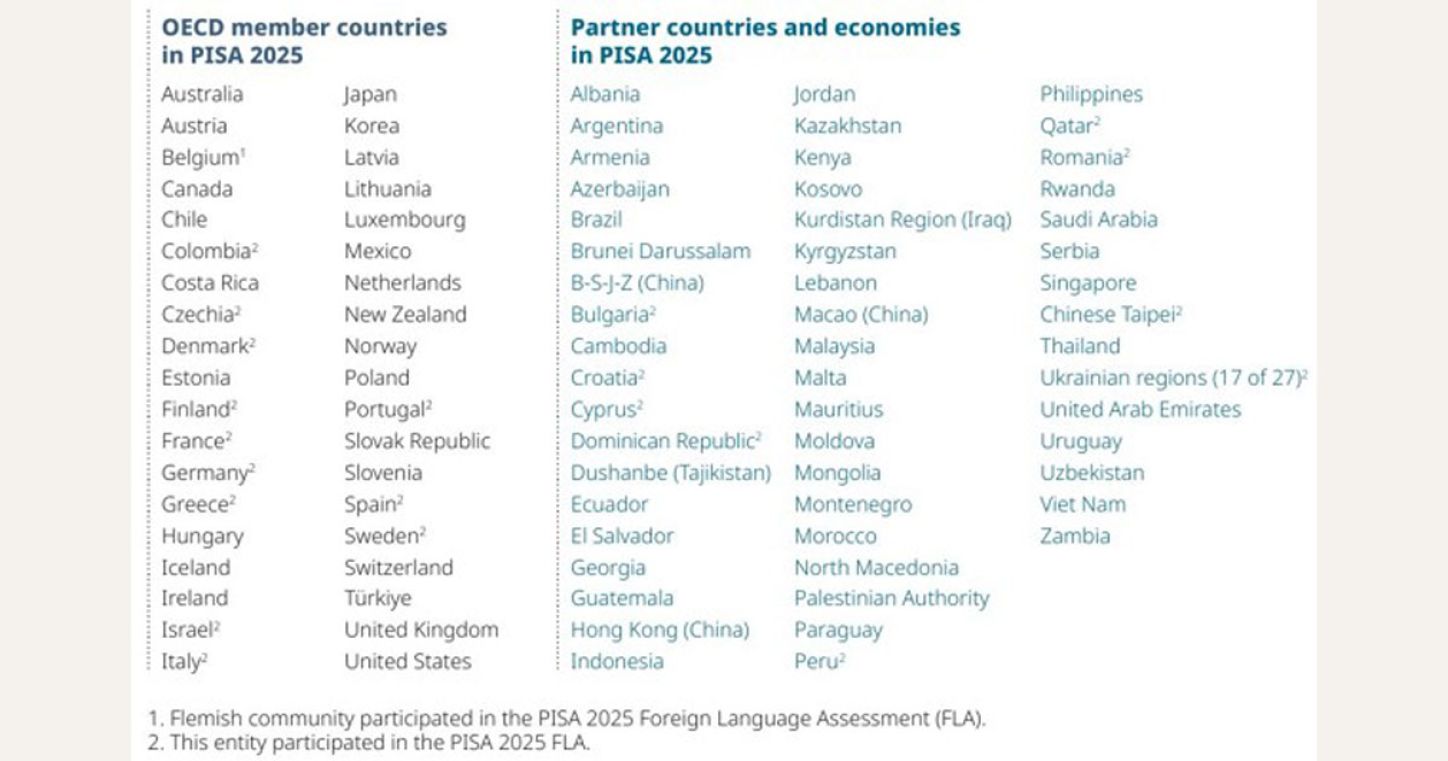
Created by the Organisation for Economic Co-operation and Development (OECD), the Programme for International Student Assessment (PISA) tests the skills and knowledge of 15-year-old students in mathematics, reading, and science. 91 countries and economies took part in the 2025 assessment, which will be released on 8 September 2026. Additional results on English as a foreign language will be published in April 2027 and a report on learning in the digital world will be released in May 2027.
What does PISA mean for EI members?
Education International (EI) has provided member organisations an embargoed copy of the report in advance, alongside a brief analysis of the results for the past few cycles.
The information PISA provides can support union advocacy for quality teaching and learning conditions. Unions that have integrated PISA results in their messaging have been able to have a greater influence on teacher policy in their country.
EI recognises that the PISA results or the interpretation by media and government of the results can pose challenges for EI member organisations. To this end, EI has prepared a set of key messages – please see the end of this document for more details. We also encourage union colleagues to read our piece, “Looking at PISA from an Education Union Perspective” included in this link.
All countries participating in PISA 2025 have been asked to invite their teacher unions to the national launch. If your union has not been invited, EI encourages you to contact your ministry to ask about their plans.
What does PISA assess?
PISA focuses on the assessment of student performance in mathematics, reading, and science to measure the extent to which students can use what they have learned in and out of schools for their full participation in society. PISA also collects valuable information on student attitudes and motivations.
PISA draws on content that can be found in curricula across the world and looks at students’ ability to apply knowledge and skills to examine, interpret, and solve problems. PISA does not prescribe or promote any one curriculum nor is it constrained by the need to find a common denominator. The results from PISA provide comparative global data that may be useful to unions in your advocacy for members.
Whom does PISA assess?
PISA assesses students between the ages of 15 years and 3 months and 16 years and 2 months who are enrolled in an educational institution at grade 7 or higher. The lists from which schools and students are selected for the PISA assessment include all students who meet these criteria, regardless of the type of educational institution in which they are enrolled and whether they are enrolled full-time or part-time.
A sample of schools, and of students within schools, is drawn, and the students selected are assigned sampling weights to represent the entire PISA-eligible cohort.
Why does PISA test this age group?
This age group has been chosen as it is when young people in most OECD countries are nearing the end of compulsory education. The selection of schools and students is as inclusive as the OECD has considered possible, so that the sample of students comes from a broad range of backgrounds and abilities.
What makes PISA unique?
PISA benefits from its worldwide scope and its regularity. Over 100 countries and economies have taken part in PISA so far and the surveys, which are usually carried out every three years, allow participating countries and economies to track their progress in meeting key learning goals. PISA is the only international education survey to measure the knowledge and skills of 15-year-olds.
PISA is also unique in the way it looks at:
- Public policy issues: Governments, principals, teachers, and parents all want answers to questions such as, "Are our schools adequately preparing young people for the challenges of adult life?", "Are some kinds of teaching and schools more effective than others?" and "Can schools contribute to improving the futures of students from immigrant or disadvantaged backgrounds?"
- Literacy: Rather than examine mastery of specific school curricula, PISA looks at students’ ability to apply knowledge and skills in key subject areas and to analyse, reason and communicate effectively as they examine, interpret, and solve problems.
- Lifelong learning: Students cannot learn everything they need to know in school. In order to be effective lifelong learners, young people need not only knowledge and skills, but also an awareness of why and how they learn. In addition to measuring student performance in reading, mathematics, and science literacy, PISA also asks students about their motivations, beliefs about themselves, and learning strategies.
How are participating countries and economies ranked in PISA?
PISA ranks participating countries and territories according to their performance in mathematics, reading, and science. PISA does not give a collective score for all subjects combined; rather it gives a score for each subject area, and the mean score in each subject can be used to rank countries.
However, even within a single subject, it is not possible to assign an exact rank to each country or territory based on its mean score. This is because PISA tests only a sample of students from each country or economy, and estimates, based on their results, the distribution of performance in the whole population of 15-year-old students. The statistical uncertainty associated with these estimates means that it is only possible to report the range of positions (upper rank and lower rank) within which a country or economy can be placed.
For example, in PISA 2003 Finland and Korea were widely reported as ranking 1st and 2nd in PISA, when in fact we can only say that, among OECD countries, Finland’s rank was between 1st and 3rd and Korea’s was between 1st and 4th.
EI is well aware that these rankings are often controversial and can be used to portray "winners and losers" or to criticise teachers without taking into account the many factors which influence education systems. This is why union-voice in response to the results is vital.
What is PISA 2025?
PISA 2025 is the ninth round of assessment since 2000. Over 760,000 students representing 33 million 15-year-olds across 91 countries and territories have participated, making this the largest PISA ever.
The countries or territories joining PISA for the first time this cycle are:
- Armenia
- Dushanbe (Tajikistan)
- Ecuador*
- Kenya
- Kurdistan Region (Iraq)
- Rwanda
- Zambia*
* Participated in PISA for Development
What does PISA 2025 assess?
PISA 2025 assesses science, reading, and mathematics. The major focus in this edition is science. For the first time ever, this edition looks at student ability to evaluate scientific evidence critically, assess the credibility of information, and apply scientific knowledge to real world decision making.
Special attention has been given to environmental science and students’ environmental agency.
In addition, the reports that will be published in 2027 will focus on learning in the digital world and English as a foreign language (reading, listening, and speaking).
Why is PISA 2025 important for education policy?
PISA results have a significant impact on education policies. Their launch tends to focus the public debate on education, and the insights they provide can be influential and, if well used, very valuable.
However, the media usually provides very superficial coverage of the results, focusing on country rankings (who is doing best, who is doing worse, how countries are doing compared to neighbours, etc.).
Further, governments will want to demonstrate progress in education and tend to blame teachers if the results are not satisfactory.
EI has prepared a set of key messages to help unions reframe the conversation around PISA results, to move it away from country rankings and towards improving education policies and making sure the right to education is a reality for all learners.
Click here to read the key messages on PISA.