
OECD data explains the need to invest in teachers and equity
Teacher shortages cannot be solved simply by recruiting more people into training programs, technology cannot replace the relationships at the heart of education, and education systems must do far more to counter inequality. These were among the key messages for education unions emerging from Education International (IE) webinar with the Organisation for Economic Co-operation and Development (OECD) Director of Education and Skills, Andreas Schleicher.
The November 2nd online meeting brought education unionists together to examine the findings of the Programme for International Student Assessment (PISA) 2025 and Education at a Glance 2026, and discuss what those findings mean for teachers, education support personnel, students, and the future of quality public education.
Opening the session, Education International General Secretary David Edwards stressed that many of the problems now highlighted by OECD data are hardly new to education unions. Investment, support for teachers, and the status of the profession have long been central union concerns.
For Edwards, the point of engaging with the reports is not simply to absorb more education data. It is to put that evidence to work and help education unions “to build power to advocate for quality public education and our profession,” he told participants.
Inequality is not inevitable
One of the key messages from Schleicher was the need to look beyond national averages on international reports. Similar average results can hide dramatically different realities for students depending on their social background and where they go to school.
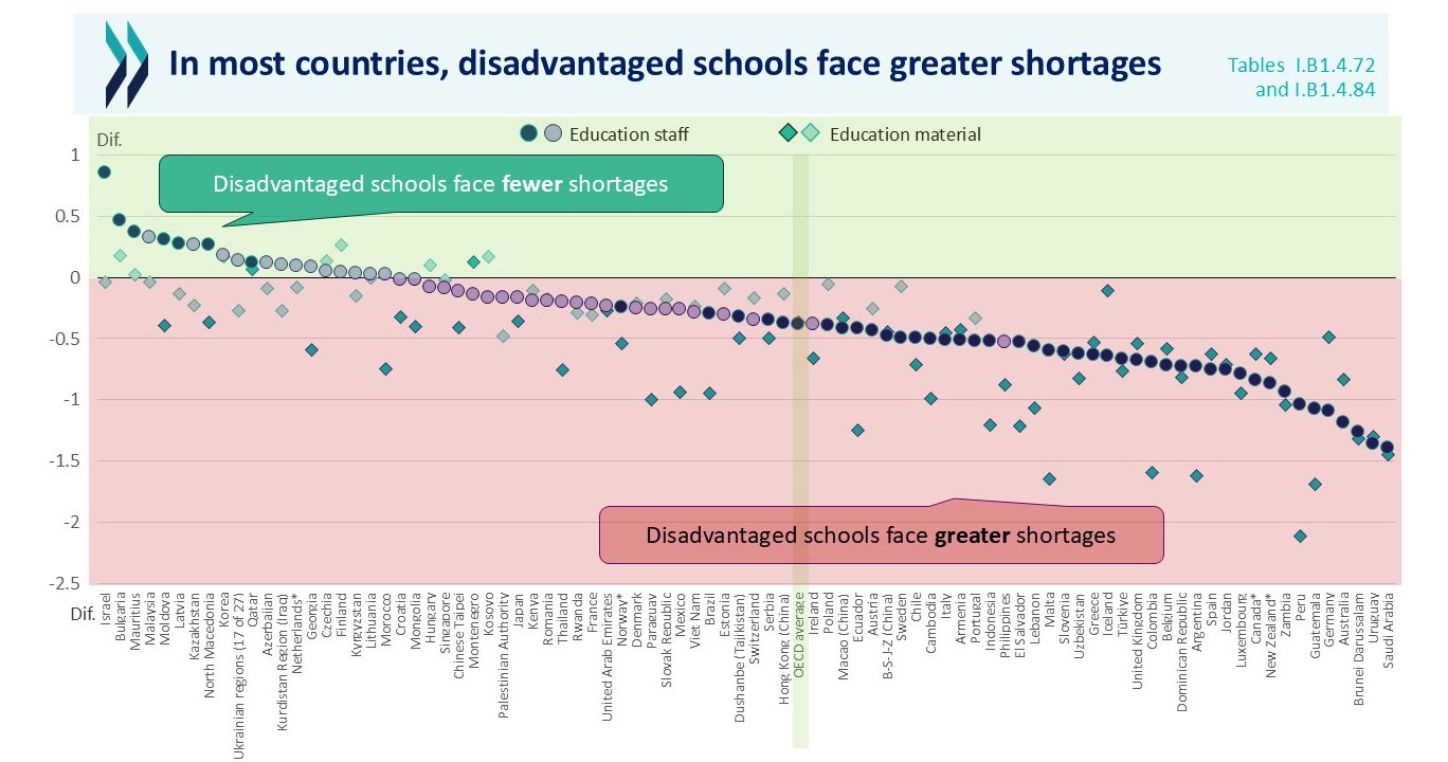
He pointed to large disparities between advantaged and disadvantaged students in several countries, highlighting that disadvantaged schools frequently face greater shortages of qualified teachers and educational resources.
For education unions, this provides important evidence for demanding public funding, equitable staffing policies, and working conditions that enable experienced and qualified teachers to work and remain in the schools and communities where they are most needed. This is also underlined in EI’s Go Public! Fund Education campaign.
As Schleicher put it, education systems need “to align resources with needs”.
Teacher shortages are also a retention crisis
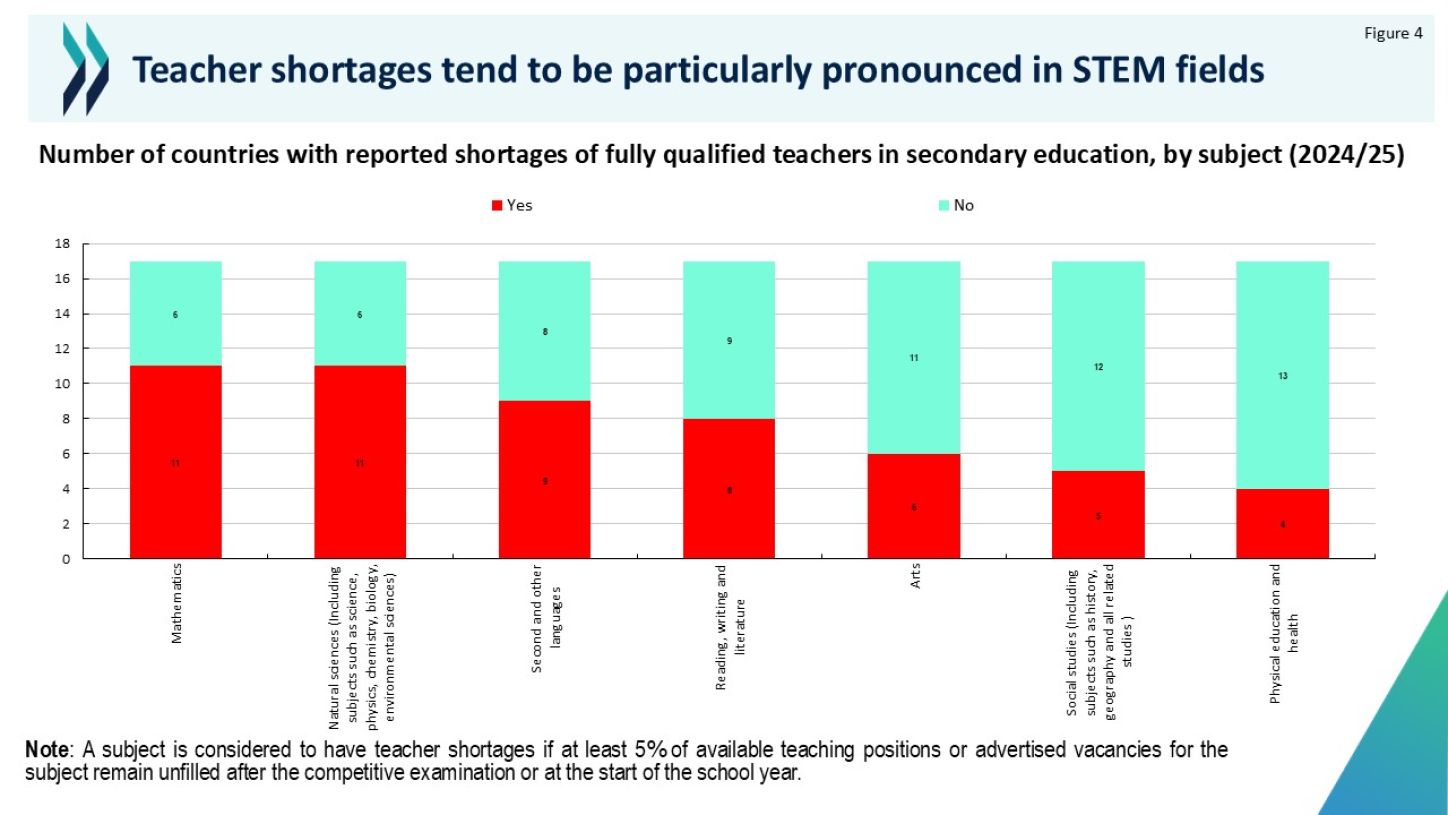
The OECD data presented during the webinar also pointed to acute shortages in particular subjects, including mathematics, science, and second languages. At the same time, many systems are increasingly relying on teachers who are not fully qualified. There are also major geographical differences within countries, meaning national averages can conceal severe staffing problems in particular regions.
But simply increasing the number of students entering teacher education will not solve the crisis.
According to Schleicher, many people who train as teachers later work elsewhere. “The talent pipeline is simply very leaky,” he explained. “Just getting more people into universities without changing the attractiveness of the teaching profession is not going to solve the problem.”
This represents a central trade union issue. Recruitment policies that ignore salaries, workload, professional autonomy, job security, career development and working conditions, including class size, risk seeing new recruits into a profession that cannot retain them.
Edwards addressed precisely this point in his closing remarks, describing the problem as a “revolving door”. He warned that some systems appear willing to accept a constant turnover of teachers rather than invest in keeping experienced professionals in school communities.
For unions, he argued, the answer is to fight for the profession and improve teacher status so that educators want and are able to stay in schools.
Working time matters as much as staffing numbers
The comparison between Japan and the United States presented by Schleicher also raised a fundamental question about how education systems use their teaching workforce.
The data also show considerable international differences in whether activities such as supporting individual students and engaging with parents are formally recognised as part of teachers’ work. In some systems these responsibilities are integrated into the job; elsewhere, including Belgium and Germany, such work may effectively be left to teachers on a voluntary basis.
If systems regard individual attention and engagement with families as essential to educational success, unions should make a strong case that this work must be recognised, resourced, and included in working time, rather than depending on teachers’ unpaid labour.
The discussion also warned governments against mixing "class size" - the number of children a teacher has in front of them - with the "student-teacher ratio." These however are not at all the same thing, as the latter is simply calculated by dividing the total number of children by the total number of staff members.
AI makes teachers more important, not less
The webinar also debated the use of artificial intelligence by the teaching profession.
Schleicher said that only around 45% of 15-year-olds across OECD countries displayed the ability to question, probe, and triangulate when evidence clashes with what appears to be common sense. That becomes particularly important when dealing with generative AI systems capable of producing persuasive answers.
Data also show that students who use AI do worse than those who do not, and that the best predictor of success in the reading test is students who read books of over 100 pages.
“If education is more about helping you reproduce the knowledge of the world rather than question it, we should ask ourselves: is this enough?” Schleicher said.
Beyond AI, PISA results point to a decline in deeper forms of reading, including evaluating and reflecting on information, integrating information and navigating multiple sources. Meanwhile, technology use has shifted from more creative activities towards greater consumption through social networks and other digital platforms.
The answer is not a simplistic rejection of technology. For Schleicher, intentional uses of technology embedded in pedagogy can support learning. He, however, warned against allowing technology or AI to remove the intellectual effort through which learning happens.
“You do not become fit by watching sports,” he said. In the same way, learning cannot be reduced to consuming ready-made answers.
This strengthens the union case for decisions about AI to start with pedagogy, professional autonomy and qualified educators, not with technology assumptions that digital tools can substitute for teachers.
The relationship at the heart of education
The OECD Director of Education and Skills also mentioned evidence on teacher-student relationships.
According to him, students’ perception that their teachers care about them, take an interest in them, and accompany them in their learning is one of the strongest predictors of good learning outcomes in PISA. Encouragingly, perceived teacher support has increased in more countries than it has declined between 2015 and 2025.
Family support, however, has fallen noticeably in many countries between 2022 and 2025. Schleicher argued that addressing declining student engagement therefore requires more than changes inside schools. Education must remain a social endeavour rather than becoming increasingly transactional.
His concluding message was particularly appropriate as governments consider the role of AI in education:
“If you want to win students back, it will take people to do that. Technology can, I am sure, take over some tasks, but, ultimately, it is really about building a stronger social fabric in education.”
Evidence for union action
In his closing intervention, Edwards connected the OECD evidence back to struggles for equality, investment and the teaching profession. He pointed to students mobilising in France, Chile, and Belgium and to the profound inequalities that mean students in poorer areas can have far less access to qualified teachers, adequate infrastructure and the support needed to navigate technology critically. The evidence, the EI leader explained, gives unions powerful arguments in fighting for opportunity and equality.
And in an age of AI and increasing “cognitive offloading”, the human dimension of education becomes even more important. Highlighting “the importance of children having teachers that love them and they love and are there for them”, Edwards called for communities to support their educators and for governments to value their teachers more.
You can also read more on our webinar held before the release of 2025 PISA data, as well as on what you need to know about PISA 2025.