ComNet Africa: Unions leading to decolonise education
Many education systems across Africa remain structured by colonial legacies: what is taught, the languages used in classrooms, and the approach to formal schooling. Education unions must lead the effort to decolonise minds, curricula, and education financing across the continent. This was the call issued during a webinar of union communicators and campaigners from EI member organisations in Africa.
Many education systems across Africa remain structured by colonial legacies: what is taught, the languages used in classrooms, and the approach to formal schooling. Education unions must lead the effort to decolonise minds, curricula, and education financing across the continent. This was the call issued during a webinar of union communicators and campaigners from EI member organisations in Africa.
"Many of our countries’ education systems still struggle to reflect African values, histories, cultures, languages and the lived experiences of our continent’s citizens. Indigenous knowledge and wisdom are often pushed to the periphery of the curriculum, while colonial and western ideas occupy centre stage," stated Dr. Dennis Sinyolo, EI Africa Regional Director, opening the Education International (EI) Africa Communicators' Network (ComNet) meeting held on 18 March 2026.
Communication is power, and unions need concrete narratives
For Dr. Sinyolo, the colonial legacy is still present even after independence. He recalled being taught references “far removed from our reality,” like nursery rhymes from England, while African languages and local knowledge were sidelined.
Referring participants to the study Unions leading the way to decolonize education authored by EI Latin America Director Gabriela Bonilla, he stressed the need to decolonise the mind, the curriculum, education reforms, and education financing.
He also underlined EI Africa’s Book Writing Project, which trains teachers to write books and stories for their students. This is not symbolic work to him: it is a direct intervention in what children read, whose language is valued, and whose world is seen as “knowledge.”
"As the collective voice of teachers and education workers, we play a central role in this transformation. We have a responsibility to challenge the status quo, defend professional autonomy, and advocate for inclusive, relevant, quality and democratic public education systems," he explained.
He connected this directly to the work of union communicators: “Communication is power. How we frame these issues, whose voices we amplify and the stories we tell will shape public understanding, opinions and policy debates.”
Zimbabwe: decolonisation through curriculum reform
Daisy Zambuko, Head of Communications, Public Relations, and Marketing Manager at the Zimbabwe Teachers' Association (ZIMTA), framed decolonisation in organising language: “For too long our education system was a common copy of the colonial past. Political independence is hollow without epistemic freedom. We are not just changing the syllabi; we are reclaiming our minds.”
She highlighted that ZIMTA play a significant role in implementing the Zimbabwe’s heritage-based curriculum prioritising 16 indigenous languages, arguing that “a child thinks best in their mother tongue.”
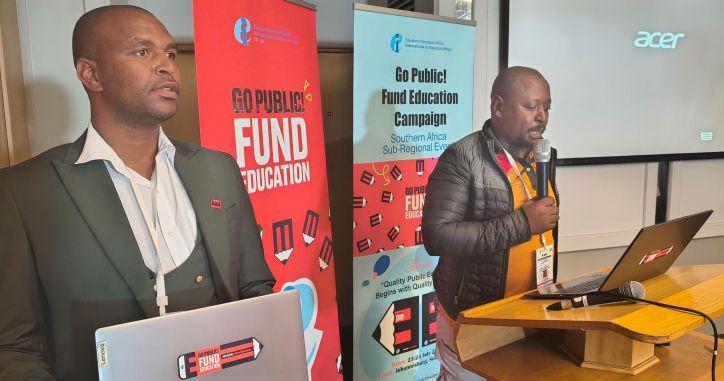
Zambuko tied curriculum change to union campaigns: resisting “the privatisation of heritage-based assets” with the Education International Go Public! Fund Education campaign; demanding the 20%, i.e. lobbying for the Dakar declaration budget target to fund Indigenous Knowledge Systems research; and insisting that “a decolonised teacher should not live in ‘colonial era’ poverty” and receive fair remuneration.
She explained that ZIMTA advocates government-sponsored workshops to support teachers transitioning between assessment systems and engages in policy dialogue with the ministry to ensure that decolonisation does not lead to teacher work overload.
She concluded that “we believe that heritage is our world and teachers are its custodians and we are here to stay.”
Tanzania: language policy, access and the everyday colonial legacy
Prosper Lubuva of the Tanzania Teachers’ Union focused on language as a concrete tool of decolonisation. “In primary education, the medium of instruction is not English anymore, it is Swahili,” he said.
He cited research that by 1990 literacy reached 80%, compared with “below 40%” in earlier years after independence—arguing that teaching in a language “known by everyone” changed learning outcomes.
He described universal primary education granted in 1974 as a “mass movement” providing free mandatory schooling, showing how decolonisation is not only about textbooks, but about who gets access to education at all.
He noted ongoing debate on whether English should dominate post primary education, while many union members believe they “could teach very well in Swahili.”
He also reported teachers being harassed for not wearing “a coat and a tie,” as if a “Eurocentric” look defined professionalism, while traditional clothes were labelled “not dressed well.”
A communicator’s action list: research, credibility and teacher autonomy
Bringing practical work direction, Eyram Linda Doe, EI Africa Communications Officer, insisted that communicators need more than slogans: they need evidence unions can own. “We need to produce and use union-led research. If we have research, it gives us power. It helps us look more credible in policy discussions.”
She argued curriculum reforms must carry “the voices of teachers, communities and learners,” and that when unions influence curriculum, education becomes “more relevant and inclusive, because we have the lived experiences.”
And she warned against reforms that treat educators as functionaries: “Unions must defend teachers from policies that limit their judgement or reduce them to technicians.”
“The stories we tell will either liberate us or keep us in the dark”
Rebeca Logan, EI Director of Campaigns and Communications, argued that communicators have a specific responsibility: to circulate the stories and images that curricula tend to erase or misrepresent. “One of the powers that we have as communicators is to share stories that are not part of the official curricula,” she said.
She used examples from schooling in Latin America, which elevated colonial figures while ignoring indigenous narratives. While textbooks went into detail about colonial characters like Christopher Columbus, they ignored Indigenous leaders like Tupac Amaru. When world history was taught, it focused more on Europe than on Africa or Asia, she noted. Decolonising must also include ex-colonised people learning about each other.
For her, “colonization is also about who we include, who we exclude, what we learn and what we don't learn about each other. The stories we tell will either liberate us or keep us in the dark.”
Decolonising also means confronting the colonial foundations of global finance, she explained, using the Haiti’s example. When Haiti won its independence in 1804 after defeating Napoleon’s forces, it was ordered to pay at that time 150 million gold francs to France - a so‑called “reparation” for the loss of what France still considered its colony. That debt haunted Haiti for generations. The country could not fully repay it until 1947, after decades of financial extraction. To meet these demands, Haiti was compelled to take out loans from French banks, locking the country into a cycle of dependency whose consequences continue to shape its economy today.
She also illustrated how union‑led exchanges can actively challenge colonial narratives in education, sharing the example of a project where educators from different regions of the world came together to learn from each other.
You can read the article on ComNet Africa published on the EI Africa website here.