ComNet Europe: Union communicators align to advance public education, democracy and workers’ rights
Education union communicators from across Europe came together through the Education International (EI) ComNet Europe to sharpen a shared narrative: public education must be defended and funded, democracy must be protected, and Artificial Intelligence y in schools must be shaped by educators - not imposed on them.
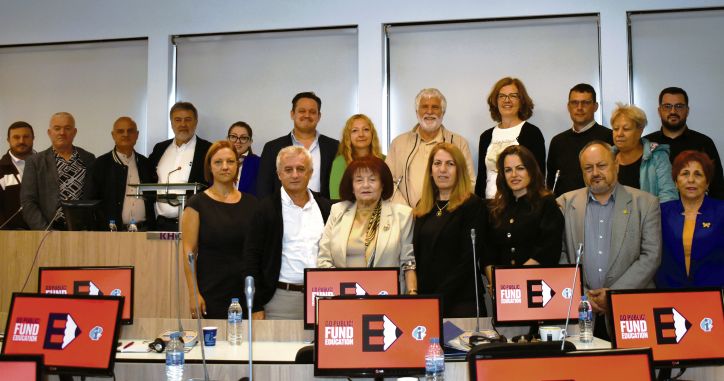
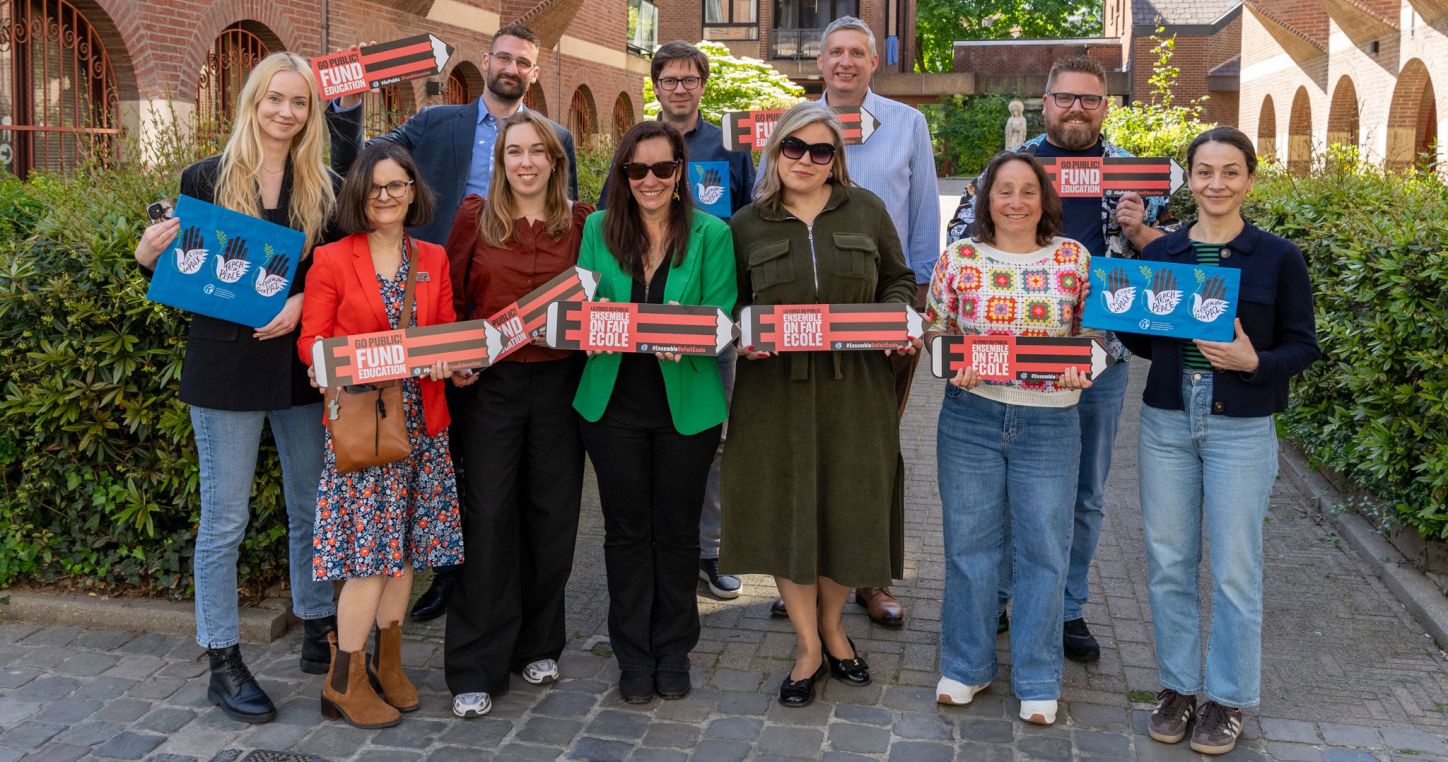
Colleagues joined from Belgium, Estonia, France, Iceland, Ireland, Kosovo, Lithuania, the Netherlands, Slovakia, Slovenia, Spain, and the United Kingdom.
The network of colleagues gathered in Brussels, Belgium, on April 28th, 2026, heard interventions from David Edwards, EI General Secretary; Jelmer Evers, Director of the EI European region, the European Trade Union Committee for Education (ETUCE); Thomas Bouissaguet, ETUCE Campaigns and Communications Officer; and Joseph Erickson, director of the documentary project Class Wars.
Campaigns are crucial in the global struggle to fund public education
In his remarks, EI General Secretary David Edwards situated communications work inside EI’s broader strategic plan covering five key priorities:
- Profession - Improving and promoting the status and the well-being of our profession.
- Public Education - Ensuring quality public education for all.
- People - Defending human and trade union rights, gender equity, and social justice.
- Planet - Promoting peace, democracy, and climate justice.
- Power - Building Union Power to ‘Power our Plan’.
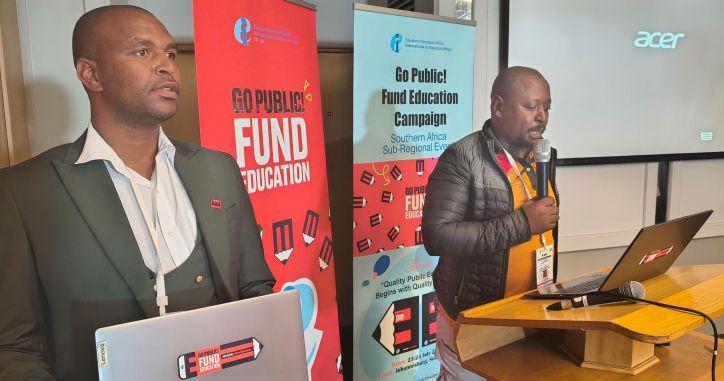
He underlined that EI’s Go Public! Fund Education campaign – which is now active in over 50 countries – was born out of the push to put the global teacher shortage on the international agenda and “to make sure that every country is taking affirmative actions towards addressing that teacher shortage with the representatives of the teaching profession.”
“What that campaign allows us to do is that we can tailor the campaign to whatever the needs are of the member organisation at whatever level they are working,” he explained.
For Edwards, communications are part of how unions turn policy moments into mobilisation. “We are not going to accomplish any of these things if we do not have adequate funding,” he said, connecting the education funding struggle to broader demands like tax justice and debt relief.
Democracy, the profession, and AI: European education unions’ collective actions
Education unions are increasingly challenging policy decisions made above the national level – and ETUCE Director Jelmer Evers warned that if unions are absent in these arenas, they risk arriving “10 steps behind.”
He described ETUCE’s three main priorities: democracy, public education and the profession, as well as AI and digitalisation.
From curriculum debates on democratic citizenship to the rapid policy diffusion around “basic skills,” he argued that European-level discussions quickly “enter your national dialogue and very quickly enter your classroom.”
Noting the importance of understanding “the geopolitical realignments,” he reminded that “if you want to democratise Europe in general, then schools and universities as public institutions need to be democratic. And social dialogue is a key aspect of that. Social dialogue between workers, employees and ministers at that level is extremely important.”
Evers also underlined the political landscape in the European Union (EU) institutions as shifting: “Corporate lobbying is extremely strong, more aggressive than it used to be,” and Big Tech is heavily resourced and influential.
He insisted that there will be a lot of programmes, ideas and reform proposals, for example on citizenship or democratic education, on digitalisation and digital literacy for students, and the students’ perspective, the teacher's perspective and the education workers’ perspective must be considered on these issues.
A major concern he raised was the prospect of digital deregulation through “omnibus” legislation – pushing and weakening protections across multiple laws – which could undermine hard-won rules that keep powerful companies in check and out of classrooms.
For communicators, he explained, this should not be abstract “EU talk.” The stakes are concrete – student data, surveillance, workload, professional autonomy, and the democratic mission of public schools.
“Trust the Teacher”: Building identity, clarity, and collective action
“In communications, the more you do, the harder it is to be able to follow anything,” ETUCE Campaigns and Communications Officer Thomas Bouïssaguet underlined.
To address that, he presented the ETUCE framework of three campaigns, organised around an identity umbrella and two action-oriented tracks.
The umbrella, Trust the Teacher, is designed to serve as a unifying stamp – a way to make values visible and ensure that public asks are recognisable and coherent.
Bouïssaguet described four pillars rooted in progressive union values and meant to carry this identity across contexts: quality working conditions (including safe schools, healthy workload, and fair salaries), professional autonomy and voice, continuous professional development, and equality, respect, and democratic schools.
The two action campaigns translate identity into pressure, he noted. One – the EU Teachers Agenda – focuses on “letting us in”, targeting specific decision-making arenas that shape education direction, while the other – Stop the Digital Omnibus – aims to counter deregulation threats in the digital sphere with a simple line: “No digital rules for education without teachers.”
He also called for evidence collection and emphasised the mobilisation structure: a campaign tracker to measure what affiliates are doing, and ready-to-use tools (letters, visuals, explainers) to support engagement with ministries and Members of the European Parliament.
Documentary shows that “you cannot separate democracy and public education”
The meeting also explored storytelling beyond the usual channels through filmmaker Joseph Erickson and his documentary project Class Wars, introduced as “a teacher investigates the global dismantling of public education.”
A teacher himself, Erickson explained that he wants the film to reach young people and spoke about producing both a feature version and an education-friendly version for classroom use.
He was also clear about his willingness to work with unions: “When I first became a teacher, I was so excited to join the union, because I always felt like this is where the community is. This is where solidarity is.”
He argued that union networks can spread the message without relying on billionaire gatekeepers, calling it “union power” – the ability to organise collectively.
“This started out as an American project,” he recalled, “but we realised that the far right is very well organised internationally,” that there “is systemic defunding of public education everywhere. The kids are set up to fail. The teachers are set up to fail.”
Talking about educators confronting political attacks on schools, he said: “You cannot separate democracy and public education. You must have a strong public education system if you are going to have a democracy. They are entwined.”
He went on highlighting what should happen after the release of the documentary: “Impact campaigns,” i.e. the organised work of screenings, Q&As, and structured outreach that turns a film from content into a tool.
ComNet Europe: Towards a powerful communications agenda
Participants also shared challenges and strategies in terms of using social media channels, as well as newsletters and publications, for union communications.
Across contributions, communications stood out as the way for education unions to name the struggle, organise the public, and build the unity needed to achieve educational goals.
ComNet Europe will go on determining the narrative about what is happening to public education, making educators visible as experts, and organising public pressure where policy decisions on education, teachers and education support personnel are made.