Argentina: New evidence of escalating attacks on education workers’ rights brough to the ILO
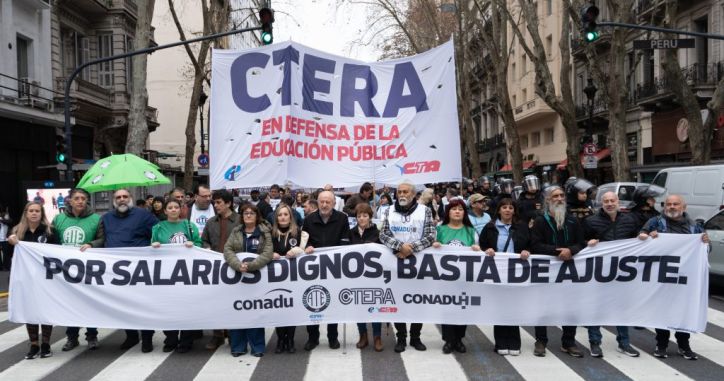
The Confederation of Education Workers of the Argentine Republic (CTERA) has brought new allegations to the International Labour Organization (ILO) of what the EI-affiliated education union characterizes as a systematic effort by the national government of Argentina to weaken teacher unions, dismantle sectoral social dialogue, and reduce public investment in education.
As the ILO continues its examination of the case, the outcome may have implications extending beyond Argentina, touching on fundamental questions concerning the protection of trade union rights and public education worldwide.
These new allegations, submitted in May 2026, are a further update to the ongoing CTERA complaint before the ILO Committee on Freedom of Association (Case No. 3485, initially filed in April 2024). It argues that the Argentine government has not only failed to address concerns raised in earlier complaints but has deepened policies that undermine freedom of association, collective bargaining, the right to strike, and public education itself.
The case No. 3485 has evolved from a challenge to a single decree into a broader dispute over the future of labour rights and public education in Argentina.
An increasingly hostile environment
Since President Javier Milei's far-right administration took office in 2023, education workers and their unions have faced an increasingly hostile environment. The government has advanced broad anti-union measures that weaken labour protections and favour private-sector interests, including the dismantling of social dialogue mechanisms and reforms that restrict freedom of association and the right to protest. Reflecting this deterioration, Argentina was included among the ten worst countries for workers' rights in the latest ITUC Global Rights Index.
CTERA and the other EI affiliates in the country – the Confederación de Educadores Argentinos (CEA), the Federación Nacional de Docentes Universitarios (CONADU), and the Sindicato Argentino de Docentes Privados (SADOP) – have denounced the measures taken by the Milei government and have been taking strong actions to defend the rights of their members.
Education International has repeatedly expressed its full support and solidarity with Argentinian education unions. “We stand in solidarity with our affiliates in defense of quality education and against any action that undermines democratic values and the well-being of teachers, education support staff, and students,” stated David Edwards, EI General Secretary. “These decrees are a direct attack on teachers, public education, and the rights of Argentine workers. No pasarán!”
A continuing dispute over the right to strike
The central issue throughout the complaint has been repeated government attempts to classify education as an “essential service” for the purposes of restricting strike action. In its original 2024 complaint, CTERA challenged Decree 70/2023, which introduced sweeping labour reforms and designated education as an essential service subject to strict minimum service requirements during strikes.
In 2025, after portions of Decree 70/2023 were declared unconstitutional by Argentina’s labour courts, the government issued Decree 340/2025. The right to strike is enshrined in the Constitution of Argentina.
According to CTERA, the new decree largely reproduced the same restrictions, again placing education among essential services and requiring the maintenance of at least 75 per cent of normal operations during industrial action.
The latest allegations from CTERA argue that the government has now gone even further. Through Law 27.802, enacted in 2026, Argentina once again classifies early childhood, primary, secondary and special education as essential services and retains the requirement that no less than 75 per cent of normal service be maintained during strikes. CTERA contends that this effectively neutralises the right to strike and constitutes a direct contradiction of long-established ILO principles.
Ignoring national courts and ILO jurisprudence
A key argument advanced by CTERA is that both Argentina’s courts and the ILO have already determined that education is not an essential service in the strict sense of the term.
The union recalls a landmark 2002 ruling by the National Chamber of Labour Appeals, subsequently upheld by the Supreme Court, which struck down government attempts to classify education as an essential service and affirmed that teachers could exercise their constitutional right to strike.
CTERA also points to previous findings of the ILO Committee on Freedom of Association, which explicitly recalled that essential services are those whose interruption would endanger the life, health or safety of the population, and that “the education sector” does not fall within that category.
From the union’s perspective, the government’s repeated attempts to reintroduce the same restrictions through successive decrees and legislation demonstrate disregard for both national judicial decisions and international labour standards.
Attacks on collective bargaining and union activity
The complaint also details what CTERA considers a broader assault on collective labour rights. The original 2024 filing challenged provisions weakening collective bargaining agreements, restricting workplace assemblies, and creating new sanctions against forms of trade union action traditionally protected under international labour law.
In 2025, the union further challenged Decree 341/2025, which effectively removed the national government from the National Teacher Collective Bargaining Process. CTERA argued that the measure undermined legislation guaranteeing national-level bargaining in education and violated various ILO Conventions, including Convention 87 on freedom of association, and Convention 98 on the right to organise and collective bargaining.
The 2026 submission states that Law 27.802 expands these restrictions. Among other measures, it reportedly limits the continuation of collective agreement provisions after expiry, weakens financing mechanisms for unions, restricts trade union assemblies, requires employer authorisation for workplace meetings, and introduces financial penalties for workers participating in union activities. According to CTERA, these provisions interfere directly with trade union autonomy and the right of workers to organise freely.
Education funding at the centre of the dispute
In its 2026 update to the ILO, CTERA also drew particular attention to the government’s ongoing reductions in education funding.
CTERA underlines that the designation of education as an “essential service” is particularly contradictory given concurrent budget cuts affecting schools, teachers, and students. The union highlights Administrative Decision No. 20/2026, published in May 2026, which introduced further reductions to education spending.
According to CTERA, the cuts include:
- A reduction of approximately USD 29.4 million from the National Literacy Plan.
- A reduction of USD 18 million from infrastructure and equipment programmes.
- A reduction of approximately USD 7.4 million from the Teacher Salary Compensation Fund.
- A reduction of approximately USD 5.5 million from socio-educational support programmes serving vulnerable schools and communities.
- A near-halving of funding allocated to Educ.ar, the country’s public educational technology platform.
- Significant reductions in funding for university infrastructure investments.
CTERA maintains that these measures continue a pattern already denounced in previous submissions, including the suspension of the National Teacher Incentive Fund (FONID), the closure of national dialogue mechanisms, the reduction of educational programmes, and declining public investment in education.
CTERA called on the ILO to examine these latest developments and to reaffirm that education is not an essential service in the strict sense as recognised by international labour standards, that teachers’ rights to organise and bargain collectively must be protected, and that governments must engage in genuine social dialogue rather than imposing unilateral restrictions on trade union freedoms.
Education International remains committed to supporting its member organisations in Argentina and globally in their collective struggle to uphold labour rights, democracy, and decent work.