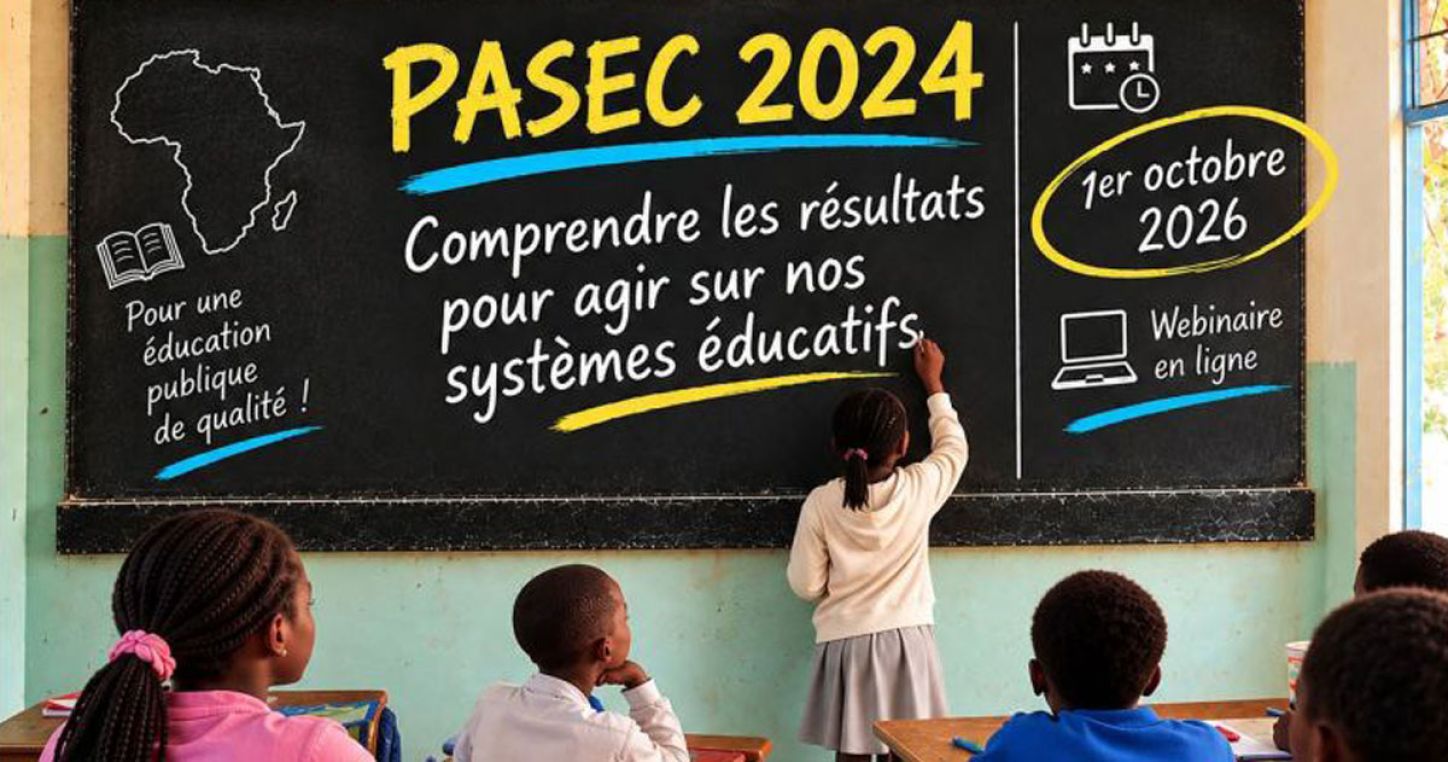
PASEC 2024: Using data to drive social dialogue and strengthen education and trade unions
A few weeks ahead of the publication of the results of the Programme for the Analysis of Education Systems (PASEC) by the Conference of Education Ministers of French-Speaking States and Governments (CONFEMEN), Education International (EI) and the Francophone Trade Union Committee for Education and Training (CSFEF) brought together trade union representatives from the French-speaking community for an online meeting dedicated to a crucial challenge: enabling member organisations to understand PASEC data, to analyse it within the context of the realities on the ground, and to use it to influence education policies in their countries.
On opening the meeting, the President of the CSFEF, Claire Guéville, emphasised the importance of this moment for education unions:
“The findings will provide us with a better understanding of students’ learning outcomes and the challenges facing education systems. We are presented with a fundamental question: what role will teachers and their trade unions play in analysing these findings and determining what use the governments concerned make of them?”
Claire Guéville, President of the CSFEF
For the CSFEF and EI, the PASEC findings, to be published on 22 and 23 October in Dakar, Senegal, should not concern only governments or experts. They must become a tool that education workers and their unions can use to strengthen social dialogue, to ensure that the expertise of education personnel is heard, and to develop fairer, better-funded, and more effective education policies for all.
Giving a voice to those on the ground
On presenting the CSFEF’s work on PASEC, its General Secretary, Luc Beauregard, pointed out that trade unions have developed closer dialogue with CONFEMEN in recent years, to claim their rightful place in evaluating and formulating education policy.
“Trade unions should not simply receive the results of the evaluations once these have been completed. They should be able to take part in the discussions, contribute to their interpretation, and share their knowledge of the realities on the ground.”
For Beauregard, PASEC data cannot be analysed without considering the context in which education staff work: class sizes, teaching resources, education funding, initial and ongoing teacher training, or working conditions.
Trade unions still too often excluded
The meeting also provided an opportunity to take stock of trade union involvement in PASEC processes.
For Appoline Fagla, General Secretary of SNEP-Benin (National Public Primary Education Union), the results in terms of previous consultations with trade unions are a cause for concern:
“We have observed very little, if any, trade union involvement, or a significant lack of transparency surrounding PASEC, a strong fear that the results might be used for political purposes and against teaching staff.”
Fagla insisted that trade unions are not opposed to assessments, but object to them being used to punish staff rather than to improve education systems.
“Trade unions are not opposed to the assessment. We are opposed to the punitive or technocratic use of the findings. The assessment should serve to support education systems and staff, not to further undermine professions already in crisis.”
The same observation was shared by Léa Georgina Eyeng Mefane, National Secretary for External Relations with the SENA (National Education Union) in Gabon. Despite her organisation’s efforts to work with the national authorities, “despite the National Education Ministry’s assurances regarding the SENA, the situation remains unchanged. The SENA is still not a stakeholder in the project or the process.”
The Gabonese trade union intends to continue its advocacy work to turn this situation around and ensure that education workers’ organisations are effectively involved at every stage in the PASEC process.
Data as leverage to press for greater investment
For Florian Lascroux, coordinator of Education International’s Capacity Building and Solidarity Unit, the PASEC findings could serve as a powerful advocacy tool in the context of EI’s global Go Public! Fund Education campaign.
“It should be quite easy to hold up these results as conclusive proof that a lack of investment in education has harmful effects, and that a shortage of trained teaching staff produces students that lack the desired skills.”
For Lascroux, the data collected as part of the PASEC could support trade union calls for increased financing for state education, better training for teachers, and improved learning conditions.
No decisions about education without involving education staff
The need to involve education personnel in decision-making processes was also highlighted by Dr Pedi Anawi, Coordinator at Education International’s Africa Regional Office.
In Anawi’s view, improving the quality of education necessarily requires the active involvement of teachers and their trade unions in discussions and decisions regarding education systems.
Three steps to turn data into action
Matthieu Pelard, head of international relations at the CSQ union centre of Quebec, presented a joint roadmap for the affiliated organisations.
The unions were encouraged to already launch the dialogue with their Education Ministries, to familiarise themselves with the results of PASEC2019 in preparation for their analysis of the 2024 cycle, and to mobilise their organisations and members around future publications.
Summarising the ambition behind this collective initiative, Pelard said:
“The webinar’s slogan was: ‘From data to trade union action’. This data will be the fuel powering our demands over the coming months.”
Preparing today for the battles of tomorrow
On closing the webinar, Claire Guéville reiterated that the meeting was only a first stage in the long-term trade union work linked to PASEC2024.
“Our efforts will not, of course, stop here. Our next stage will be the release of the PASEC results in Dakar. We all have to prepare to analyse the findings.”
Claire Guéville, President of the CSFEF
Guéville also insisted on the need to check the data against the lived realities in schools, and to prevent the results from being instrumentalised for political gain: “The more of us take ownership of this data, the better placed we’ll be to make our voices heard.”
“Let us therefore continue to work together to ensure that the PASEC findings make a real contribution to improving our education systems, to understand the data, to give a voice to those on the ground, and to act in support of public education,” she concluded.