PASEC: a social dialogue tool for quality education
Since 1991, the programme for the analysis of education systems (PASEC) of the Conference of Ministers of Education of French-speaking countries (CONFEMEN) has been assessing the skills of primary school pupils in French-speaking African countries that have volunteered to take part. It has become a tool for the standardised assessment of education systems leading to reforms, and an instrument for dialogue between countries. Education International and the French-speaking Trade Union Committee for Education and Training (CSFEF) have called on the authorities and representatives of teaching staff to harness its potential by using it in a coordinated fashion and systematically.
PASEC, a process of continuous development
For a long time, PASEC has been assessing students’ proficiency in maths and reading at the start and end of primary school. Since 2019, the skills of teaching staff have also been assessed in these subjects. The latest edition, PASEC 2024, in reference to the year the assessment process was implemented, includes data on students' proficiency in secondary education and on students' parents. Another new aspect in this edition is that non-French speaking African countries have been included, such as Nigeria, Guinea Bissau, and Sao Tome and Principe.
These different perspectives on each education system, as well as comparing the results with previous editions and with those of other countries, are a vital source of information to drive improvements in education systems.
PASEC 2024: a cause for concern
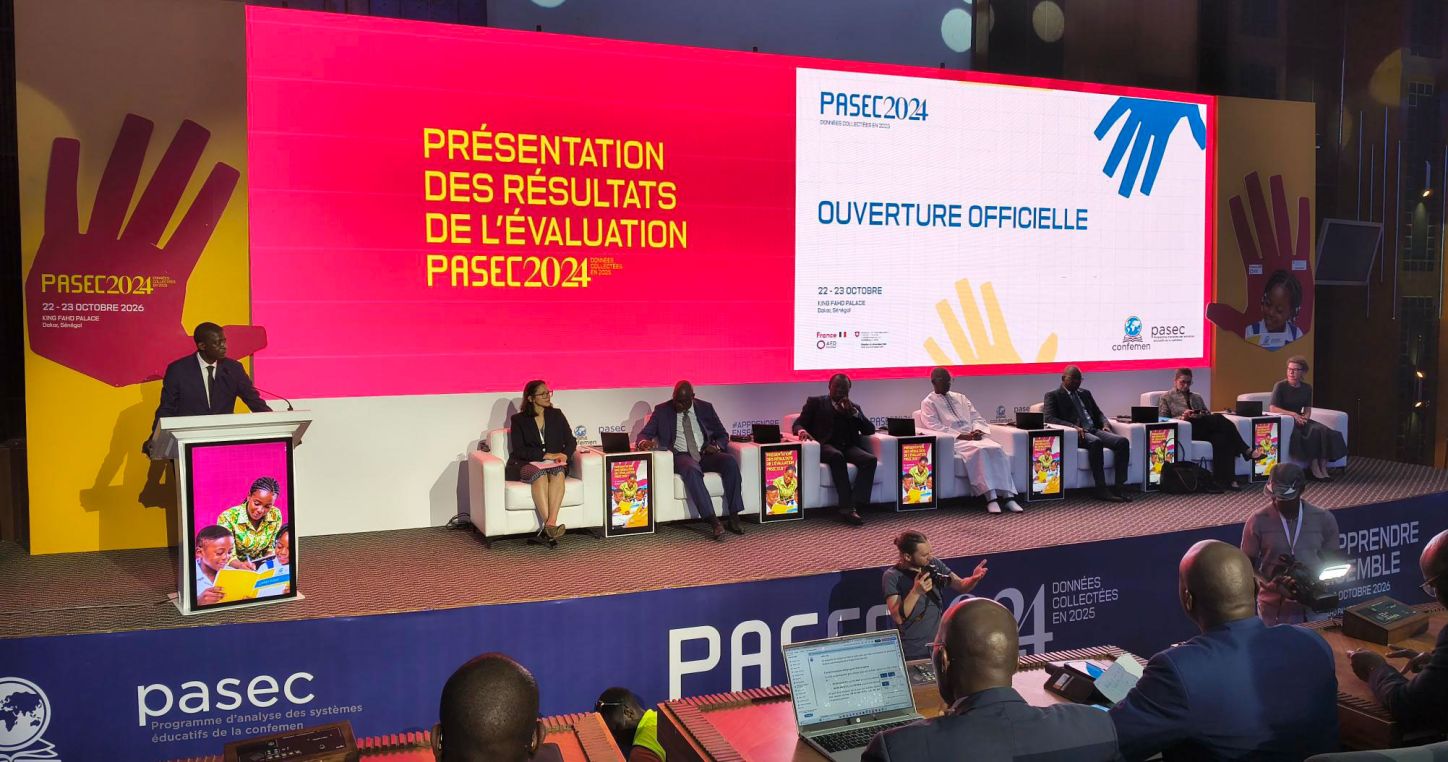
The international reports from the latest PASEC survey were launched at an international conference in Dakar on the 22nd and 23rd of October. The event was attended by delegations from most of the countries involved in the project: Benin, Burundi, Cameroon, Congo, Cote d’Ivoire, Djibouti, Gabon, Guinea, Guinea Bissau, Madagascar, Mali, Nigeria, Sao Tome and Principe, Senegal, Chad, Togo, as well as five ministers.
The raw data provide the following lessons learned (for more details please see the appendix and complete international reports, available here).
- There are significant disparities between counties. As such, averages must be analysed in detail.
- A large number of students and teachers do not have the sufficient competency levels expected.
- Several indicators are a serious cause for concern, in particular when it comes to teachers’ level of education, their access to training, class sizes, and the availability of textbooks.
- Extended schooling does not produce the desired effects: on average, the number of pupils who have achieved the levels expected falls between the beginning of primary and the end of secondary.
- There are worrying trends: in some cases, 2024 results were worse than those from 2014.
A number of survey questions about the classroom environment provide insights into the education systems. For example, some education systems are better able to reduce the achievement gap between students from different social backgrounds. It would be interesting to find out what provisions or reforms led to these gaps.
Country reports, expected by mid-November 2026, will provide further insights and help to answer pressing questions, such as: What are the causes of the gap between student achievement in public and private schools? Why is there a gap between students from urban and rural areas? How can the achievement gap between girls and boys be explained?
Strong actions and robust social dialogue
The results did not come as a surprise to education unions in participating countries. Unionists know the realities on the ground and what happens in schools. However, what the reports do provide is a more detailed picture, describing trends in a robust manner and providing precise figures, thus enabling comparisons and offering clarity on complex phenomena.
The low levels of achievement among students, despite the number of years in school, the limited proficiency teaching staff themselves have in the subjects they teach, and poor school results mean that all education stakeholders must mobilise and governments must launch initiatives to respond.
To this end, the CSFEF and EI attended the conference to launch the 2024 PASEC results. EI members surveyed before the conference expressed regret that national authorities have not included unions in previous PASEC processes. The CSFEF and EI’s mandate vis-à-vis the CONFEMEN and PASEC teams, as well as in relation to national delegations at the conference, was clear: organisations representing teaching staff must be involved.
Interview with Rémy Nsengiyumva, president of the STEB in Burundi, during the PASEC 2024 launch:
The CSFEF and EI will continue to support the CONFEMEN and PASEC teams to facilitate exchanges on the reports. At the same time, the CSFEF and EI will roll out actions to support education unions to analyse the reports and draft robust advocacy proposals. Unions must acquire know-how on all the aspects included in PASEC reports in order to co-design policies to address the issues identified.
Critically, the conference in Dakar did not discuss education funding, which should stand at a minimum of 6% of GDP according to international standards. However, progress on teacher and student performance demands considerable and sustainable investment in education. All the needs identified, from providing textbooks to all students to initial and continuous teacher training or reducing class sizes require funding. The reports thus reinforce EI's Go Public! Fund Education campaign and its call for governments to invest in public education and in the teaching profession.