Three years of Go Public! Fund Education: Union power transforming public education worldwide
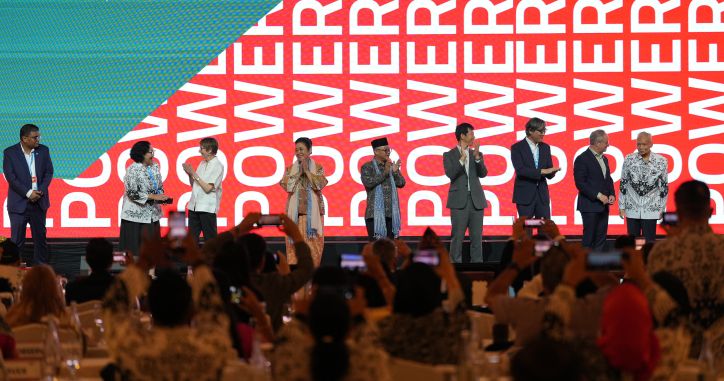
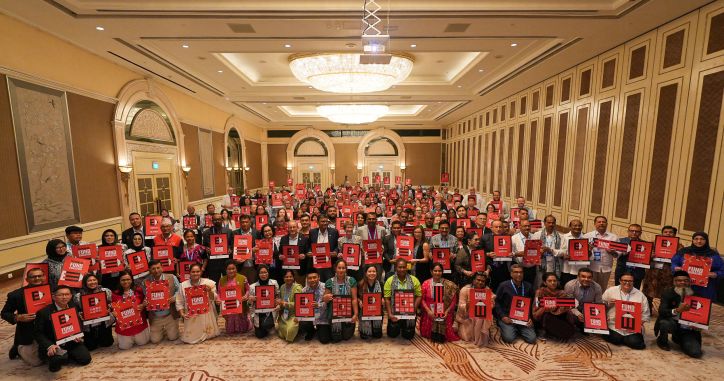
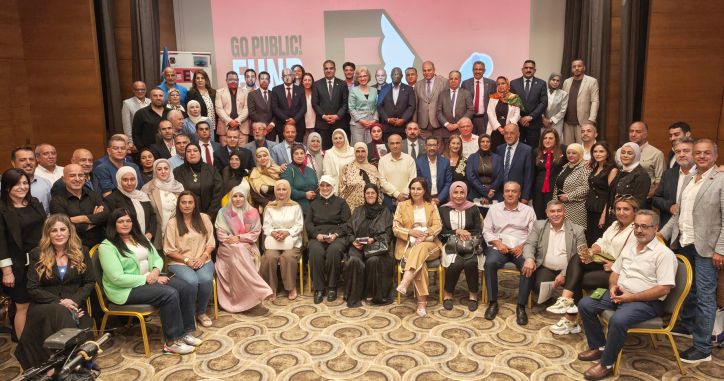
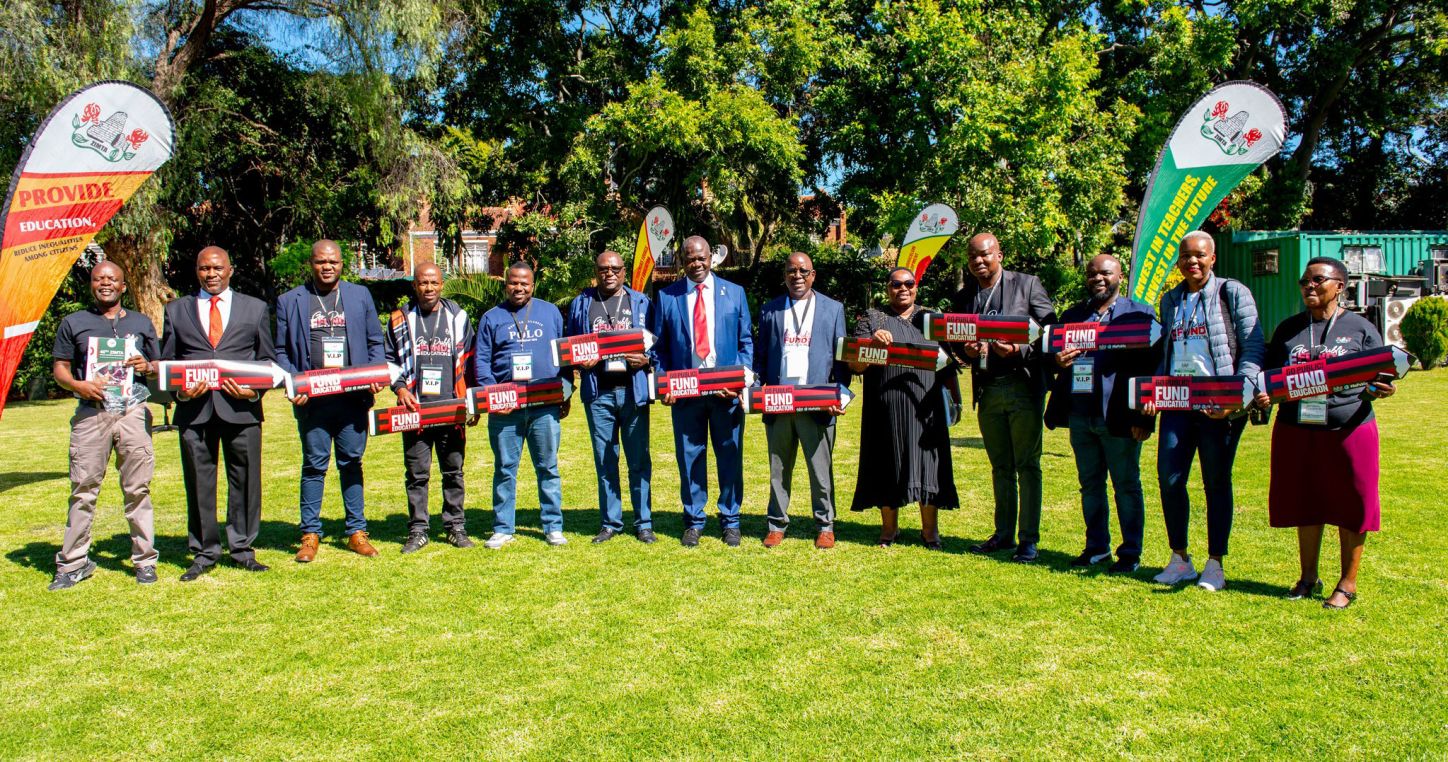
For the International Day of Education, January 24th, Education International (EI) leaders came together to recognize the power of the Go Public! Fund Education campaign, which calls on governments to invest in public education and in teachers. In the 3 years since the launch of the campaign, it has been visible in more than 50 countries with growing impact.
Welcoming participants to the global webinar to mark the occasion, EI Deputy General Secretary Haldis Holst said “Today, we will reflect on the collective power and the progress we have achieved through the Go Public! Fund Education campaign.”
The campaign “means guaranteeing labour rights and ensuring good working conditions, as well as manageable workloads and competitive salaries. It also means valuing teachers, ensuring they are central to decision-making and trusting their pedagogical expertise.”
She added that EI members “Share a vision for free quality public education for all and a respected and supported education workforce. This is why we have rallied for the Go Public campaign. Three years on, the campaign is present in 50 countries and growing.”
The Go Public campaign demonstrates education unions’ formidable collective power
EI President Mugwena Maluleke noted in his remarks that “when we launched Go Public! Fund Education, we made a fierce commitment to every child's right to learn, to holding governments accountable to defending our profession, its quality, its dignity, and its soul.
Wherever I have travelled as your President, I have seen you answer that call. I have seen you build union power with conviction and purpose on. I have witnessed your determination, your willingness to learn from one another, and your solidarity in action.”
He underlined that “Go Public resonates because it reflects who we are and what we face. It connects our shared values, it connects our shared challenges. It speaks to our vision of a world where every child has access to free, quality public education, and where teachers and education support personnel are respected, valued for the foundational work we do.”
The EI leader also said that the campaign “speaks to our formidable collective power. When educators from every continent unite around a common cause, we move the world. In our classrooms, in our unions, and in our Education international, we lead with hope, we transform, and we open up the future. Over the last three years, by joining forces, sharing wisdom, and standing in solidarity, you have demonstrated the power of our movement, delivering real gains for teachers and education personnel across countries.”
He went on mentioning the United Nations (UN) recommendations for a strong and resilient teaching profession, the Pan-African Conference on Teacher Education and the Santiago Consensus as major milestones in the campaign aiming to increase funding for public education and to end the global teacher shortage.
“We have come a long way and Go Public has brought us closer than ever. Go Public! Fund Education is your campaign. It is our campaign, driven by our values and our unshakable commitment to our colleagues and our students. Education is an act of hope. It is an act of resistance against despair. In a world on the edge of transformation and turbulence, let us rise together for social justice and peace. Let us continue to fight for public education, for the dignity of teachers, and for a future where knowledge and hope triumph over ignorance and despair. Together, we will overcome any challenge, because our course is just, and our strength is boundless.”
Top global education union leaders then took the floor to highlight progress made towards achieving quality inclusive public education in their regions and countries.
The Mongolian educators’ victory: a 50% raise of the teachers’ basic salary
Joining from Mongolia, Zambal Tsogtgerel, President of Federation of Mongolian Education and Science Unions, said that the education sector in his country had been severely affected by state budget cuts. “However, we were able to fight for our teachers and include the necessary budget for an increase of teachers’ salaries into the 2026 state budget.”
The union was able to organize a massive mobilization of teachers nationwide demanding a salary increase for teachers, and to join the discussion table with the government, he explained. “In January 2025, we sent the official letter to the government. In July, we started our Go Public! Fund Education campaign. We were able to convince the government that this is a priority, so that quality education could be provided. One important thing is that we were able to leverage the force of the press and media and the support from parents.”
He highlighted that, as of January 2026, teachers’ basic salary has been raised to 2.8 million Mongolian tughriks (around 680 euros), marking a 50% increase, and will be raised by 26% from November 1st, 2026. “It was a great achievement. The government promised that they will focus on education as a priority sector. In fact, it turned into quite an education year for 2026.” Negotiations between the union and the government to reach the target of 3.5 million Mongolian tughriks (around 840 euros) will continue in 2026.
Social dialogue, key for increased funding for public education and teachers
For Europe, Zulkhiya Nozakova, President of the Trade Union of Education and Science Workers of the Republic of Tajikistan, spoke about the development of the Go Public campaign in her country.
She informed participants that “we are using the social dialogue as the most important key during the Go Public campaign, and currently we are using their sectoral agreement with the Minister of Education. For example, we are in all working groups adopting the legislation on education and science, to see changes in the education sector, especially to get some benefits and more financing for the education sector.”
A huge achievement for her union was the adoption of a law on the status of teachers, as the Trade Union Education and Science Working of Republic Tajikistan was represented in the working group adopting of this legislation. They were able to put in the legislation a series of benefits that would improve conditions for teachers. For example, free medical consultations for teachers, and a 20% salary increase for teachers who are in competitions at international level. The legislation also included additional pay for teachers living and walking to work in high mountainous areas – which is the is the case in 93% of Tajikistan. "'We need the funds for this, and for us it is a really huge achievement. In all working groups and regional meetings, we are using the Go Public campaign,” she added.
She also reported that from September 2026, the salary of teachers in Tajikistan will be increased by 25%, thanks to the union mastering the legislative process and being involved in social dialogue.
Enabling unions to advocate for African governments to move towards more education funding
Marième Sakho Dansokho, EI Vice-President for Africa and President of SYPROS/Senegal, presented work done by member organizations in her region.
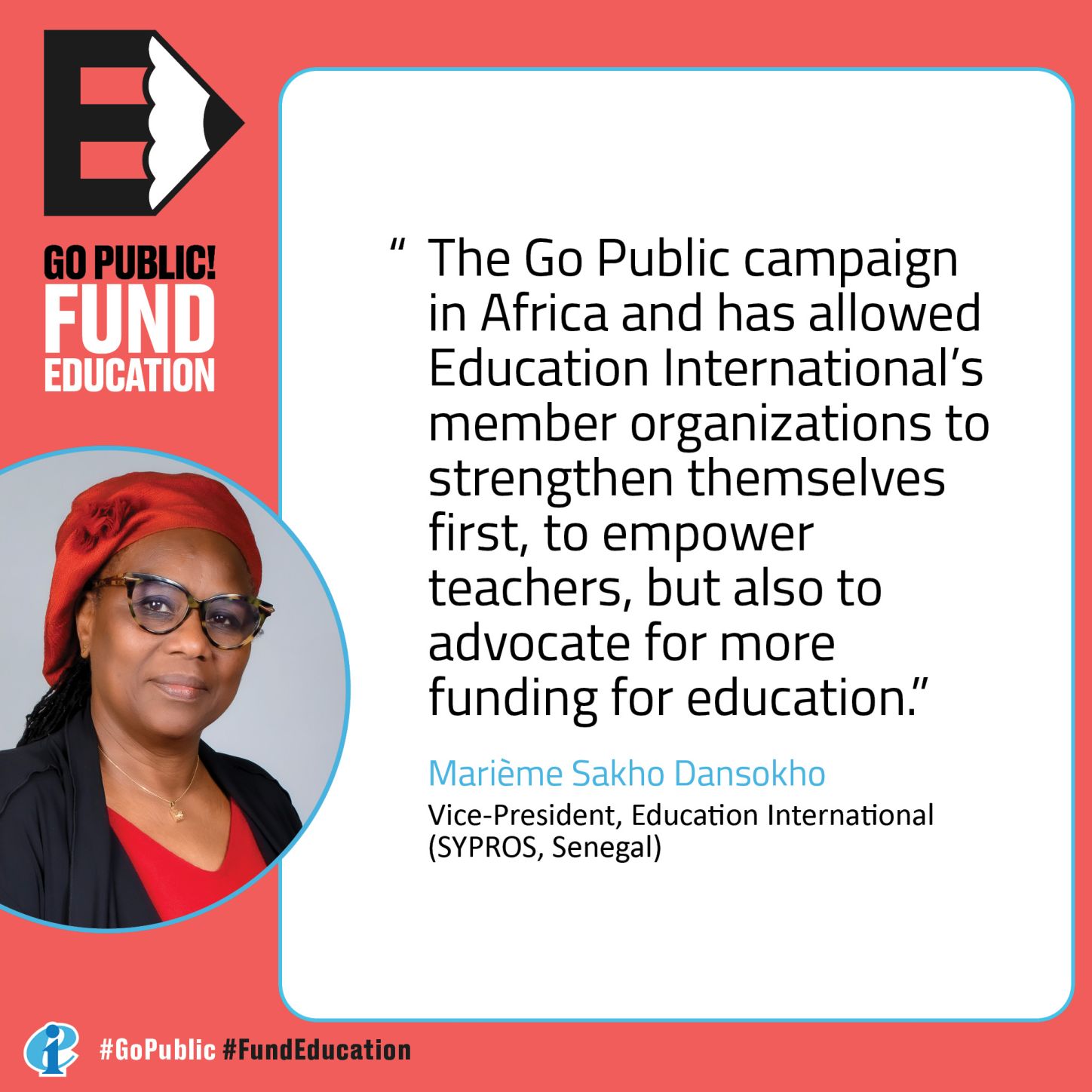
“The Go Public campaign is a highly relevant initiative of Education International. It has been an excellent initiative that has developed in Africa, in more than a dozen countries. And it must be said that this campaign has allowed our organizations, the member organizations of Education International, to strengthen themselves, first and foremost by strengthening teachers, but also by enabling them to advocate for countries and governments to move towards adequate education funding,” she said.
She added that in various countries, activities have been carried out within the framework of this campaign, and it has helped to integrate education funding into policy debates, especially in the lead-up to elections.
The UN recommendations on the teaching profession must not sit on a shelf
Manal Hdaife, member of the EI Executive Board, Chair of the EI Arab Countries Cross Regional Structure Committee, and regional branch leader of the Public Primary Schools Teachers League in Lebanon, explained that, with the members of the UN High-Level Panel on the Teaching Profession, “we were very clear about one thing, that this report – the UN recommendations on the teaching profession - was never meant to sit on a shelf. It was meant to be used.”
According to her, the recommendations have become a political and organizing instrument in three very concrete ways.
“First, they legitimize teachers' demands globally. For years, teachers have been told that calls for professional autonomy, decent salaries, safe working conditions, and social dialogue were unrealistic or unaffordable. Now, those same demands are affirmed at the highest international level, that changes the balance of power. Governments can no longer dismiss them as union claims, they are global commitments.''
"Secondly, they unify struggles across countries and contexts. Whether we are talking about teachers and stable systems, crisis settings, or conflict zones, the report provides a shared framework that allows educators to organize not in isolation, but as part of a global profession with common standards and common expectations." She went on to add that the "recommendations shift the conversation from numbers to power. This is not only about teacher shortage or learning outcomes, but also about who shapes education systems, whose voices count, and whether teachers are treated as professionals or disposable labor.”
Students recognize that they are entering a profession that is essential to society
Turning to North America and the Caribbean, the webinar welcomed Nadine Molloy, member of the EI Executive Board, and trustee of the Jamaica Teachers’ Association. She explained that “one of the things that we have noticed across the countries where we have had our very public, very media-friendly, social media-friendly launches” is that “governments have actually been willing to come to the table, to have conversations with us on the hard issues that we are dealing with in the Caribbean, such as teacher migration. I was almost taken aback when I saw members of the Ministry of Education actually posing with us for pictures and making comments at our annual conference.”
She further recognized that, across the region, stakeholders are coming to the table. “Parents-Teachers’ Association, Homeschool Association, other private sector entities, they have been coming to the table, speaking to us, giving us pointers, lending their voices to our cause, and that has amplified much of the conversation around the reform and some of the transformation that we have been agitating for a long time, and will continue to agitate for them.”
Molloy, who is also principal at Shortwood Teacher's College, said that her students “recognize that, even though they are entering a profession that is under strain, they are entering a profession that is essential. We are seeing where they want to be role models. We are seeing they want to make a social contribution to nation building."' Despite all of the challenges, they are seeing it as a stable profession, that gives them a chance to just do more for their society."
"We are hoping that the Go Public! Fund Education campaign will motivate them some more, because we will be able to do better for our teachers as they come in. It is an emotional job, and we want to make sure that their well-being is taken care of as well.”
Going public and funding education support personnel
Participants were also remembered that the campaign does not only address the challenges of the teaching profession, but also the challenges of education support personnel. They also are in dire need of improving their working conditions, ensuring they receive the respect and recognition they deserve.
Marjolaine Perreault, EI Executive Board member and Director General of the Centrale des syndicats du Québec in Canada, said that “in all school systems, there is chronic underfunding, and it affects all categories of staff, especially teachers, but also educational support staff. They work in a collaborative way, hand in hand with teachers. They contribute to the educational success of the vast majority of students, and they too are often victims of budget cuts, of salary reductions. They are also often in precarious situations. And they are essential to the school ecosystem.”
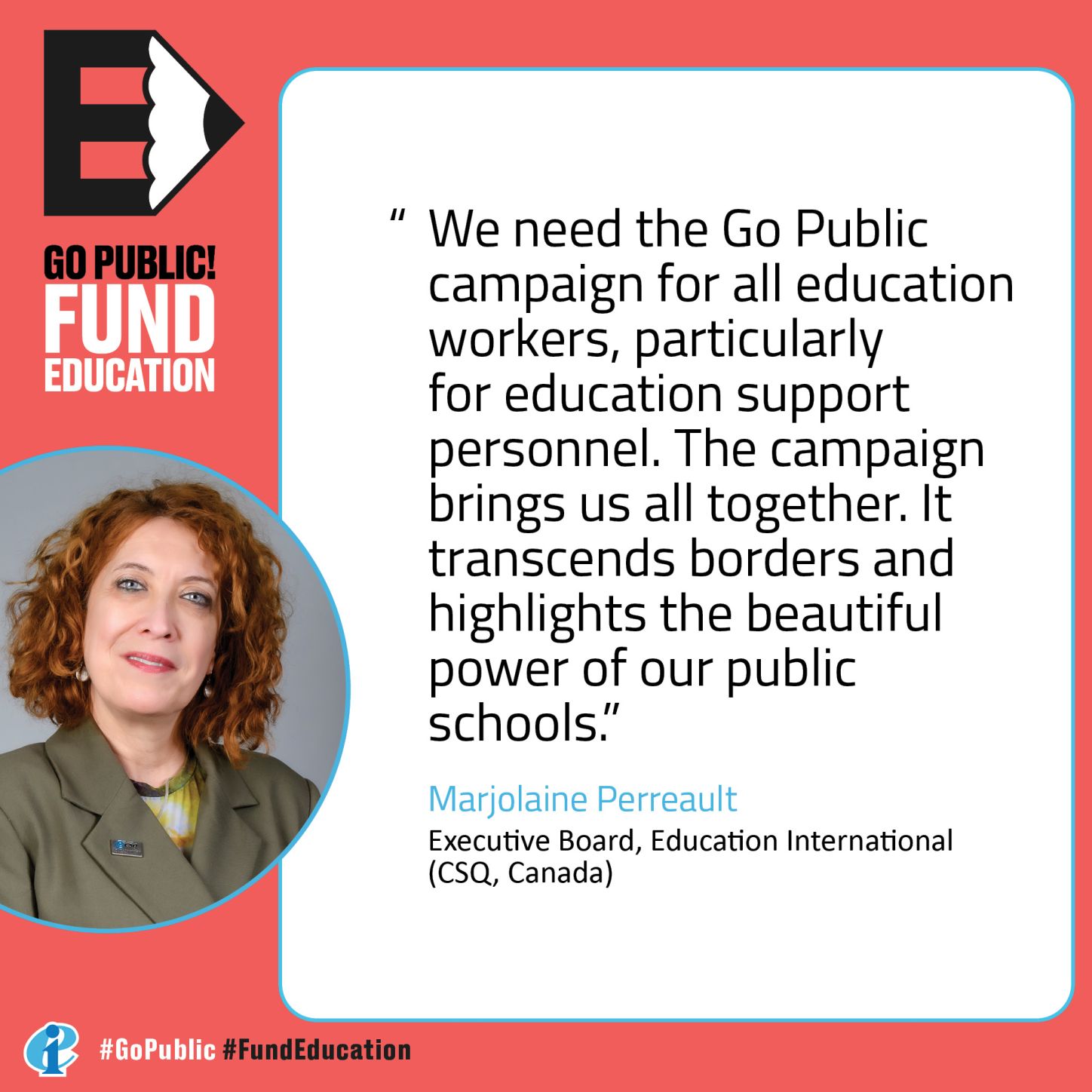
She insisted that education support personnel “enable students to succeed and allow teachers to focus on their core work: training and educating students. Clearly, Go Public is essential for all job categories, especially education support staff. That is why we celebrate World Education Support Personnel Day on May 16th.”
For her, the Go Public campaign “unites us all. It is a campaign that transcends borders, highlighting both the positive aspects of public schools and the challenges they face.”
The teacher-student relationship must be recognized as a Human Heritage
Explaining why the Go Public campaign is important for his region, Heleno Araújo, EI Vice-President for Latin America, and former President of the CNTE in Brazil, stressed that educators and their unions use the campaign “to face big challenges regarding inequalities in the allocation of public resources in our countries” and “guarantee the education quality and everybody’s right to education, especially the vulnerable groups.” “The Go Public campaign brings us this collective action of EI, and when we present it to the local governments, we have the strength to face the challenges,” he asserted.
Calling for the recognition of the teacher-student relationship as a Global Human Heritage, M. Araújo said that “it is fundamental so that we have the adequate conditions to develop our work” and that “it is important to avoid our substitution by platforms and the use of AI to substitute our work in the classroom and within our schools.” He went on saying that the unions in Latin America are mobilizing and collaborating with other social movements and their governments, “so that they help us from within the UNESCO structures and move forward in this important conquest.”
He also pointed out that in Brazil, the Go Public campaign helped the union get the law of democratic management adopted, “a law valuing our profession.” He also underlined that the union advocated for a 4% increase of the public education budget and that President Lula signed a law ensuring real gain for teachers and upgrading their salaries.
Funding education, financing democracy
Gilda Montero, EI Executive Board member and president of ANDE in Costa Rica reasserted that “democracy rests on three fundamental pillars: education, health, and security.”
She also warned that “education is under serious attack from far-right governments.” Public education has reached the most socially vulnerable populations, “giving hope to many to become better human beings,” she said.
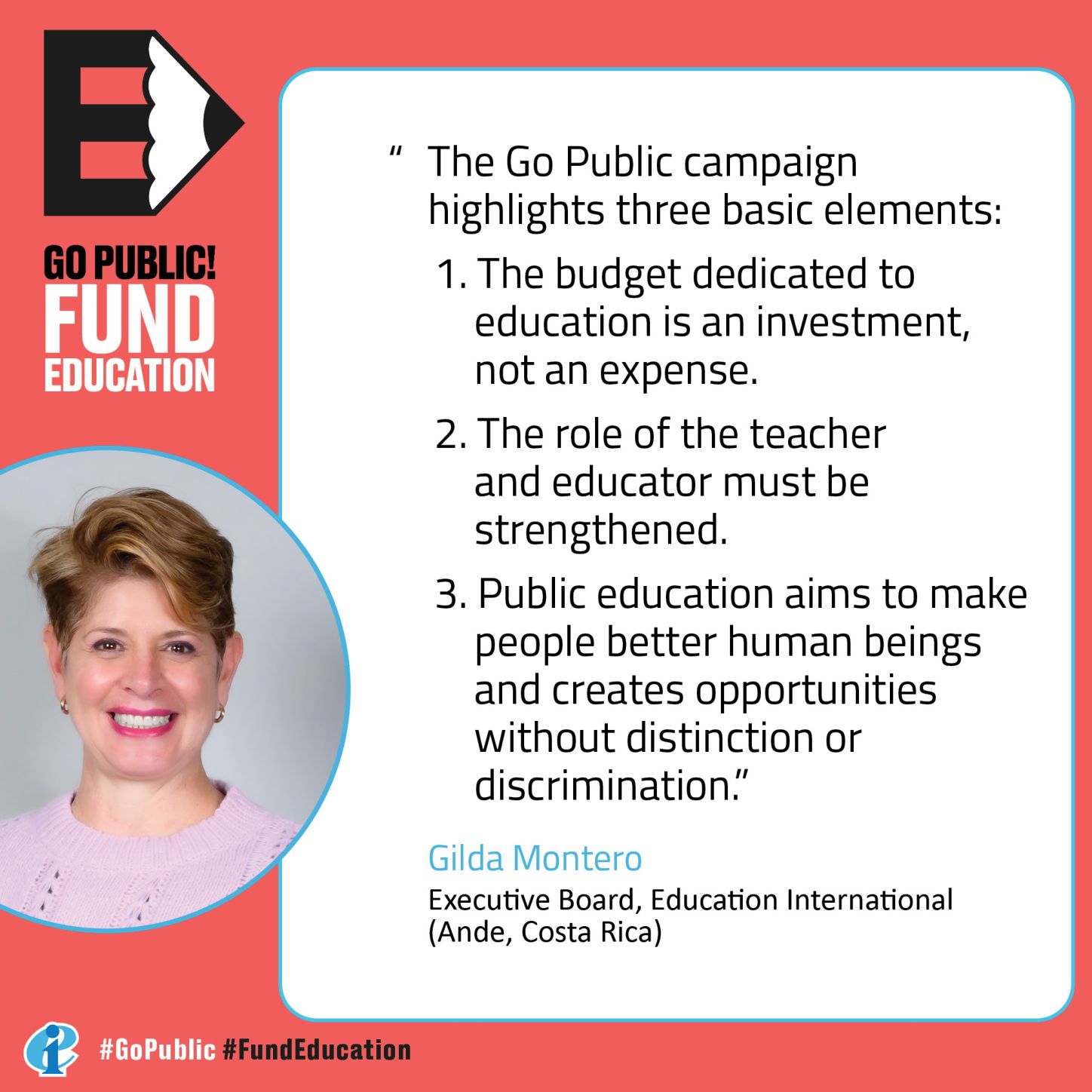
The ANDE leader underlined that the Go Public campaign seeks to reclaim three basic elements: first, the education budget, which should be seen as an investment and not an expense; second, strengthening the role of teachers, educators working with those populations most in need of education; and third, the public education's purpose is to transform people into better human beings and provide opportunities for all, without distinction or discrimination.
Three years into the Go Public! Fund Education campaign, one message rings loud and clear: when education unions lead, they create change. Across continents, teacher unions have demonstrated that collective action strengthens public schools, elevate the teaching profession, and secure the resources students deserve.