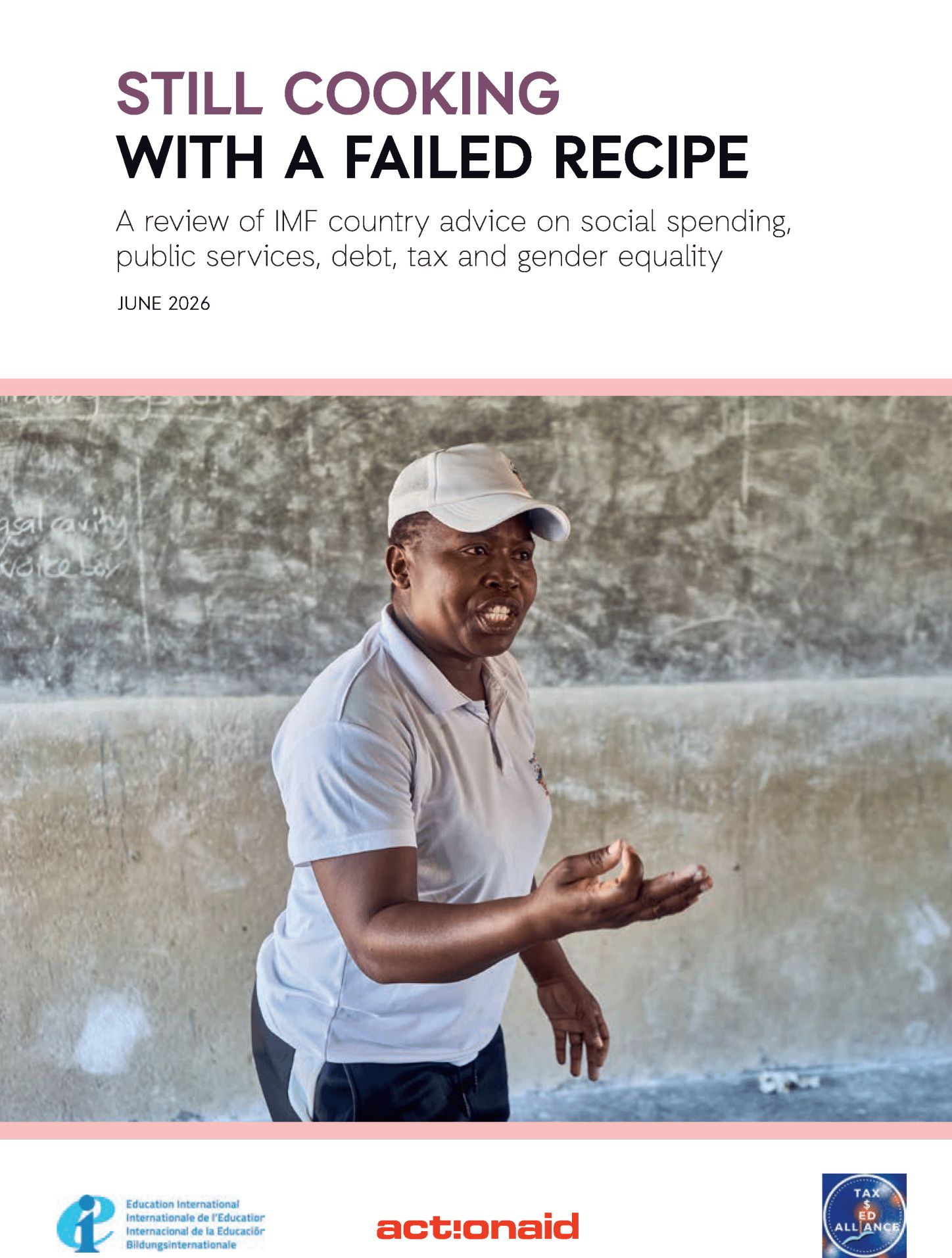
Still cooking with a failed recipe
A review of IMF country advice on social spending, public services, tax and gender equality
A new report by ActionAid, Education International and the Tax and Education Alliance, supported by 19 partners, has revealed how the International Monetary Fund's (IMF's) rigid, one-size-fits-all approach to public spending continues to harm people living in poverty around the world. The report reveals staggering double standards and calls out the empty rhetoric of change within the institution. The IMF is still essentially a debt enforcer that serves the interests of wealthy creditors over people's lives, human rights, public services, and gender equality.
The IMF claims to have changed. In a 2014 speech, its Managing Director, Christine Lagarde, declared that it is no longer 'your grandmother's IMF': the institution that famously imposed structural adjustment programmes in the 1980s, tearing open economies, savaging social spending and undermining development.
We studied 29 IMF documents on 11 countries over a three-year period (February 2022-February 2025), analysing IMF advice across Article IV consultations, loan agreements and related technical assistance documents. The countries we selected ( Brazil, Ghana, Kenya, Malawi, Nepal, Nigeria, Senegal, Uganda, the UK, Zambia and Zimbabwe) are deliberately diverse, from different regions and income groups, to enable us to determine whether IMF advice was truly contextualised for each country, or whether the IMF defaulted to its ‘out of date’ recipe book.
In this research, we identified a pattern of contradictions between the rhetoric in Washington and country level practice. We also found contradictions between the narrative and the numbers within single IMF documents. The narrative sometimes suggests that the IMF has shifted and considers social spending on health and education to be important. But the numbers and projections, usually in tables in the annexes, tell a different story. And this is what drives implementation and carries weight with ministries of finance. Our findings include:
- The International Monetary Fund (IMF) may have changed its language, but not its recipe: behind the rhetoric, austerity is still the default.
- The IMF still back public sector wage cuts and freezes [SM1.1][RS1.2][RS1.3][RS1.4]that undermine teachers, nurses and other public sector workers that public services rely on.
- The IMF claims to care about social protection but opposes effective universal schemes, supporting only narrowly targeted provision and safety nets which are often ineffective in practice.
- The IMF fails to recommend the ambitious and progressive tax reforms that are necessary to achieve development goals and human rights, and still defaults to supporting regressive taxes that put most of the burden on those who are least able to pay.
- Despite having a gender strategy for the first time, there is almost no evidence of the IMF looking at the gendered impact of its policy advice. In practice women continue to be the shock absorbers of the IMF’s austerity policies.
- Our analysis shows that the IMF is out of date and not fit for purpose in the 21st century. A wider reform of the international financial system is needed, including support for finalising the UN Framework Convention on International Tax Cooperation and developing a new UN Framework Convention on Sovereign Debt.
The IMF of today is our grandparents’ IMF, still serving the interests of Global North governments, creditors and multinational companies, and deeply unaccountable to the people whose lives and bodies it shapes and controls. The IMF plays a central role in the colonial international financial architecture that was shaped in 1944 and is little altered to this day. It will never serve the interests of people in the Global South as it is designed to enable their exploitation. In short, the IMF is still cooking with the same failed recipe.
National governments must listen to their people who are demanding an end to the IMF’s coercive control over their economies, an end to austerity and the start of a new era of economic liberation.
Collaborating organisations
- ActionAid International
- Education International
- The Tax and Education Alliance
Co-sponsored by
- Afrodad
- Akina Mama wa Africa
- APMDD
- Bretton Woods Project
- Center for Economic and Social Rights
- Debt Justice
- EndAusterity Campaign
- FEMNET
- Global Alliance for Tax Justice
- Global Social Justice
- IBON International
- ITUC
- Latindadd
- MENAFEM
- Public Services International
- Tax Justice Network Africa
- Tax Justice Network
- Third World Network
- WEDO
Read the full report here: